The first useful surprise in the Locus story was a customer using the product for the wrong reason. Nishith Rastogi and Geet Garg had built RideSafe, an application intended to flag deviations from a planned journey and help keep women safe. Food-delivery companies found a different use for it: keeping an eye on their delivery fleets. The founders had built a way to notice when a journey went astray. Businesses wanted help deciding how the journey should happen.
- A safety app’s unexpected users supplied the clue for a logistics business.
- Locus connects delivery promises, routes, carriers and execution for enterprises.
- BigBasket’s published case study shows shorter journeys alongside high on-time delivery.
- Ingka Investments bought the company in October 2025; Locus continues serving other customers.
The customer nobody had invited
That distinction explains the company better than a list of AI features. A dot on a map tells you where a driver is. It does not tell you which driver should take the next order, whether the vehicle has room, or whether a promised delivery window is achievable. RideSafe’s adoption by food-tech businesses exposed a gap between watching logistics and making its decisions.
Locus took shape in 2015. Rastogi and Garg had both worked at Amazon; their backgrounds included fraud detection, machine learning and scalable services. The early company worked from an apartment in Bengaluru. Its original DispatchIQ product handled on-demand and scheduled planning. There was something pleasantly unglamorous about the assignment: make the daily sequence of practical decisions less wasteful.


The pivot is useful precisely because it needs no invented catastrophe. The public account describes surprising adoption, followed by a realization about demand. Customers had revealed an adjacent problem. The founders followed it. Anyone building software can copy the observation; copying the resulting logistics expertise takes rather longer.
The promise comes before the route
Consider a hypothetical grocery order booked for a narrow delivery window. A shorter drive is welcome. So are a suitable vehicle, enough loading capacity and a driver who can arrive before the customer leaves. These requirements compete. Optimizing one while forgetting the others produces an elegant route and an irritated household.
Locus sells enterprise software for that tangle. Retailers, consumer-goods companies, e-grocers and logistics providers use it to plan dispatch, select carriers, track shipments and manage execution. Its named customers include Unilever, Nestlé, BigBasket, Blue Dart and Lenskart. Current product pages report more than 360 enterprise customers across over 30 countries. This is a business selling operating infrastructure to other businesses, rather than a consumer courier service.
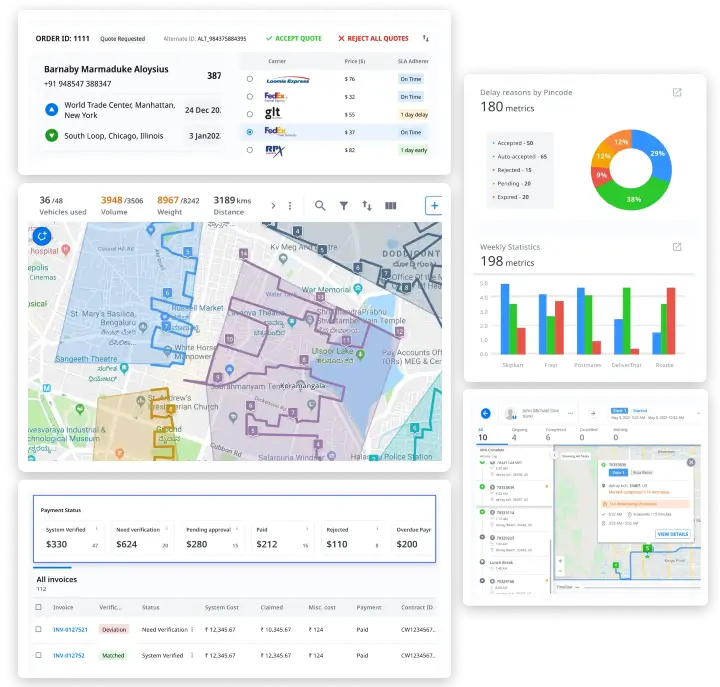
The product boundary has expanded. An order-to-delivery dispatch platform arrived in 2022. Checkout, hub and carrier capabilities followed. ShipFlex assigns shipments to carriers using rules around cost, speed and availability, then brings tracking into a common view. The driver application carries the plan onto the road, including order changes and proof of delivery. Analytics bring actual performance back to the people responsible for the next plan.
- 01PromiseCheck the slot against capacity.
- 02PlanMatch orders, vehicles and rules.
- 03ExecuteDispatch, track and handle changes.
- 04LearnCompare outcomes and settle costs.
Conceptual view of the connected workflow, not a measured performance chart.
Delivery Promise Management makes the logic especially clear. It checks a slot against capacity across the journey before showing it at checkout. The implication is simple: the delivery promise belongs in the operating plan from the start. A checkout page should not be allowed to spend capacity the warehouse and fleet do not possess.
The 122 kilometers that disappeared
BigBasket supplies a more concrete test than the word “optimization.” Its published Locus case study illustrates a distance comparison of 863 kilometers before and 741 afterward, while reporting 99.5% on-time delivery. That is 122 kilometers removed from the illustrated comparison, roughly 14.1% by arithmetic; the case study labels its savings 14.28%. Those figures describe a customer example, not a guaranteed result for every deployment.
122 km less distance in the illustrated comparison
The report does not make this a network-wide daily total.The operating objective matters as much as the distance. Locus’s account of the relationship says BigBasket prioritized arriving on time, with perishable goods and short planning windows shaping the algorithm’s constraints. The lesson for a buyer is to insist on a baseline and a service target together. Cutting distance while losing delivery reliability would be a dubious bargain.
The company also publishes cumulative totals exceeding 1.5 billion optimized deliveries, $320 million in logistics savings and 17 million kilograms of avoided emissions. These are company-reported aggregate claims. They help describe the scale of Locus’s proposition; they do not tell a prospective customer what its particular integration will save.
Who gets to make the next decision?
The latest proposition is an “agentic” transportation management system. The useful question is what the software may do without asking. Locus describes approval levels ranging from human authorization to actions taken within guardrails, plus simulation, shadow operation and staged rollout. Teams can set rules and review outcomes. These details matter because a logistics decision has a physical consequence.
Bringg and FarEye occupy overlapping territory, with routing, delivery orchestration and visibility among their capabilities. Buyers cannot settle the comparison merely by counting mentions of AI. Locus’s pitch combines its roots in constrained routing with broader transportation execution, carrier management and settlement. Its integration approach is intended to connect with existing enterprise systems, and its current TMS offering describes embedded engineers helping customers build workflows and custom agents.
The commercial model is enterprise SaaS, with a demo-led sales process and negotiated scope. The work includes connecting data and adapting operating rules, not merely granting access to a screen. Locus became available through AWS Marketplace in October 2025, adding a procurement and billing channel. For an organization already buying through AWS, that changes the purchasing route; it does not abolish the implementation work.
“innovation is thrilling but reliability is sacred.”
Nishith Rastogi, on joining Ingka Group, October 2025
That line from Rastogi’s acquisition essay gives the company’s public culture a useful tension. He also recalls ringing a bell when a delivery met its service agreement. A software team celebrating a punctual parcel is an appealing image: the applause belongs to an ordinary event that required considerable effort to make ordinary.
The retailer on the other side of the road
In Rastogi’s telling, an IKEA store later opened across the road from Locus’s original apartment in Nagasandra. By October 2025, the relationship had become rather closer. Ingka Investments, the investment arm of the largest IKEA retailer, acquired Locus. The announcement preserved its brand, leadership and operational independence, along with its business serving enterprises beyond Ingka.
Ingka’s explanation provides the commercial backdrop. Online sales represented 28% of total IKEA retail sales in FY24, compared with 11% in FY19. Home delivery was becoming a larger part of the shopping experience. Historically, IKEA had depended on multiple third-party providers for essential delivery services. Owning Locus gave Ingka more control over capacity, routing and execution, complementing its investments in warehouse management and in-home services.
The transaction followed substantial venture backing: a $2.75 million Series A in 2016, a $22 million Series B in 2019 and a $50 million Series C in 2021. GIC led the Series C, with Qualcomm Ventures and existing investors participating. Those amounts describe capital raised, rather than the cost of building the product. The acquisition announcement presents the strategic rationale without a purchase price.
What to steal from the route plan
Start by watching unexpected users. Then write down the operational promise before optimizing it. For a logistics buyer, that means testing real orders against actual addresses, vehicle limits and time windows; measuring distance and service together; and expanding automation gradually as results justify it. These are practical inferences from Locus’s product approach, rather than a promise of identical savings.
The same reasoning sets limits. Incomplete capacity data or inaccurate addresses leave the software with a poor picture of reality. Rules that exist only in a dispatcher’s head need to become explicit. A business with a few straightforward routes may find the integration burden of an enterprise TMS disproportionate. The interesting ambition at Locus is to connect the promise with the decisions needed to keep it. The doorbell remains the final examination.