The route is alive
Somewhere right now, a delivery van is idling at a curb that wasn't on this morning's plan. A street is closed. A customer moved a window. Traffic did what traffic does. The old way to handle this was a phone call, a shrug, and a route that quietly fell apart by lunchtime. Wise Systems handles it differently: the plan updates itself, the driver gets the next-best stop, and the day stays on its feet.
That is the whole company in one sentence. Wise Systems builds software that plans, dispatches, and continuously re-optimizes last-mile delivery routes using machine learning. Not a static map printed at 6 a.m. - a living plan that keeps thinking after the wheels start turning.
Last mile delivery gives us a unique lens on the health and workings of a city.
Chazz Sims, Co-Founder & CEOThe mile where everything goes wrong
The last mile is the part of the journey customers actually see, and the part logistics has spent decades pretending it had solved. A package can cross an ocean efficiently and then lose all that efficiency in the final few miles to a doorstep. It is the most expensive leg, the least predictable, and the one most likely to end with a shrug and a "sorry we missed you" card.
The math is genuinely hard. Every additional stop multiplies the possible routes. Add real delivery windows, driver shifts, vehicle limits, traffic, weather, and the small fact that nobody actually knows how long a stop takes, and you have a problem that resists clean answers. Most software treated it as a tidy puzzle to be solved once and printed. Reality, inconveniently, refused to hold still.
You can optimize a route beautifully at dawn. The trouble starts the moment a real driver meets a real street.
The last-mile paradoxFour classmates and a math problem
In 2014, four people met in the MIT Media Lab's Development Ventures class - a course that asks students for ideas capable of touching a billion lives. Most teams reach for the obvious moonshots. This one looked at delivery trucks. Chazz Sims, a data scientist who studied cities at the Media Lab's Human Dynamics group, saw the last mile as a readout on how a city actually works. Ali Kamil brought the engineering. Layla Shaikley, who had done research at NASA Ames, took on design and customer success. Jemel Derbali, a Harvard Law graduate, ran operations and partnerships.
Their bet was specific: stop treating the route as a fixed answer and start treating it as a prediction that should improve every single day. Feed the system real outcomes - which stops ran long, which windows slipped, how a neighborhood behaves at 4 p.m. - and let it learn. The trucks become the training data. The city teaches the software.
The trucks become the training data. The city teaches the software.
The core idea, distilledHow a class project became infrastructure
- 2014Founded out of MIT Media Lab's Development Ventures class.
- 2015First seed funding; the idea leaves the classroom.
- 2018$7M Series A led by Google's Gradient Ventures.
- 2020Series B; Valo Ventures comes aboard.
- 2021$50M Series C led by Tiger Global; partnership with Mitsubishi Fuso for Japan.
- 2023Launches Strategic Planner and business intelligence tools for last-mile fleets.
One plan, constantly second-guessing itself
What Wise Systems sells is not a single app but a loop. The Route Planner builds the day's optimized routes, weighing constraints and machine-learned service times - its estimate of how long each kind of stop actually takes, rather than a flat guess. The Dispatcher watches the day unfold and re-optimizes when reality interferes. The Driver App hands each driver a clean stop sequence. The Customer Portal tells the recipient when to expect the knock. And Performance Manager turns all of it into analytics a fleet manager can act on.
Route Planner
AI engine that builds optimized routes around windows, constraints, and learned service times.
Dispatcher
Real-time re-optimization as traffic, weather, and exceptions change the day.
Driver App
Turn-by-turn stop sequencing, status updates, and proof of delivery.
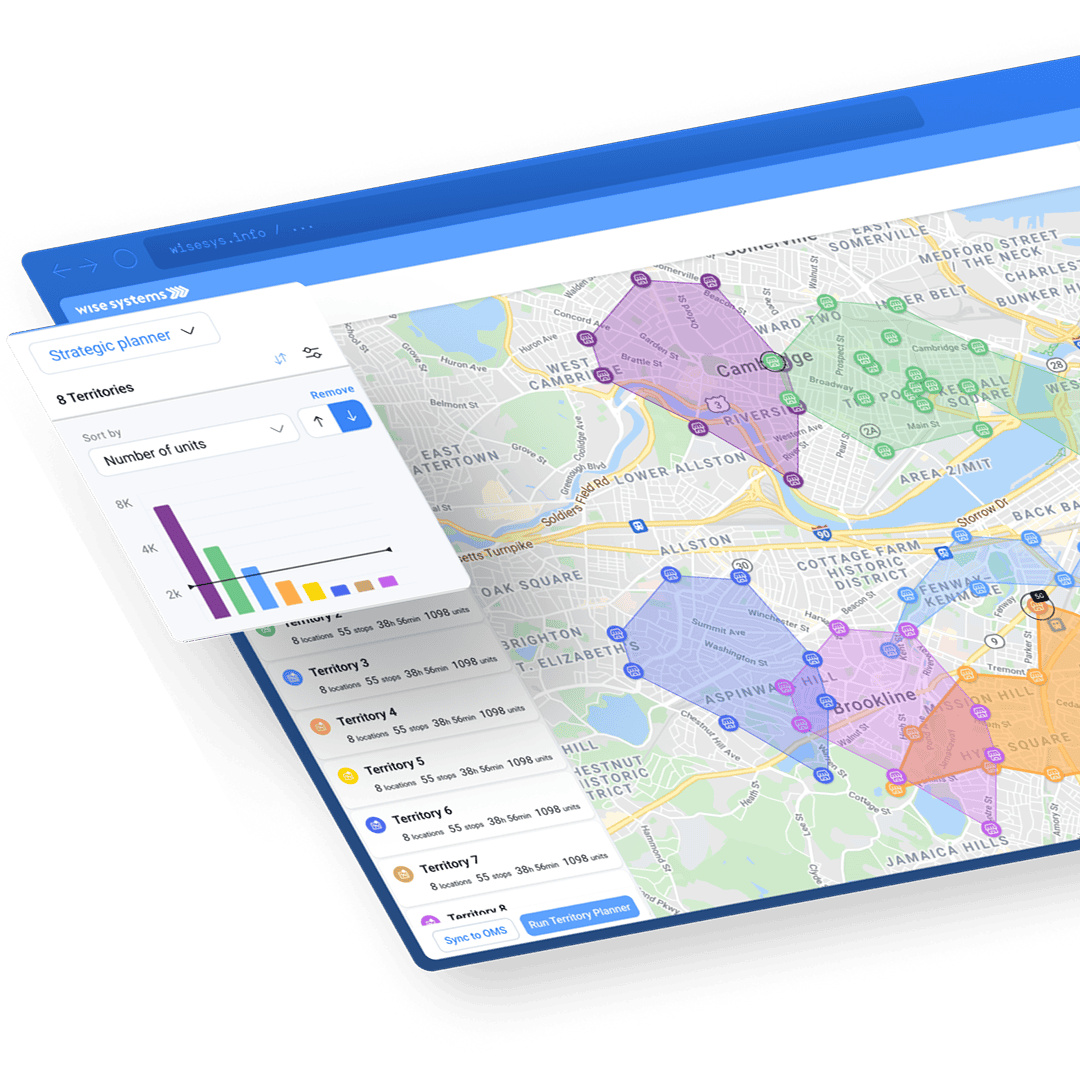
Strategic Planner
Model routing strategies, zones, and fleet scenarios before committing.
Performance Manager
Analytics on fleet utilization, driver performance, and delivery quality.
Customer Portal
Live tracking and communication for the person actually waiting at home.
Most routing software solves the problem once. Wise Systems never stops solving it.
The product, in one lineWho is actually betting on this
Ideas about logistics are cheap. Multi-billion-dollar enterprises putting their fleets on your software are not. Wise Systems powers delivery and service operations for global names including Anheuser-Busch and Lyft, across beverage distribution, parcel and courier, retail, and field service. The investors followed the customers: Tiger Global led the $50M Series C, with Google's Gradient Ventures, Section 32, Valo Ventures, and Prologis Ventures along the way - bringing total funding to roughly $73M.
The funding climb
Disclosed round sizes / USD millions
The 2021 jump is the part that matters: it is the difference between a clever idea and a company expected to run worldwide. Seed and Series B amounts were undisclosed.
There is also a partnership with Mitsubishi Fuso to carry the technology into the Japanese market - a reminder that the last mile looks different in every city, which is rather the point of software that learns each one.
Anheuser-Busch ships a lot of beer. They do not hand the last mile to a science project.
On enterprise trustThe perfect delivery, on purpose
Wise Systems frames its goal plainly: the perfect delivery experience, balanced across everyone the route touches - the customer who paid, the recipient at home, the driver behind the wheel, the dispatcher under pressure, and the manager reading the numbers. Those interests usually pull against each other. The cheapest route for the company is rarely the kindest one for the driver or the most reliable for the customer. Wise Systems' whole proposition is that machine learning can hold those tensions at once instead of sacrificing four of them for one.
The city, read through its deliveries
Online ordering is not a phase. Every parcel, prescription, and pallet that moves to a doorstep makes the last mile more crowded, more costly, and more visible. The fleets that win will not be the ones with the most trucks. They will be the ones whose routes get smarter every day instead of starting from zero every morning. That is the bet Wise Systems made in a classroom in 2014, and it has only gotten more correct since.
Go back to that van at the curb. The street is still closed, the window still moved, traffic still did its worst. The difference is that none of it is a crisis anymore. The plan already adjusted. The driver already knows where to go. The customer already got the message. The last mile, the one logistics spent decades shrugging about, has quietly become the part the software handles best.
The route that learns beats the route that's printed. Every single day.
Wise Systems, the closing argument