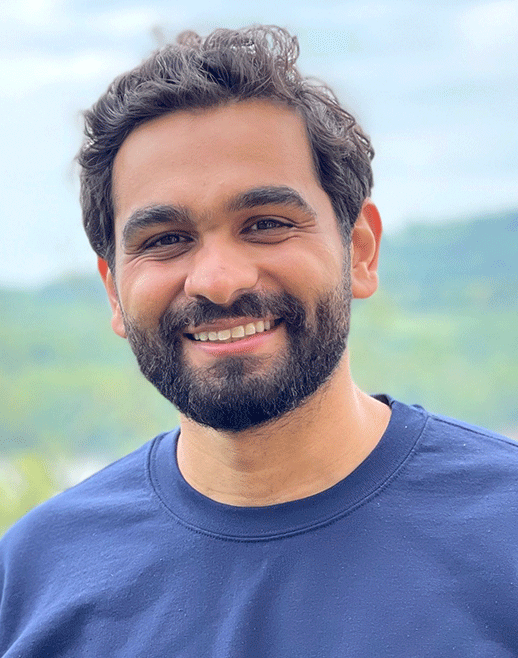
Every Walmart order that arrives in two hours. Every 7-Eleven delivery that shows up before your coffee gets cold. Somewhere in the logistics chain between "order placed" and "package dropped," there is a good chance Nash is orchestrating the move. And at the center of Nash is Mahmoud Ghulman - a physicist turned founder who has decided that last-mile delivery is, at its core, a computation problem.
Nash does not own trucks. It does not employ drivers. What it does is sit between any business and hundreds of delivery providers - connecting, routing, dispatching, rerouting, tracking, and resolving - via a single API. The analogy Ghulman reaches for is Stripe: the invisible layer that made payments frictionless for millions of merchants. Nash is attempting the same for the physical movement of goods.
"What we're doing for delivery is what Stripe has done for payments: we have built a simple API and workflow builder."Mahmoud Ghulman, Co-Founder & CEO, Nash
Before Nash, there was Mozn - where Ghulman led business development on AI solutions for anti-money laundering, stock-market fraud, and credit scoring in the Gulf. Before Mozn, there was Arsann - his first startup, an on-demand gig-worker parking logistics company he founded and ran for three years in the region. Two companies. Two attempts to drag physical-world operations into the software era. By the time he co-founded Nash in San Francisco in 2021, the pattern was unmistakable.
Ghulman and his Nash co-founder, Aziz Alghunaim, first crossed paths at a high school science fair. Both went on to study at MIT. Alghunaim shipped code at Palantir and helped launch Tarjimly, a YC-backed refugee translation platform. Ghulman ran companies in logistics. A decade after that science fair, they built one together - and walked into Y Combinator's S21 batch.
The MIT years were not spent learning to code. Ghulman studied physics - conducting research across three separate laboratory groups. The Soljacic Group (photonics). The Grossman Group (solar energy). The Gedik Group (ultrafast spectroscopy). Each explored systems that move faster than human intuition can follow - exactly the kind of thinking required to orchestrate tens of thousands of simultaneous deliveries in real time.
Nash launched into the pandemic-era delivery boom and quickly became infrastructure for businesses that could not afford to build their own logistics operations. The pitch to small businesses was survival. The pitch to enterprise was optimization. Both worked. Monthly revenue grew at an average of 52% in the year before their Series A. Andreessen Horowitz, which had quietly led the seed round in late 2021, came back to lead the Series A in July 2022 - a $20M round that brought total funding to $27.8M.
"Over the past few years, my co-founders and I watched how consumers have come to expect incredibly fast, reliable delivery at an affordable price. This has created a landscape where medium and small businesses struggle to meet consumer demands due to the complexity and high cost associated with running and maintaining a last-mile delivery operation."Mahmoud Ghulman
General Partner Andrew Chen of a16z put it simply: "Their unique model can be broadly applied to literally every vertical." That breadth is now visible in Nash's customer list: grocery chains like Ahold Delhaize, Coles, and Woolworths; convenience retail giant 7-Eleven; Walmart; Square. The platform covers 957 US cities and reaches 94% of the American population. Most people interacting with same-day delivery from a major retailer have no idea Nash is in the middle of it.
In 2025, Nash acquired Kosmo - a Singapore-based logistics platform - signaling that Ghulman's ambition is not contained by North America. "This acquisition reflects our commitment to building the logistics infrastructure for the internet," he said at the announcement, "and giving businesses - whether small or enterprise - the tools they need to scale last-mile delivery with confidence." The company now has footholds in Southeast Asia and Latin America.
Nash's current architecture revolves around what the company calls "Autonomic Logistics" - AI agents handling routing, dispatch, planning, and fleet management through what they describe as a "Context Fabric," a shared substrate beneath every delivery decision. The results the company publishes are striking: more than 99% delivery success rate, 20% reduction in delivery costs, and 50% reduction in manual intervention. Not metrics from a pitch deck. Metrics from customers with names on them.
Ghulman speaks at conferences on AI and logistics challenges. He posts infrequently but purposefully on LinkedIn and X. He runs a company of 140 people from San Francisco while managing a platform that moves millions of packages. The physics background shows up in how he frames the problem - not as a delivery challenge, but as a system optimization at enormous scale, where the right model, applied correctly, makes the chaos manageable.