Imagine a restaurant with three delivery orders and two riders. One rider is nearby. The other is farther away but heading toward two of the customers. Assign the nearest rider to the newest order and you may congratulate yourself on an efficient decision. You may also have made the rest of the evening worse. Distance is the easy part. The difficult part is knowing which promise you are about to break.
The dispatch, in brief
- What it sells: cloud software that plans, assigns, tracks and validates deliveries.
- Who buys: restaurant groups, retailers, parcel operators and logistics businesses.
- The useful distinction: routing is connected to the work of dispatchers and drivers.
- The corporate wrinkle: the current website names Stellation Inc. as the operator of the LogiNext brand.
This imagined dinner rush is a useful way into LogiNext. The company works in the gap between an order arriving and that order reaching a customer. Its software brings together constraints that tend to live in separate places: a delivery window, a vehicle’s capacity, a driver’s location, an existing route. A dot on a map can tell you where someone is. Making that person’s next assignment takes rather more intelligence.
01 / The expensive habit of starting from scratch
Dhruvil Sanghvi and Manisha Raisinghani met at Carnegie Mellon University. Later, Raisinghani worked at IBM on a GE Transportation project involving fleet efficiency; Sanghvi was working with logistics clients in Chicago. In her account of LogiNext’s origins, they noticed companies spending millions of dollars on custom software that other businesses could not readily reuse. They returned to India in 2014 and launched an initial product within two months.
The opportunity was in repetition. Businesses differed, but vehicles still had limits and customers still expected their orders. A reusable product could turn those recurring operational problems into a subscription business. Raisinghani described an early preference for separate products addressing specific concerns, followed by a platform approach when it became necessary. That sequence matters: learn the job, then join the jobs together.
“Data makes me curious and analytics excites me.”
Manisha Raisinghani · Co-founder and former CTO · 2021

02 / A map with consequences
LogiNext Mile handles planning and routing for pickups and deliveries. It supports automated allocation, customer delivery preferences, ETA notifications and analysis of completed trips. On-Demand handles the less courteous order: the one that arrives after the plan has been made. It considers available resources and existing assignments when placing that order into a delivery sequence.
Haul addresses movement between hubs, including shipment assignments, vehicle capacity and fleet tracking. Reverse covers the return journey, with return-to-merchant and return-to-origin workflows. The Driver App carries the plan into the field and supports delivery execution and validation. Together, the products describe a business concerned with the whole movement of an order, including the occasions when it must come back.
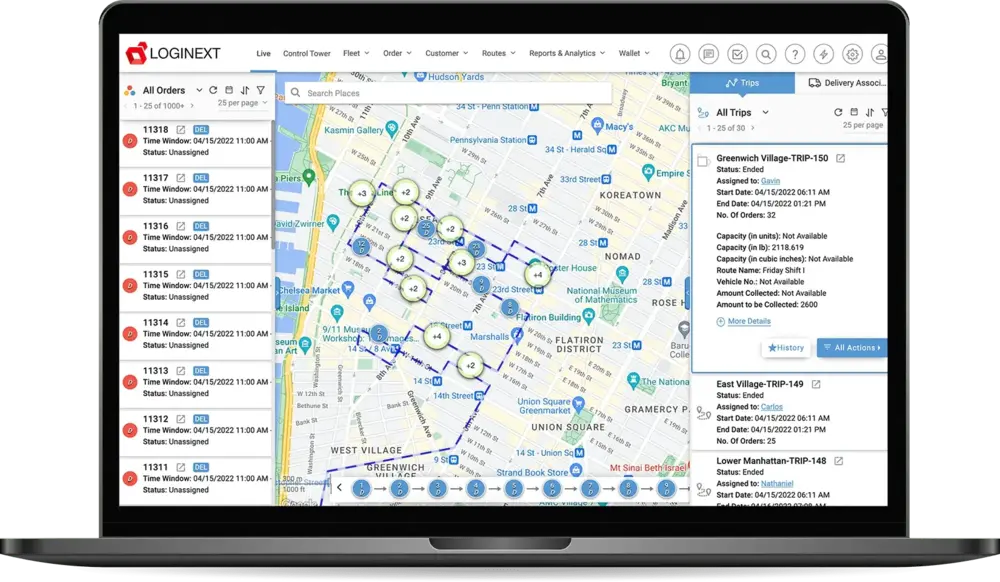
The attraction is a shorter distance between seeing a problem and changing the work. A dispatcher can plan assignments; a driver can receive instructions; the customer can receive an updated arrival estimate. Those actions belong to one operating process. The expertise lies in translating messy delivery requirements into constraints a system can evaluate, while keeping the result usable by people who have a shift to finish.
An order’s working life
03 / The dinner rush is a group project
In February 2021, LogiNext announced a partnership with AmRest, the European restaurant operator whose portfolio included KFC, Pizza Hut, Burger King and Starbucks. The agreement gave AmRest access to Mile. The announcement described improved visibility and tracking in the first phase and said the platform had already handled millions of orders for AmRest restaurants during the previous year.
The customer here is a restaurant operator managing delivery across a portfolio. The distinction matters. A familiar brand on a software vendor’s page does not mean every restaurant bearing that name uses the same system. This is enterprise software bought around an operating structure: managers, locations, delivery resources and orders that need a common view.
Thailand offers a different setting. LogiNext’s 2023 announcement about CP Axtra described work for Makro and Lotus’s, covering order assignment, fleet management, trip planning, picking and packing, visibility and analytics. A retail delivery has different contents from a restaurant order. Both create a coordination problem before they become a transport problem.
LogiNext says it serves more than 200 enterprise clients across over 50 countries and has powered over a billion deliveries. Those are company-reported scale figures. The more revealing evidence is the range of work represented by the customer examples: restaurant dispatch, retail fulfillment and the movements between depots. Its market is the organization whose delivery operation has become too complicated to coordinate comfortably by hand.
04 / Thirteen cents, before the rest of the bill
The business model is SaaS. LogiNext’s public pricing page advertises a 14-day trial and displays indicative Growth rates of $0.15 per order with quarterly billing or $0.13 with annual billing. Enterprise customers get custom pricing, a dedicated account manager and additional setup and review provisions. The published figures are explicitly indicative; a buyer still needs the contract terms.
Price arithmetic / 10,000 orders
Illustrative order charges at displayed rates, not a quote or a total deployment budget.
That arithmetic gives a starting point. Implementation work, integrations and any paid add-ons belong in the evaluation too. A software charge is easy to count. Time spent chasing a failed delivery is harder to count, which makes it particularly easy to leave out. A good pilot measures both.
The alternatives include Bringg, FarEye, Locus and Onfleet, with overlapping routing, dispatch and delivery-management capabilities. LogiNext’s proposition combines multiple transport workflows with live execution tools. That is a reason to evaluate it, rather than proof that it will outperform another vendor. Compare the systems using your delivery constraints and your awkward orders. A polished map is an exceedingly agreeable salesman.
05 / The brand took another route
The funding history has a sharp turn. A $39 million round led by Tiger Global and Steadview in January 2020 put LogiNext’s reported valuation near $100 million. In August 2024, The Economic Times reported a $250,000 asset sale to Stellation as part of a winding-up process. That sale figure is an asset transaction price, not a like-for-like replacement for the earlier equity valuation.
Sanghvi disputed the report’s portrayal, saying, “All of the clients and employees are operational”. The current official website names “Stellation Inc. dba LogiNext” in its copyright line. The evidence supports a distinction between the historical corporate entity and the continuing brand. Buyers should understand which entity signs and supports their contract.
The subsequent public activity includes a 2025 review announcing the introduction of Milo, an in-product chatbot, and a July 2026 announcement of inclusion in Gartner’s vehicle routing and scheduling Market Guide. Neither announcement settles the historical financial questions. They do show continuing product communication under the LogiNext name.

06 / Give the software an inconvenient afternoon
The useful lesson to copy is the founders’ original choice: start with a recurring operational problem that people are already paying to solve. For delivery teams, the equivalent is to record what a dispatcher actually considers before assigning an order. Then test whether software can make those decisions with fewer interventions and better results.
As an operating inference, the first weakness to look for is incomplete input: inaccurate addresses, missing capacity information or late status updates. A system making assignments from stale information can produce an elegant answer to yesterday’s problem. No routing tool creates an available driver or makes an impossible delivery window reasonable. If the operation lacks reliable data or staff cannot follow the workflow, automation may simply move confusion faster.
Run the pilot through a busy shift. Count completed orders, punctuality, cost per delivery and the calls needed to rescue the plan. Include a return and an order that arrives at the worst possible moment. The test is whether the operation improves when its convenient assumptions disappear. Dinner will provide a fairly honest review.