The first product GPS Insight sold was certainty. A dispatcher no longer had to pick up a CB radio and ask where a truck was. A manager could open a browser and see the answer. That sounds ordinary now, in the era of a blue dot on every phone. In 2004, when Rob Donat founded the company in Scottsdale, commercial GPS data was still raw material. The opportunity was to turn it into something a fleet could use before the next shift began.
Today, GPS Insight tracks far more than location. Its software monitors vehicles, trailers, heavy equipment, drivers, fuel, routes, engine diagnostics, maintenance and compliance. Its cameras detect a hard brake, a close following distance or a distracted driver. Its field-service products schedule technicians, dispatch jobs, capture forms, send invoices and collect payments. The pitch is no longer “find the truck.” It is “understand the business attached to the truck.”
A dot becomes a decision
GPS Insight sits between physical work and office software. A connected device sends location and vehicle data to the cloud. The platform plots the vehicle, stores its history, and watches for conditions a manager has decided matter: idling too long, leaving a geofence, speeding, approaching a maintenance interval, or generating an engine fault. The useful moment arrives when that signal creates an action - a new route, a service appointment, a safety conversation, or evidence for a disputed claim.
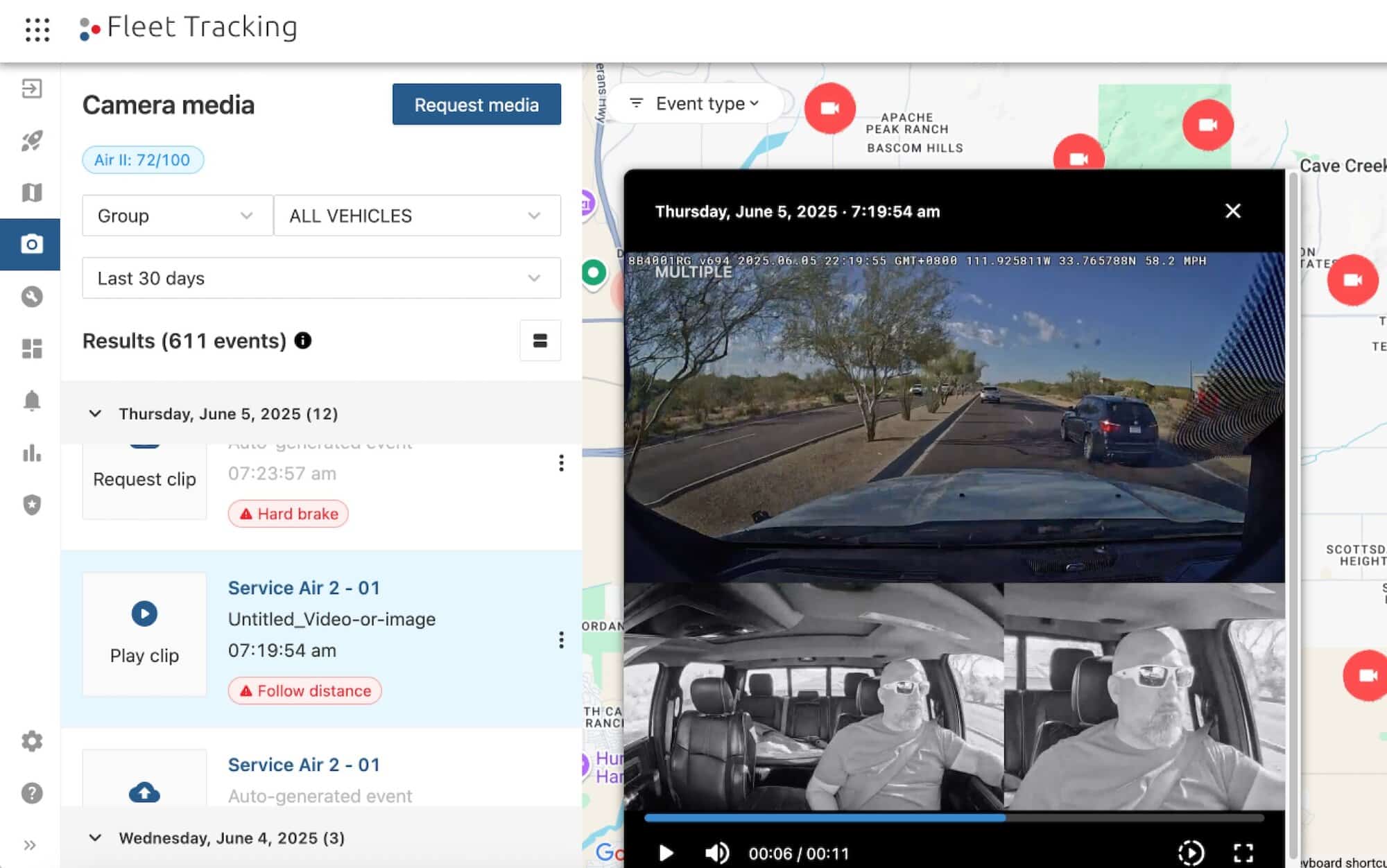
The camera products add context. A telematics alert can say a driver braked hard. Video can show that another car cut into the lane. Driveri, built with Netradyne technology, identifies selected events, offers in-cab alerts, scores behavior, and surfaces clips for review. The point is not to turn a safety manager into a full-time television critic. The system is supposed to narrow a day of footage to the minutes that deserve attention - including good driving that can be recognized, not only violations.
The GPS Insight value chain
The enemy was not ignorance. It was friction.
Parks & Sons, a Phoenix-area waste and recycling company, offers the cleanest example. Its dispatchers once managed 50 to 65 routes through CB radio and mobile calls. Growth made the arrangement noisy and route changes remained manual. The company tried GPS tracking from two providers, but neither combined the functionality and usable interface it wanted. GPS Insight's route replay finally put several vehicles on one screen. Overlapping routes became obvious, dispatch calls fell, and Parks & Sons reported saving $150,000 in fuel in the first year.
“We were able to identify route overlapping with ease - it's all there on a single screen for us to see.”Shawn Parks · Parks & Sons
Culy Contracting entered through a different door. The construction business initially needed an electronic logging device for compliance. The first failure it discovered was a maintenance process built on drivers arriving whenever a truck needed an oil change or inspection. Several could appear in the same week, creating downtime. Monthly IFTA mileage reports required staff to decode handwritten records. GPS Insight automated schedules and mileage collection. The company also reported tracking and recovering equipment worth $350,000. Compliance got the meeting; asset visibility and workflow earned the wider deployment.
MedCare Equipment found another leak after acquiring a smaller competitor: some drivers in the acquired group were idling four to six hours a day, versus a little over one hour elsewhere. MedCare estimated that subgroup alone wasted more than $35,000 in fuel annually. Its reported delivery success rose from 80 percent to 99 percent after dispatchers could identify the closest vehicle with the right equipment. The software did not invent a better route or load the oxygen tank. It made the bad pattern legible.
Public fleets add a different kind of return: proof. After Hurricane Harvey, the City of Lake Jackson used mileage history to document travel for FEMA reimbursement. When a resident said a garbage truck had skipped a house, staff could check a geofence instead of sending a supervisor across town. In another complaint, records helped show that a street sweeper's broom was not down when it passed a parked vehicle. These are small courtroom dramas played out in map history. They explain why government buyers care as much about an audit trail as a live location.
What changed when the work became visible
Customer-reported outcomes: MedCare Equipment and LN Curtis. Results vary by operation and implementation.Buy the workflow next to the wheel
The product expansion followed a recognizable vertical-software pattern. GPS Insight had vehicle data, but a plumber, utility crew or equipment technician also lives inside schedules, forms, work orders and invoices. In 2020, GPS Insight acquired ServiceBridge, a field-service platform aimed at small businesses and franchise networks. In 2021 it acquired FieldAware, which brought larger, more complex service operations into the portfolio. The following year, Certified Tracking Solutions and its Titan GPS brand extended the company's Canadian footprint, bilingual ELD capability and specialty asset tracking.
The ownership changed too. Accel-KKR acquired GPS Insight in May 2021 and combined it with InSight Mobile Data and Rhino Fleet Tracking. At announcement, the group said the businesses served more than 11,000 accounts and 225,000 vehicles across over 30 industries. A later government brief described more than 300,000 active users across the broader platform. Deal values were not disclosed. Charles Layne became chief executive in 2023, succeeding Gary Fitzgerald, who moved to the board.

The acquisitions explain GPS Insight's place in the market. It is broader than a low-cost locator and smaller in public profile than connected-operations giants such as Samsara, Motive, Verizon Connect and Geotab. It competes by packaging tracking, cameras, compliance and field service around a customer's actual mix. That modularity can suit a regional contractor that wants to start with GPS, a public agency with unusual billing and departmental requirements, or a North American fleet that needs both U.S. and Canadian compliance.
04 · What it costsThe sticker price is only the first line
GPS Insight does not publish a universal price sheet; buyers request a quote based on fleet size and the jobs they need the system to do. Software marketplaces have listed basic tracking from roughly $14.95 to $24.95 per month, but those figures should be treated as entry points, not a current all-in quote. Cameras, hardware, installation, compliance modules, field-service seats, support and contract length can change the total. An older Fleetio integration was announced at no added integration cost, while a Savings4Members partnership advertised discounts of 20 to 30 percent for eligible members.
A serious buyer should calculate cost per active vehicle and cost per technician, then compare it with one specific leak. How many gallons disappear into idling? How much coordinator time goes into mileage reports? What does one preventable collision, missed service, unnecessary rental or disputed claim cost? The GPS Insight case studies are persuasive when they show that denominator. “More visibility” is pleasant. A $150,000 fuel line is a budget.
There is also a human implementation cost. Dash cameras can trigger resistance when drivers hear “surveillance” and managers hear “evidence.” A workable program needs published rules, limited access, consistent coaching and a reason to celebrate safe miles. GPS Insight's own Driveri material emphasizes positive driving notifications alongside violations. That balance matters. An accurate score nobody trusts is operationally useless; a camera introduced with clear boundaries can protect the same driver it coaches.
Steal this playbook
- Pick one expensive failure, not ten vague goals.
- Baseline fuel, idle time, incidents or paperwork before rollout.
- Automate the response, not only the alert.
- Expand after the first savings are visible.
Skip it when
- You have a tiny fleet and need only occasional location checks.
- No one owns the alerts or coaching workflow.
- Your camera policy is vague or hidden from drivers.
- The integration work costs more than the leak being fixed.
Less hardware, richer context
Recent moves point toward a fleet platform that knows more without adding another box. A 2026 partnership with CerebrumX is intended to bring embedded vehicle data directly from mixed-fleet OEM systems, including diagnostic codes, service warnings, fuel analytics and selected remote controls. GPS Insight also named Netradyne its 2026 AI Camera of the Year and has promoted a simpler Fleet All-in-One camera and tracker for customers who do not need the most elaborate installation.
The wager is sensible: the fleet manager does not want a museum of portals. But integration is where broad platforms either become useful or become cupboards full of products. The test is whether a camera event, engine warning, technician schedule and fuel-card swipe can meet in one workflow with a clear owner. If they can, GPS Insight is not merely following vehicles. It is helping run the work around them.
Go deeperMaps, demos and field notes
See the products in motion, browse the training library, or inspect the company's public API client.