There is a peculiar type of retail failure in which everybody is right and the shopper still goes home without the pasta. The inventory system says twelve boxes exist. The back room may indeed contain twelve boxes. The shelf, however, contains none. The database has told the truth in the manner of a lawyer: precisely, defensibly and quite uselessly.
The aisle in five items
- Simbe sells a monthly shelf-intelligence service, not a robot for stores to buy.
- Tally scans products, price tags and placement; mobile and web software tell staff what to fix.
- The company reports 3,000-plus autonomous units under contract across 10 countries.
- Its sharpest strategic decision was to favor observation over robotic picking.
- The approach works when operations owns the workflow. A clever pilot marooned in IT is merely expensive theatre.
Simbe exists because physical retail has long tolerated this gap between the official store and the actual store. Founded in 2014 by Brad Bogolea, Mirza Akbar Shah and Jeff Gee, the South San Francisco company makes the actual store legible. Its most recognizable instrument is Tally: a tall, narrow, slow-moving robot that travels the aisles, photographs shelves and reads the evidence. Out of stock? Wrong price? Product in the wrong place? Promotion promised but absent? Tally notices.
It does not fetch the pasta. This is important. The founders initially imagined that retail robots might eventually move, pick and manipulate goods. They soon decided the larger near-term opportunity was data. Robot hands make impressive demonstrations; robot eyes can inspect tens of thousands of products, several times a day, without asking the store to rebuild itself. Simbe chose the humbler job and found the bigger business.
“We thought we knew, but boy we did not know.”Kim Anderson, Schnuck Markets VP of Store Operations, on shelf availability
The first product was embarrassment
Schnuck Markets began testing Tally in three stores in 2017. Before the machines arrived, the grocer believed its on-shelf availability was healthy. Consistent scans revealed more gaps than expected. This was not a malfunction. It was the first deliverable: an argument that could no longer be settled by instinct.
The first thing to fail was the original implementation assumption. The rollout was treated largely as a technology project - deploy, integrate, switch on. But shelf intelligence creates work. If the system finds hundreds of price errors and empty facings, someone must decide which matter now, who owns them and how completion is checked. Schnucks and Simbe learned to make the deployment an operations program as well as an IT program, to introduce use cases in phases and to embed the resulting tasks in the store's day.
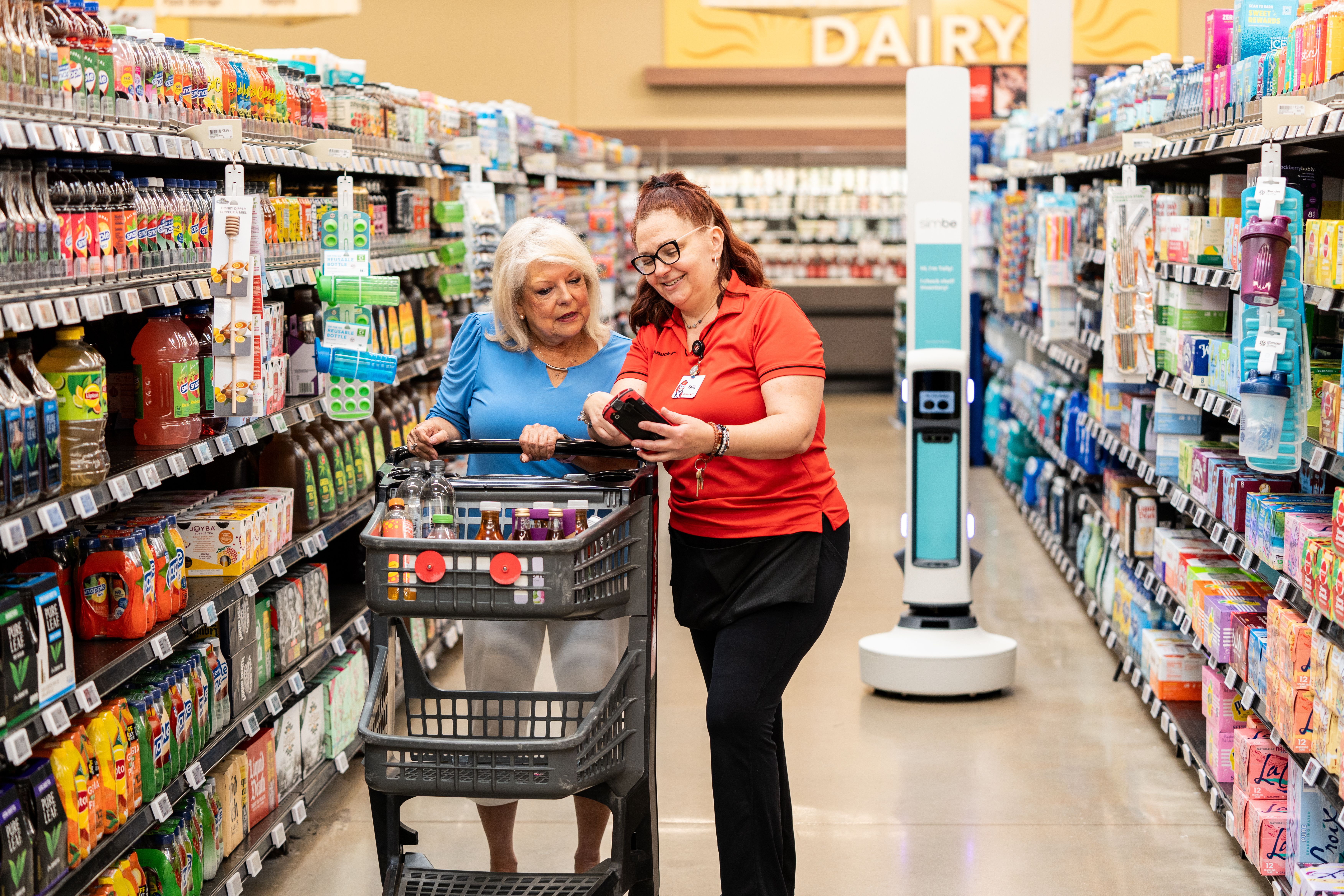
That lesson explains what Simbe does better than any glossy robot photograph. The company is a full-stack enterprise system. Tally gathers the broad store view. Tally RFID locates tagged apparel and electronics. Tally Spot, a fixed camera introduced in 2025, watches places where conditions change too quickly for periodic patrols - prepared food, produce, alcohol, medicine and checkout. Simbe Vision recognizes products and labels. Store Intelligence supplies dashboards, reports, virtual shelf views and APIs. Simbe Mobile gives associates a prioritized list rather than a data lake and a sympathetic shrug.
A subscription wearing a friendly face
A retailer does not buy Tally. Simbe charges a monthly Robot-as-a-Service fee based on store size, product count and the mix of computer vision, RFID and scanning required. The company publishes no fixed dollar menu. Hardware, software and round-the-clock fleet support travel together; if a robot needs repair, Simbe owns the inconvenience. A new customer generally reaches the company's target accuracy in about seven days, while an existing customer can bring another store online faster.
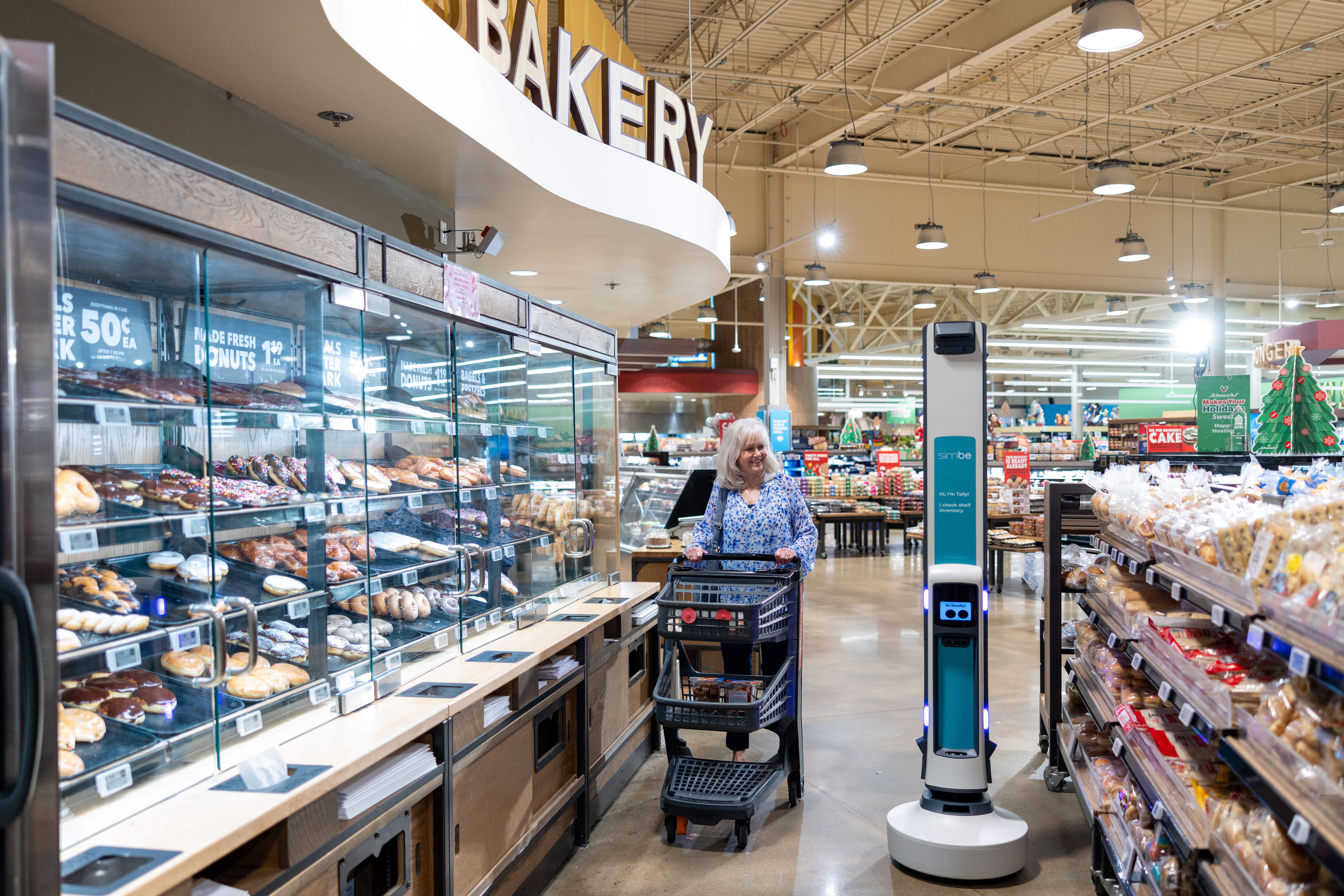
This model has two virtues. It removes the capital purchase that can freeze a trial in committee, and it makes reliability Simbe's recurring obligation. It also explains why the robot is designed to be unthreatening: rounded, quiet, slower than one-third of normal walking speed and capable of turning in place. A warehouse machine may hide behind a fence. Tally works beside a child selecting cereal.
The customers are not buying a novelty. They are grocers and wholesalers such as Schnucks, BJ's Wholesale Club, Wakefern and SPAR Austria; farm and home retailers including Country Supplier and HomeBase; and operators such as Decathlon, Harmons and B&R Stores. Google Cloud supplies infrastructure for processing fleet data. NVIDIA provides the edge AI platform in Tally 4.0. Intel RealSense depth cameras helped earlier generations see and navigate. SoftBank Robotics supplied manufacturing and inventory-financing support when Simbe needed to turn prototypes into a fleet.
What changed their minds
The company began with laser-cut wood and 3D-printed plastic. In 2015 the founders moved to China, soldered late and sometimes slept on a warehouse floor while building the prototype. The romantic version of this story concerns grit. The useful version concerns proximity: they placed themselves near manufacturing, shortened the distance between flaw and fix, and made something that could survive outside a lab.
Customer evidence then kept narrowing the proposition. The earliest notion was broad retail automation. The market rewarded reliable visibility. A mobile robot could cover a whole store economically, but it could not watch rotisserie chicken every minute. Hence Tally Spot. RFID could locate soft goods that a photograph alone might not. Hence Tally RFID. Merchants needed chain-wide evidence for vendor conversations, not only store alerts. Hence realograms and Simbe for Merchants. The product became multimodal because the store is not one sensing problem.
By 2025, Simbe said Tally operated in 10 countries for nearly five dozen retail organizations. In January 2026 it announced Tally 4.0, with as much as 12 hours of runtime, sharper and more varied cameras, wider 3D and 360-degree coverage and more computing at the edge. In September the company reported more than 3,000 autonomous units under contract. That expansion followed $104 million in disclosed and reported financing, including a $50 million Series C led by Growth Equity at Goldman Sachs Alternatives in 2024.
The part worth copying
Automate observation before automating manipulation. Start with one painful measure, give each finding an owner, phase the alerts, and scan again to verify the fix. The loop matters more than the machine.
The conditions hidden behind the demo
The economics improve with square footage and product count. Simbe says stores should generally exceed 1,000 square feet and that most customers exceed 5,000. A tiny shop with a few hundred items can rely on human memory and a clipboard. A large supermarket cannot. The method also depends on action: a store that lacks labor to replenish shelves, clean product data, integration capacity or an operations leader will merely receive a more accurate description of its disorder.
Competitors attack the same blind spot from different angles. Badger Technologies and Brain Corp offer robot-powered shelf scanning. Focal Systems and Pensa Systems emphasize fixed or vision-based shelf monitoring. Trax provides image-based retail execution. Handheld scanners and employee audits remain cheap, familiar alternatives; ceiling cameras can watch continuously but require dense installation. Simbe's distinction is the combined system - autonomous mobility for broad coverage, fixed cameras for speed, RFID for tagged goods and workflow software for the human response.
The temptation is to ask whether robots will replace store workers. Tally's narrower answer is more interesting. It replaces walking the aisle in search of a problem. A person still chooses what to do, moves the case from the back room, helps the shopper and handles the hundred exceptions that make a store a store. The machine's gift is not autonomy in the grand science-fiction sense. It is the end of plausible deniability in aisle seven.