A store that knows what it has
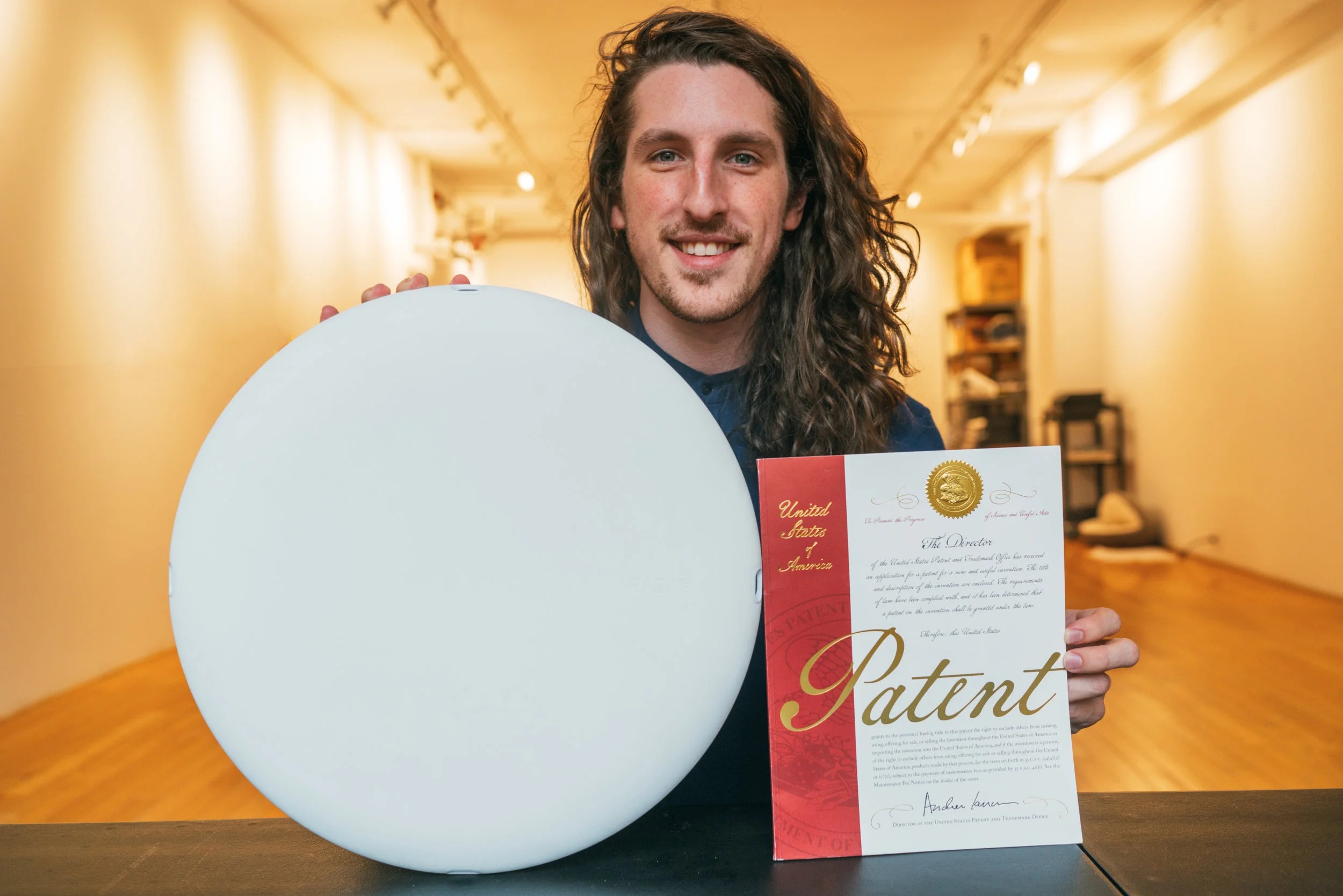
Spencer Hewett runs a company whose entire product lives above your head. Walk into an American Eagle or an Old Navy today and somewhere in the ceiling tile, mounted flush and mostly invisible, is a RADAR sensor - a small white disc doing the same job about 1,500 times over across the country. It pings every RFID tag in the store roughly every five seconds and tells the retailer, down to the SKU, the size and the color, exactly where a given item is sitting right now. Not what the inventory system thinks is in stock. What's actually there.
That distinction is the whole business. Hewett has said existing RFID setups can tell a brand what's somewhere in the building with maybe 70 to 85 percent accuracy - useful for an annual audit, useless for a customer standing at a fitting room asking for a different size. RADAR claims 99 percent, refreshed continuously, which is the difference between a shrug and a fast answer. One retailer that deployed the system saw online order fulfillment jump from about 70 percent to 98 percent. Another cut shrink - inventory theft, damage, misplacement - by 60 percent.
In May 2026, RADAR closed a $170 million Series B, co-led by Gideon Strategic Partners and Nimble Partners with Align Ventures also participating, pushing the company's valuation past $1 billion. It was a steep jump from the $38 million round the company raised in 2024, and well beyond the $60 million it had originally set out to raise this time. The company now covers more than 1,400 stores, up from around 500 a year earlier, and Hewett has talked about scaling onboarding from a handful of retailers a year to dozens.
The slow line that started it
The founding anecdote Hewett tells traces back to something almost embarrassingly small: standing in a long, slow-moving line at a Victoria's Secret, unable to find out whether the store had what he was looking for without waiting to ask. It's not a dramatic origin story, and that seems to be the point - the problem was mundane, universal, and apparently nobody had bothered to fix it with real infrastructure. He became, in his own retelling, obsessed with it.
He'd had a head start on obsession. As a teenager he made pocket money reselling designer handbags on eBay, later interning at the company - an early, low-stakes education in the gap between what a listing says and what's actually available. He was born in Illinois and raised across six states, one of two younger siblings to two older sisters, which by his own account meant a childhood split between dolls and building computers to sell. He enrolled at Washington University in St. Louis to study computer engineering. He didn't finish.
Dropping out on purpose
In 2012, as a sophomore, Hewett left school for the Thiel Fellowship - Peter Thiel's program that pays young people $100,000 to skip or pause college and build something instead. He moved to Palo Alto. What followed wasn't a straight shot to a unicorn. It was years of unglamorous iteration: an early RFID prototype called Shopit, informal study of physics under an MIT-trained mentor, and a stretch of supporting himself by renting out space on Airbnb while he refined the hardware. He went through Y Combinator's W13 batch and Stanford's StartX accelerator along the way. Early, smaller ventures - a computer-cooling company called Frigid Computer, a stint at Segan Industries - came and went before the idea that would become RADAR took its current shape in 2017.
That gap - roughly five years between winning the fellowship and founding the company that would eventually carry his name into the unicorn club - is the part of the story that tends to get compressed in press coverage into a single triumphant sentence. It wasn't. It was a founder without a company, tinkering, broke enough to need Airbnb income, betting that the underlying insight was still right even when the execution wasn't yet working.
Getting American Eagle's chairman on the board
RADAR's turn toward apparel retail specifically - rather than warehouses or logistics generally - came partly from outside pressure. Hewett has credited Jay Schottenstein, the American Eagle chairman who became an early backer, with pushing him to focus the technology on consumer-facing store floors rather than back-of-house inventory management. American Eagle's chief operating officer sits on RADAR's board. The relationship shows up in the deployment numbers: American Eagle and Old Navy together account for nearly all of RADAR's current store count, a concentration that is either a moat or a risk depending on how the next few contract renewals go.
The technology itself has kept moving past pure location-tracking. Hewett has described newer features like "Fitting Room Intelligence," which tracks which items shoppers try on and exchange to flag sizing problems, and "Floor Set IQ," which recommends store layout changes with predicted sales lift attached. The camera inside RADAR's sensors, originally there to support the RFID reads, is increasingly doing computer-vision work of its own - what Hewett has called "product-to-people attribution," a phrase that means exactly what it sounds like and will probably need a more comfortable name before it shows up in a press release again.
What comes after unicorn status
Hewett was named to Forbes' 30 Under 30 list for Retail & Ecommerce in 2022, and RADAR made The Information's list of 50 Most Promising Start-ups in 2023 - the standard waystations for a founder on this trajectory. The $1 billion valuation in May 2026 puts him in the smaller category of Under-30 founders whose companies actually clear unicorn status rather than just getting listed near people who did. Total funding to date sits above $230 million.
None of that changes what the company sells, which is still, fundamentally, a very specific and very unglamorous kind of certainty: knowing where a physical object is, continuously, without anyone having to walk around and look for it. Hewett's stated long-term ambition - to "index every single object in the world" - sounds like the kind of thing a founder says in a pitch deck. But the version of it he's actually built so far is narrower and more useful than that: a ceiling full of sensors, reading tags every five seconds, in stores where a shopper just wants to know if they have it in her size.