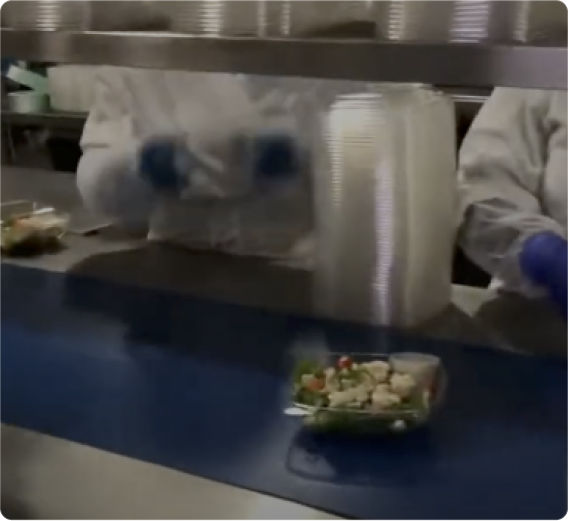
A factory floor, a robot, a lot of rice.
Walk into a co-manufacturing plant outside Petaluma at 6 a.m. and you will see an arm. It is bolted to a frame, painted the kind of off-white that lab equipment is always painted, and it is portioning saag paneer into plastic trays moving past on a conveyor belt. The arm does not get tired. It does not call in sick. It does, occasionally, learn something new.
That arm is what Chef Robotics actually does for a living. Not a humanoid in a press release. Not a demo at a trade show. A working machine, on a real line, packing real food that real people will microwave on Tuesday. The company has done this 70 million times now. It is the most boring possible version of the AI revolution, which is part of why it is working.
The kitchen is understaffed. It always has been.
Food manufacturing has a quiet crisis: every plant manager in North America is short on people, and the turnover on a meal-assembly line can hit triple digits per year. The job is cold, repetitive, and unforgiving. The work, however, is not optional - somebody has to put the rice next to the chicken next to the broccoli, in roughly the right amounts, ten thousand times a shift.
Traditional automation never quite solved it. The lines change too often. A meal-kit company runs forty different SKUs in a week; an industrial scoop-and-place machine is calibrated for one. So plants kept hiring humans, and humans kept leaving, and the gap between what consumers ordered and what factories could ship kept widening.
This is the gap Chef Robotics wedged itself into. Not the glamorous part of AI. The part where someone has to portion the lentils.
From a Penn lab to a burrito bowl.
Rajat Bhageria is not, by background, a restaurateur. He came out of Penn's robotics and machine-learning program, started a venture fund in his mid-twenties, and had already built and sold a startup in assistive computer vision. In 2019 he made a bet that sounded, at the time, a little daft: that the first big commercial market for embodied AI would not be self-driving trucks or warehouse pickers, but meals.
The early going was a polite disaster. Chef Robotics tried selling into quick-service restaurants and ghost kitchens - the obvious play, the deck-friendly story. It did not work. Restaurants wanted finished theater; Chef had production engineering. So the company did the unsexy thing: it turned away its first customers and went looking for industrial food plants that needed robots more than they needed novelty.
That pivot, founders will tell you privately, is the only reason the company exists. It is also the kind of move you can only make if you are slightly stubborn and slightly funded. Bhageria, by all accounts, is both.
ChefOS, or the operating system for food.
What Chef sells, if you look closely, is not really a robot arm. The arm is commodity-ish; the company integrates standard industrial manipulators. What Chef sells is the software stack that lets that arm pick up sticky rice without crushing it, or scoop a stew without splashing, or portion sliced avocado without turning it into guacamole. That stack is called ChefOS, and it is the thing investors are actually buying.
ChefOS is trained on millions of real scoops. Every time a robot picks up a new ingredient on a customer line, the data flows back, the models update, and every other robot in the fleet gets a little better at quinoa, or at olives, or at the particular viscosity of butter chicken on a cold morning. The marginal cost of teaching the hundredth customer is dropping every quarter. That is the flywheel.
The business model is Robotics-as-a-Service. Customers do not buy a machine; they subscribe to a working line. Chef ships, installs, maintains, and updates. The plant pays per shift, or per meal, depending on the contract. It is the cloud-software playbook applied to physical equipment, and it is - finally - working in industrial hardware.
Brief history of a robot arm
Numbers that plant managers notice.
Plant managers are skeptical of pitch decks. They like P&L statements. So here is the language they actually speak: Amy's Kitchen reports a 12% improvement in product consistency after deploying Chef, a 4% drop in food giveaway (the polite term for the rice that misses the tray), and a 17% gain in labor productivity. Sunbasket says it freed up 10% of the staff on a typical run, and saw consistency tick up 25%.
These are not moonshot numbers. They are accounting numbers. Which is exactly why they matter - because a robotic arm that pays for itself in eighteen months is a different kind of object than a robotic arm that promises to in three years.
Customer impact, by the receipts
Beyond the case studies, there is the asterisk of fleet scale. Chef has, per the company and corroborated by The Spoon, produced more meals than every other food-robotics startup combined. That is a striking sentence to read about a six-year-old company that nobody had heard of three years ago.
Humans for the human parts.
Bhageria's stated mission is gentler than the typical AI-replaces-labor pitch. He talks, in interviews, about empowering humans to do what humans do best, and letting machines handle the repetitive work that nobody really wanted in the first place. Whether you find that framing convincing depends on how you feel about labor economics in the food industry, which is a longer conversation than this page.
What is harder to argue with is that the plants Chef serves were already understaffed. The robots are not displacing a queue of eager applicants; they are filling a queue that was already empty. The people who would have stood at that station for ten hours a day get reassigned to quality control, packaging, and the parts of food production that still benefit from a pair of human eyes. At least, that is the version the company tells, and customers have not publicly disputed it.
The broader bet is on physical AI as a category. While the rest of the industry chases humanoids and generalist robots, Chef is making a focused argument: pick a vertical, dominate it, then let the data compound. So far the data is, in fact, compounding.
The boring future, already shipping.
It is fashionable, in 2026, to argue about AGI timelines and robot rights and the precise moment a humanoid will fold your laundry. Chef Robotics is making a different argument, which is that the AI revolution will be won by companies who picked an unsexy job and did it for real. Meal assembly is that job. There are roughly three trillion meals served globally every year. The market is, in robotics terms, hilariously large and hilariously underserved.
If Chef is right, the next decade of physical AI will look less like Westworld and more like a quietly humming arm above a tray of pasta primavera. The investors backing it - Avataar, Kleiner Perkins, Construct Capital, Bloomberg Beta, and a long bench of others - are betting that the boring version wins.
Back at that plant outside Petaluma, the arm is still scooping. The shift will end in two hours. Someone will swap the ingredient tubs. The arm will start over. By the end of the week, it will have packed about a hundred thousand more meals. By the end of the year, the fleet will pass a hundred million. Nobody on the floor will applaud, which is, in its own way, the point.