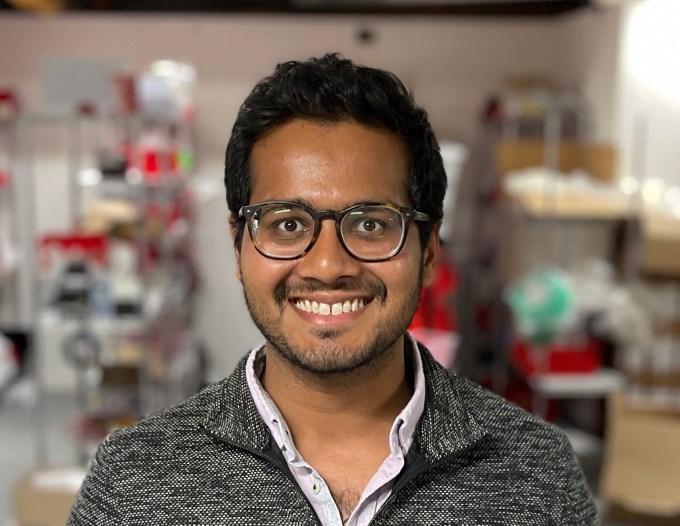
The Pragmatist Who Actually Shipped the Robots
In April 2026, Chef Robotics crossed 100 million food servings produced by its robots in commercial facilities - more than every other food robotics company combined. Rajat Bhageria, the company's founder and CEO, said so matter-of-factly. No launch event. No press release confetti. Just a milestone that separates his company from every robotics firm that promised to transform the kitchen and then didn't.
This is the man who, when asked about competitors making grand declarations about autonomous cooking, said without ceremony: "A lot of robotics companies have made grandiose promises, but they haven't really shipped any robots. We're much more practical." That sentence is a mission statement disguised as a dismissal.
Chef Robotics builds AI-enabled robotic arms for food assembly lines - the kind used in airline catering, meal-kit fulfillment, institutional food service, and frozen food manufacturing. The robots handle the picking and placing of food ingredients into trays, containers, and packaging, operating in high-mix environments where hundreds of different SKUs flow through the same line. That variety - braised chicken today, spiced tofu tomorrow - is precisely what made automation hard here before AI arrived.
AI is going to have a massive impact on our world, but the big question is: will it stay confined to the digital world, or will it transform the physical world as well?
- Rajat Bhageria, Chef RoboticsHe Walked Away From Millions in Signed Contracts
In 2022-2023, Chef Robotics had contracts with fast-casual restaurant chains. Real money. Signed agreements. The kind of customer relationships that make investors comfortable. Bhageria walked away from all of them.
The problem was data. Fast-casual restaurants wanted fully autonomous kitchen robots - but they wouldn't let Chef Robotics do what it needed to do to get there: deploy robots that handled just one ingredient at a time, generating the training data necessary to build smarter AI. A restaurant wants a robot that does everything. Chef Robotics needed customers who would let its robots do one thing, thousands of times, to learn.
Food manufacturing had the answer. In high-volume assembly lines - airline meals, frozen entrees, hospital trays - workers already operated in stations, each person adding a single ingredient repetitively all day. The labor was structured precisely the way Bhageria needed for data collection. He replaced the restaurants with manufacturers, accepted the grueling fundraising period that followed, and built the data flywheel that now puts his company ahead of every competitor.
The flywheel is his core thesis: more robots deployed generates more production data, which trains better AI models, which enables the robots to handle more food types and edge cases, which wins more customers. TechCrunch described it as Chef Robotics having "escaped the robot cooking graveyard." Bhageria would probably note that escaping requires never getting close in the first place.
The Numbers That Close Deals
The robotics industry runs on demos. Chef Robotics runs on audited production results. Amy's Kitchen reported 12% improved consistency and 17% labor productivity gains. Chef Bombay saw 88% waste reduction. Cafe Spice reassigned 5-6 workers per line to higher-value tasks while doubling and tripling output. These aren't pilot projections. They're what happened in live facilities.
The customer list includes some of the largest names in institutional food service: one of the biggest school lunch providers in the country, one of the largest airline catering companies in the world, along with Sunbasket, Amy's Kitchen, Chef Bombay, and Cafe Spice. The RaaS (Robotics-as-a-Service) model means customers pay only when the robots deliver results - no upfront capital expenditure. This removes the largest barrier to adoption in an industry already skeptical of technology promises.
From a Cincinnati Bedroom to a Wharton Dorm Room
Bhageria grew up in Cincinnati, Ohio, having moved with his family from India through France and across the United States. By high school, he had published a peer-reviewed scientific paper in glass science - first author, 20+ academic citations. He also wrote a book critiquing how education systems stifle creativity, published immediately after graduation. He was 17.
At the University of Pennsylvania's Wharton School, he studied economics and computer science, then stacked a master's degree in robotics and machine learning from Penn's GRASP Lab on top - completing it during his undergraduate senior year. He started his first company, CafeMocha, a platform for creative writers, at 16. It attracted users from Brazil, Argentina, and China.
The company that got noticed was ThirdEye. During a 36-hour hackathon, Bhageria and two classmates - Ben Sandler and Joe Cappadona - built a computer vision app to help visually impaired people identify objects around them. None of them had written a line of Android code before that weekend. ThirdEye went on to validate with the National Federation of the Blind, land coverage in NBC News, TechCrunch, BBC, Forbes, and HuffPost, and was ultimately acquired by TheBlindGuide in 2017. Bhageria's explanation for not dropping out to pursue it full-time: "College is a nonrenewable resource."
Alongside ThirdEye, he co-founded Prototype Capital, a pre-seed venture fund operating through a distributed network of 72+ founder scouts across the United States. The portfolio has grown to $2B+ in collective value, with investments in Hightouch (valued at $400M+), Ghost Robotics (acquired for $400M), FaZe Clan (public), and dozens of other companies. He also worked as a Kleiner Perkins Fellow at Indiegogo under founder Slava Rubin.
Chef Robotics started in 2019. By 2026, it operates across three continents and has produced more AI-assisted food servings than any company in history.
The more robots we deploy, the more data we get. The more data we get, the better our AI becomes. The better our AI, the more problems we can solve for customers.
- Rajat Bhageria on the data flywheel strategyPhysical AI and the Food Supply Chain
Bhageria describes Chef Robotics as a physical AI company first, robotics company second. The hardware is the vehicle; the AI is the product. Specifically, he is building toward a food foundation model - a general-purpose AI trained on the enormous volume of food handling data his robots generate across production facilities.
In January 2026, he appeared on the Cognitive Revolution podcast to discuss exactly this: imitation learning, data flywheel effects, and the vision of a model trained on every type of food ingredient, in every configuration, at scale. The episode is titled "A Foundation Model for Food." It's a statement of ambition, not a product announcement. But it maps to every strategic decision the company has made: the pivot from restaurants, the RaaS model, the institutional customer focus, the 100 million servings milestone.
In May 2026, Chef Robotics unveiled a bi-manual physical AI system designed for prep-table food assembly - handling lower-volume, higher-complexity tasks that require two robotic arms coordinating in real time. The same month, the company released "Deposit Assist," which combines a physical funnel with AI-driven controls to reduce food waste during the portioning step. These are not headline features. They are incremental expansions of what the model can do, applied to new parts of the food manufacturing process.
The market Bhageria is entering is enormous. Food assembly represents approximately 70% of labor costs in food manufacturing. Automation in this space has historically been rigid - machines built for a single product on a single line. AI-driven robotics changes the economics. A robot that can learn to handle braised chicken, then spiced tofu, then granola bars, without a complete hardware overhaul, is a fundamentally different value proposition than anything the food industry has seen before.
Lived in 4+ countries, traveled to 21+. Speaks 4 languages.
Published a peer-reviewed science paper in high school. 20+ academic citations before college orientation.
Built ThirdEye's first prototype in a 36-hour hackathon with zero prior Android experience.
Runs a VC fund with 72+ scouts distributed across every corner of the United States.
Ghost Robotics, one of his portfolio investments, was acquired for $400M.
Wrote a weekly entrepreneurship column for Forbes while building Chef Robotics.
Contributed to an Oxford University Press anthology as an undergraduate.
Thiel Fellowship (20 Under 20) finalist - chose to stay in college anyway.
A Career Built in Parallel
Bhageria rarely does one thing at a time. While building Chef Robotics, he has continued managing Prototype Capital and contributing to Afore Capital as a Venture Product Partner. Before Chef Robotics, he ran ThirdEye while completing his master's degree and co-founding the VC fund simultaneously. The pattern holds across his whole career.
| Venture | Role | Period | Outcome |
|---|---|---|---|
| CafeMocha | Founder | 2013 | Creative writing platform with international users |
| ThirdEye | Co-Founder | 2015-2017 | Acquired by TheBlindGuide; NBC, BBC, Forbes coverage |
| Prototype Capital | Co-Founder & Managing Partner | 2015-present | $2B+ portfolio; 72+ scouts; Ghost Robotics ($400M acq.) |
| Afore Capital | Venture Product Partner | 2017-present | $124M pre-seed fund, San Francisco |
| Maintool | Interim COO | 2017-2019 | Smartwatch adapter company |
| Chef Robotics | Founder & CEO | 2019-present | $72.7M raised; 100M+ servings; 12+ facilities |
The Road to 100 Million Meals
Sell Before You Build. Then Actually Build It.
Bhageria's rule for hardware startups: sell before you build. Secure real customer commitments before hardware development begins, so the market has already validated the problem. Chef Robotics followed this playbook from the start - building relationships with food manufacturers before finalizing the robot design, adjusting the product to fit real production line constraints rather than idealized lab scenarios.
The second principle is the data strategy. Unlike software, where you can iterate a product quickly, robotics requires physical data collection at scale. Bhageria structured Chef Robotics' entire business model - RaaS pricing, institutional customers, high-volume production environments - to maximize the rate at which the company collects real-world food handling data. Every serving the robots produce adds to the training set. The customer value proposition (no upfront cost, pay only for results) is also the data collection strategy.
On the question of worker displacement, Bhageria is direct about aiming for automation that empowers rather than eliminates. His stated mission is to "accelerate the advent of intelligent machines that empower humans to do what humans do best." In practice, his customers' workers have been reassigned to quality control, food safety oversight, and equipment management - roles that command higher wages and require more judgment than repetitive ingredient portioning.
Links & Resources
Interviews & Podcast Appearances
Bhageria has appeared on a number of podcasts and video interviews discussing robotics, food automation, and physical AI. Notable appearances include:
"A Foundation Model for Food, with Chef Robotics CEO Rajat Bhageria" - discussions of imitation learning, data flywheel strategy, and the food AI roadmap. Available on Spotify and YouTube.
"The robot revolution and our food future" - deep dive into embodied AI and the labor shortage in food manufacturing.
"Food, Robotics and AI with Chef Robotics' CEO Rajat Bhageria"
"The Story of Chef Robotics" - the full founding story from restaurant contracts to food manufacturing pivot.
"Why High-Mix Manufacturing Is a Sweet Spot for Flexible Automation and AI"
Founder stories, investing, robots, AI, and the passion hypothesis. 47 minutes.