The invitation was not quite standard Pentagon recruiting practice. One day, an Air Force captain called Lauren Knausenberger’s husband and asked whether he could take his wife out for a beer. Her husband laughed, passed along the number, and a meeting followed. Knausenberger arrived with the sort of office supply that has launched both good ideas and regrettable business plans: a bar napkin.
She began to draw. The conversation became a sketch of how the Air Force might solve technology problems differently. The sketch became a pitch. The pitch led to General Kim Crider, then to General Mike Holmes, then to Lieutenant General Bill Bender. Eventually, as Knausenberger later told the story, the generals “tackled” her into serving her country.
There is something usefully compact about this origin story. A stranger makes an improbable call. A technologist turns a drink into a working session. A giant institution discovers that recruitment can begin with curiosity rather than ceremony. By June 2017, Knausenberger had joined the Department of the Air Force as its director of cyberspace innovation. Four years later she was the department’s Chief Information Officer, responsible for enterprise IT, cybersecurity, data and artificial intelligence across the Air Force and Space Force.
The intern who learned where the secrets live
Long before the napkin, Knausenberger had already encountered national security from inside the machinery. In 1998, while still a teenager, she entered the National Security Agency’s Gifted and Talented Program as a cryptography and intelligence analyst intern. She later studied decision and information sciences at the University of Maryland, graduating in 2003, and began her full-time career as a business systems analyst at American Management Systems.
At CACI, where she worked from 2004 to 2015, her assignments widened. She designed systems, managed large IT and finance programs, became the person called for program turnarounds, and ultimately led a division supporting intelligence-community work. The recurring task was translation: between the people with a mission, the people with a system and the people with a reason the system could not change on Tuesday.
An MBA from Wharton followed in 2012. In 2015 she founded Accellint, a consultancy focused on national-security problems, and worked as a venture partner with NextGen Angels. She could now see the same procurement table from two directions. Government possessed consequential problems and formidable scale. Startups possessed speed and commercial invention. They often spoke mutually intelligible dialects of English while behaving as if translators had gone on strike.
NSA cryptography and intelligence internship
CACI programs and intelligence-community portfolio
Accellint founder and venture partner
Air Force innovation, transformation and CIO roles
SAIC Chief Innovation Officer
Defense Unicorns Chief Business Officer
Speed, with receipts
When Knausenberger entered the Air Force, software teams were learning to work in shorter cycles while the security machinery around them still kept the leisurely calendar of another age. Code could change daily. Authorization could arrive after the operational need had acquired grandchildren.
Her chosen first target was cybersecurity accreditation. The pain was broad, the frustration obvious, and her position gave her room to convene people who could alter it. Working with the Air Force’s DevSecOps community and organizations including Kessel Run, she helped develop the Continuous Authority to Operate approach. Instead of treating security as a ceremonial checkpoint at the end, teams could build evidence through automated controls, testing and ongoing monitoring. The point was not simply to go faster. It was to make security more closely resemble the software it governed: continuous, observable and capable of improvement.
That distinction runs through her public testimony on open-source software. Modern applications may contain thousands of dependencies. A vulnerability in one component can ripple through an organization before a binder of controls has made it to the correct shelf. Secure build environments, software bills of materials, verified identities and automated checks let teams see what they have and respond while the response still matters.
“Everyone fails…until they don’t!”Lauren Knausenberger on transformation
She carried that thinking into the CIO job. Appointed deputy CIO in 2020 and CIO in 2021, Knausenberger supported roughly 20,000 cyber operations and support personnel around the world and oversaw a technology portfolio worth approximately $17 billion. Her agenda included enterprise cloud networks, continuous software delivery, endpoint management, zero trust, digital education and a better everyday experience for Airmen and Guardians.
The last item was less glamorous and therefore revealing. In 2022, service members used social media to demand that the Defense Department fix their computers. Knausenberger met the complaint at eye level. Better endpoint data, remote management and targeted spending could turn an expensive irritation into measurable work. “We can follow the data,” she said near the end of her tenure, “and we can spend that next dollar on something smart.” Strategy, in this telling, includes the number of minutes a person loses waiting for a machine to wake up.
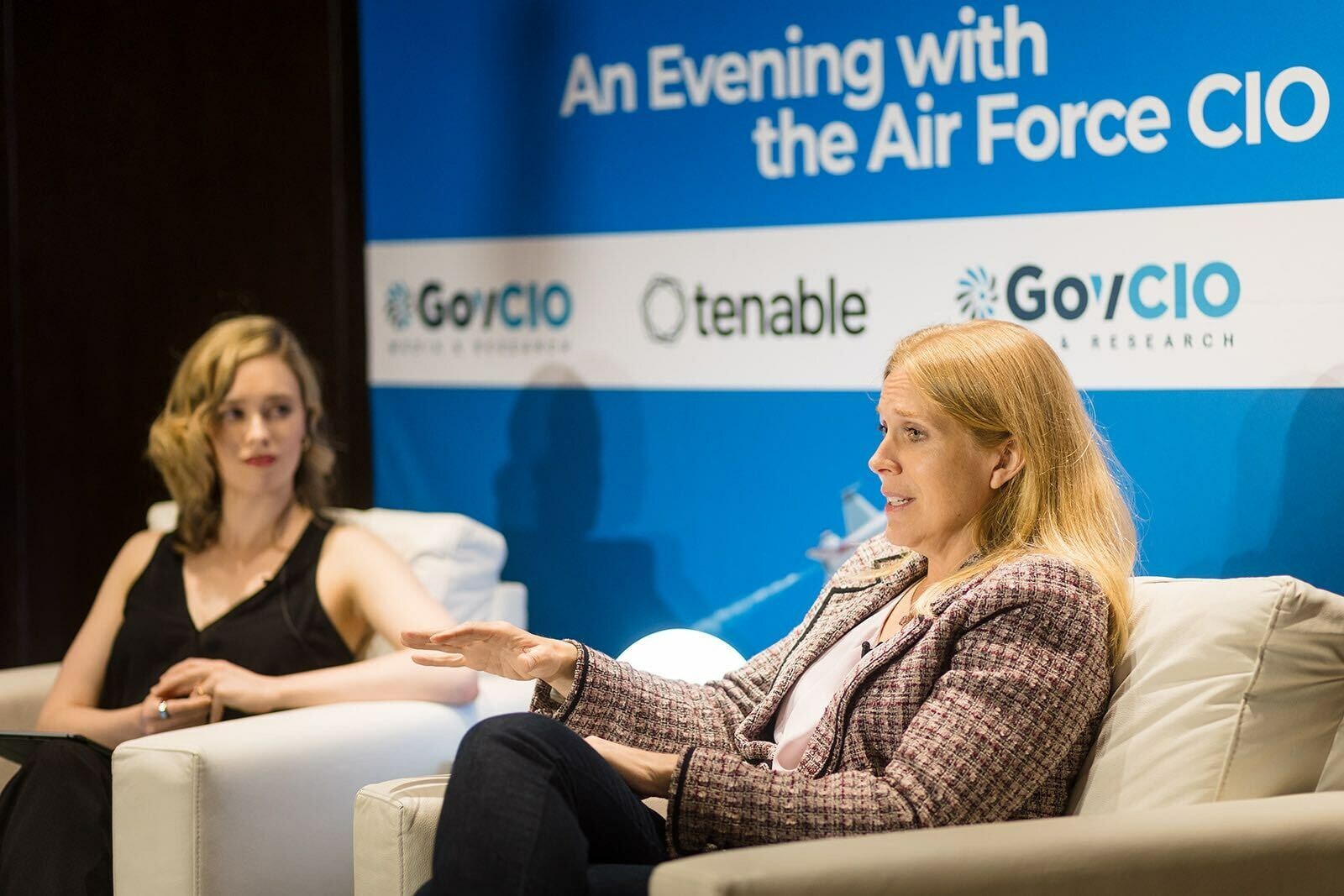
Superheroes, sidekicks and useful mischief
Knausenberger’s language is unusually playful for the federal IT world. She once devised a superhero chart to explain innovation culture. Captain Marvel represented people at the front of the mission. Lucius Fox, the ingenious enabler from Batman, stood for the sidekicks who make heroic work possible. Megamind and Wormtail occupied the less flattering end of the chart: people who may intend to protect the institution but become overly devoted to rules that have stopped making sense.
The chart was funny because everyone in a bureaucracy can quietly assign the roles. It was useful because it made a moral distinction without pretending every blocker was malicious. Most institutional friction is maintained by conscientious people operating inside inherited incentives. Change the incentives, give them evidence, and yesterday’s gatekeeper may become tomorrow’s accomplice.
Her collaborators described a leader with a can-do attitude and an appetite for directness. She collected two Exceptional Civilian Service medals and more than 20 technology leadership awards during her Air Force service, along with the 2023 Global ORBIE CIO of the Year award. Yet when she left government in June 2023, her own accounting focused elsewhere.
“My team is my legacy. The plan we put in place is my legacy.”At the close of her Air Force tenure, 2023
A team is a difficult monument to photograph. It can also keep working after the plaque has been ordered. Knausenberger joined SAIC in October 2023 as Executive Vice President and Chief Innovation Officer, leading innovation strategy, AI-enabled transformation, rapid capability development, technology partnerships and the company’s venture activity. In 2024 she joined the board of EnerSys, serving on its audit and technology advisory committees.
The unicorn in the air gap
In September 2026, Knausenberger became Chief Business Officer of Defense Unicorns. The company builds open-source tools and commercial software for delivering and sustaining applications across cloud, on-premises and tactical-edge environments, including networks disconnected from the public internet. Her remit includes growth strategy and partnerships. The larger assignment sounds familiar: connect technical capability to operational need before time turns one into an anecdote about the other.
She has framed the objective as making software a deterrent to war. The phrase becomes concrete at the edge. A deployed system may need a security patch, an AI model or a new mission application where bandwidth is unreliable and the ordinary comforts of a cloud connection do not exist. A secure supply chain must survive the trip. Updates must carry their ingredients list, controls and evidence with them.
Knausenberger says she has already seen the company’s software save lives, money and “soul sucking time.” The last item sounds small beside the first two, but it belongs in the same sentence. Time lost to preventable friction is capacity withheld from a mission. She wants to scale the recovery of it.
Her career has now crossed the intelligence community, a consultancy, venture investing, military bureaucracy, a large integrator, a public-company board and a defense software company. The titles vary. The argument underneath them has remained remarkably steady. Modern missions depend on software. Secure software depends on evidence. Evidence can be automated. People should spend their judgment on the parts a machine cannot settle.
Asked in 2024 what advice she would offer her younger self, Knausenberger dispensed with frameworks entirely: “Just be you. It’s going to be OK.” It is a small sentence from someone accustomed to very large systems. Perhaps that is why it lands. Somewhere between the cryptography internship and the $17 billion portfolio, between Captain Marvel and continuous authorization, she retained an instinct for reducing a problem until a person can act on it. Sometimes the reduction fits on a bar napkin.