The aircraft cost billions. The maintenance workflow involved an heroic amount of Microsoft Excel. Robert Slaughter, then an Air Force physicist attached to a maintenance unit during an early forward deployment of the F-22, could not reconcile those two facts. The jet embodied decades of advanced engineering; the people keeping it available were still wrestling information through spreadsheets. So he led an experiment: use artificial intelligence to predict when parts would need attention, replace them before a failure grounded the aircraft, and give maintainers a clearer view of what was coming.
The analysis worked. Within months, the project showed that aircraft availability could improve. Then came the less photogenic problem. A year later, the model still could not reach an operational software system. Access to the necessary data remained difficult. The clever part had succeeded; the useful part had not arrived.
That delay became the hinge in Slaughter's career. He had entered the Air Force through physics, with early interests in particles and advanced propulsion. He would leave it 13 years later preoccupied by something more ordinary and, in its way, more stubborn: delivery. What good is a model, an application or an update if the operator cannot put it to work?
A physicist meets the delivery problem
Slaughter's academic route was not a disguised business-school plan. He studied space physics at Embry-Riddle Aeronautical University, commissioned through ROTC in 2008, and continued at the Air Force Institute of Technology. His 2010 master's thesis concerned positron annihilation spectroscopy and the behavior of positronium around nanoparticles. He later completed doctoral work in engineering physics that reached into computer vision. This is a long way from venture rounds, container registries and brand mascots.
Yet software kept appearing inside his assignments. Engineers in the Air Force belong to the acquisition world, an arrangement that often trains technically capable people to advise programs on buying rather than building. Slaughter kept moving toward the building. He worked as a computer vision scientist, led DevOps for space vehicles and the National Space Defense Center, and pursued predictive maintenance. The recurring lesson was that a prototype could be intelligent and still be institutionally immobile.
One problem, seen from four altitudes
In 2018 and 2019, he created Space CAMP, a software incubator meant to put space operators close to developers and shorten the distance from need to working tool. One public workshop paired rapid software practice with what the Air Force called “intrapreneurship” - the unmilitary art of selling an idea inside a military organization. The work acknowledged a truth every reformer eventually meets: code moves quickly; permission, budgets and habits do not.
Platform One, then the open door
The next answer was Platform One, the Department of Defense DevSecOps platform team that Slaughter co-founded and directed. Its purpose was to make secure software development less of a bespoke ordeal for every program. Instead of each team rebuilding its pipeline, security controls and deployment machinery, the platform offered reusable foundations. Security could enter early and continuously rather than arrive as a ceremonial gate at the end.
This was not only a tooling exercise. Slaughter's own formula for digital change begins with people, grows into culture, moves through process and reaches technology last. Coming from a physicist, placing technology fourth is almost comic. Coming from someone who watched a successful algorithm wait for a place to run, it is practical.
Platform One also gave him a close look at the limits of reform from inside. In 2021, after roughly 13 years on active duty, he left the Air Force and started Defense Unicorns with Jeff McCoy and Andrew Greene. The three had worked in the same broad defense-software ecosystem. They believed the peculiar environments nearest military operations had been treated as an afterthought by the commercial software world.
An air-gapped system is isolated, wholly or partly, from ordinary networks. That isolation may be necessary for security and still create a delivery headache. A phone updates while its owner sleeps. A submarine, aircraft or field system cannot assume a friendly connection, a familiar cloud or even consistent hardware. Software arrives with dependencies, configuration, security evidence and an appetite for change. The package must know how to travel.
Defense Unicorns built around that journey. Zarf packages software for disconnected environments. Pepr helps enforce policies in Kubernetes. The broader Unicorn Delivery Service, or UDS, provides a portable foundation across cloud, on-premises, classified and tactical-edge systems. Slaughter has described it as an operating system for military systems: a layer that makes the software above easier to run and update. The company sells products and support, while maintaining a visible commitment to open-source tools and infrastructure independence.
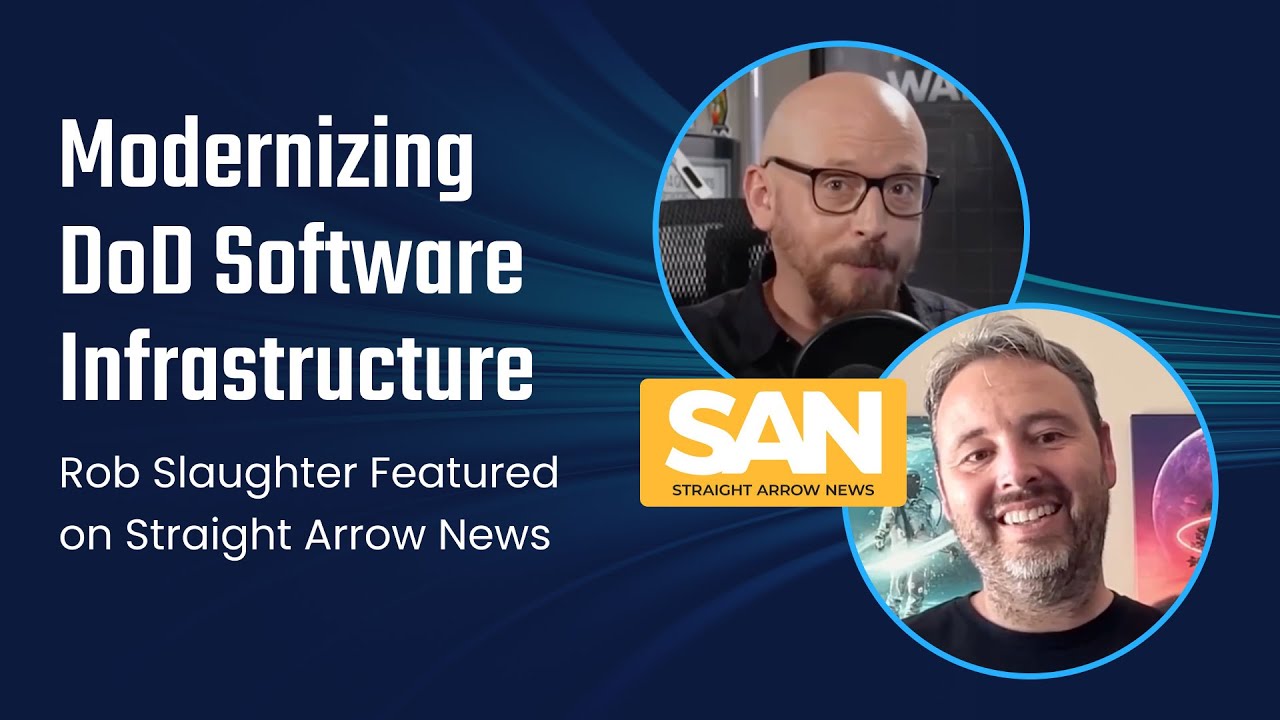
The unicorn is part of the architecture
A company that works on military software might reasonably choose a logo resembling a shield, a spear or an expensive black polygon. Defense Unicorns chose Doug, a cartoon unicorn. Slaughter's explanation is cultural and mildly mischievous. While competitors were styling themselves after the grim visual language of a military video game, his team wanted something closer to Fortnite. Their customers did not require another dark emblem to understand that war is serious.
The lightness is not incidental. Slaughter calls himself the Culture Executive Officer. He has publicly celebrated a promotion to “official Unicorn Uber driver.” His social profiles often put the unicorn directly into his name. This could be dismissed as startup whimsy, except that it serves a harder organizational idea: people doing consequential work do not have to perform misery to prove commitment.
It also makes the company difficult to confuse with anyone else. In defense technology, where brand language can become a parade of steel nouns, rainbows are a competitive instrument. The joke acquired a second meaning in January 2026, when Defense Unicorns raised $136 million in a Series B led by Bain Capital Tech Opportunities and crossed a valuation of $1 billion. The animal on the logo became an accounting category.
By then, the company said its technology supported more than 50 military systems and adoption had risen 300 percent year over year. The Navy's Columbia-class submarine program had become a major customer; the Air Force, Army and Space Force also used the company's work. Slaughter's public ambition grew with the footprint. He argues that operators should be able to choose the software they take into a mission and update it on demand, whether it sits in a cloud region, on a vehicle or somewhere connectivity is an unreliable luxury.
The right to update
“Software as a weapon system” can sound like an attempt to make a deployment pipeline more exciting at dinner. Slaughter means something precise. Modern hardware depends on code. Sensors, aircraft, ships, autonomous systems and command tools gain or lose capability through software. If one side can absorb a new model, repair a vulnerability or adapt an application in days while the other waits years, update speed becomes operational speed.
This explains his attachment to open source. He has argued that Linux won the server, Kubernetes won the cloud and open models will win artificial intelligence. In his version of defense software, openness is not a charitable accessory. It is a hedge against vendor lock-in, a route to scrutiny, and a way for different programs to build on common machinery. The commercial challenge is to earn money from the value around open tools without withdrawing the freedom that made them useful.
It also explains why he talks about creating many more defense unicorns. He does not present national security as a market that should settle around a tiny club. He wants hundreds or thousands of companies attacking different parts of the problem. That aspiration is convenient for a founder in a growing sector, certainly. It is also consistent with his insistence that the operator should retain choice.
The unanswered questions are now questions of scale. Can an open architecture remain open as contracts, investors and product lines multiply? Can a company preserve its oddball culture while moving deeper into programs governed by caution? Can software built for portability negotiate every old machine and approval regime it meets? A billion-dollar valuation does not solve those problems. It purchases the obligation to keep solving them.
Slaughter's career has moved from particles to platforms, but its defining image remains simple: a sophisticated aircraft, a spreadsheet, and a useful idea stranded nearby. Defense Unicorns is his attempt to close that final distance. The update button may be metaphorical. The wait has always been real.