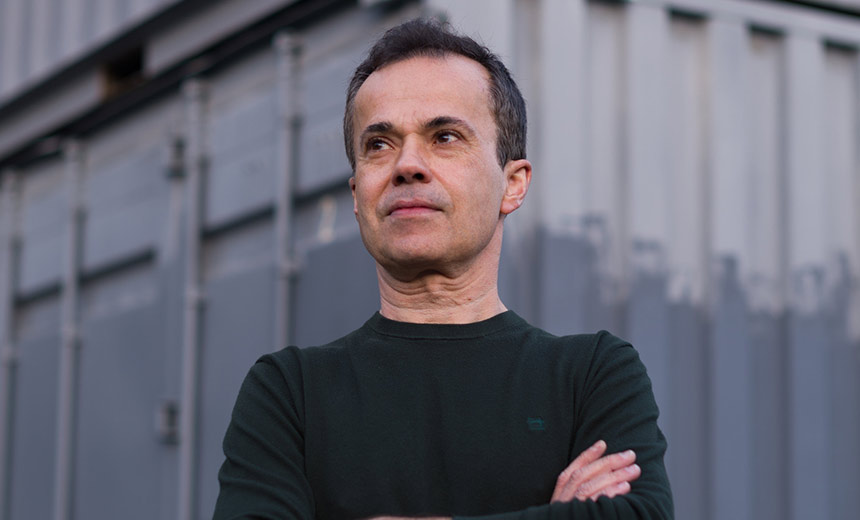
Mehran Farimani runs a company built on a counterintuitive premise: most of your software's vulnerabilities live in code that never runs. Not edge-case bugs, not logic errors - just packages sitting in containers, unused, waiting to become someone else's attack vector. His job is to find them and strip them out before they do. At RapidFort, that idea has turned into a $42 million Series A, 100+ enterprise customers, and a new category he coined himself: Software Attack Surface Management.
But start anywhere else in his career and the logic breaks down. Farimani is a University of Waterloo mathematician turned digital-imaging executive turned computer vision founder turned cybersecurity CEO. Each chapter built on the last, even when the industries looked unrelated. The through-line is automated decision-making at scale - whether that meant printing digital presses more accurately, teaching machines to describe people in retail stores, or hardening millions of container images without touching a single line of application code.
The EFI Years: Learning to Run a Business Unit
Before anyone was talking about software supply chains, Farimani spent years at Electronics for Imaging (EFI) running the Fiery Division as Senior Vice President and General Manager. The Fiery controller became the standard interface between digital design and professional printing - ubiquitous in print shops, advertising agencies, and corporate print rooms across the world. Running it meant managing a product that had to be both technically precise and commercially viable at the same time. Farimani learned what enterprise scale actually looks like from the inside, not from a pitch deck.
AI has accelerated software delivery and attacker capability at the same time. The window between disclosure and exploitation has collapsed.
Mehran Farimani, CEO, RapidFortPercipo: The Computer Vision Bet That Paid Off
He left EFI to found Percipo, an AI company that set its sights on a problem retail had been fumbling with for years: how do you understand what happens in a physical store? Percipo built what its team described as some of the fastest and most accurate human image description technology on the market, and deployed it across more than 40,000 retail locations globally. The scale is not accidental. Farimani has a habit of building things that need to work at infrastructure scale - not just in demos, not just in controlled environments, but in 40,000 stores simultaneously.
Percipo ran in production long enough that Farimani saw, firsthand, how quickly software debt accumulates in real-world deployments. Cloud infrastructure grows faster than anyone maintains it. Dependencies pile up. Security teams get overwhelmed by the sheer number of alerts. By the time he founded RapidFort in 2020, he had a precise diagnosis of the problem and a strong hypothesis about the fix.
RapidFort: Hardening the Software Supply Chain
The premise at RapidFort is surgical. The platform profiles running containers - watching which components actually execute in production - then strips out everything that doesn't. What's left is a hardened image that's on average 64% smaller and carries 71% fewer vulnerabilities than the original. No code changes. No manual patching sprint. Just subtraction applied with machine precision.
Farimani launched Community Images as a free public offering: pre-hardened containers for the 60+ most popular open-source workloads, available without payment or registration. A million developers downloaded them without a single paid acquisition campaign. That's not marketing - that's product-market fit announcing itself organically. When 15,000 curated near-zero CVE images followed, the trajectory became clear: RapidFort was building trust at community scale before asking enterprises to write checks.
Deploying code into production presents inherent risks as the majority of software is built using trusted open-source components.
Mehran Farimani, Co-Founder & CEO, RapidFortThe Attack Surface Insight
The category name Farimani coined - Software Attack Surface Management - is not marketing language. It's a technical claim: the surface area of a piece of software that can be attacked is not fixed. It can be reduced, continuously and automatically, by removing what doesn't execute. Gartner picked it up. Enterprise security teams started budgeting for it. The 2025 CyberShark Pitch Competition recognized it. And in February 2026, Blue Cloud Ventures and Forgepoint Capital led a $42 million Series A to accelerate where that category goes next.
The timing is not incidental. As AI-generated code floods production systems, the gap between what ships and what has been audited is widening. Farimani has been direct about this: the window between vulnerability disclosure and active exploitation has collapsed. Organizations need solutions that operate at the same velocity as the threats they face. That's what RapidFort is building - not a scanner that tells you what's wrong, but a system that removes what shouldn't be there before it becomes someone's problem.
Leadership Philosophy: Disciplined Experimentation
Farimani's approach to leadership pulls from his engineering background more than from any business-school playbook. He runs on disciplined experimentation - test the hypothesis, measure the result, eliminate what doesn't work. Transparency is not a values statement at RapidFort; it's the operational model. And he delegates early, building a team of co-founders and executives who each bring domain expertise he specifically doesn't have: Rajeev Thakur (CTO) from Palo Alto Networks and the DevOps world, Russ Andersson (COO) with prior startup exits, George Manuelian (CRO) from AWS and Cisco. He knows what he knows. More importantly, he knows what he doesn't.
At 25+ years into a technology career that has spanned digital imaging, retail AI, and enterprise cybersecurity, Farimani has earned the right to be specific. He doesn't talk about disruption. He talks about removing 60-90% of unused packages from containers and what that does to a security team's Monday morning. That specificity - and the organic adoption it generates - is what $42 million in Series A capital is now betting on.