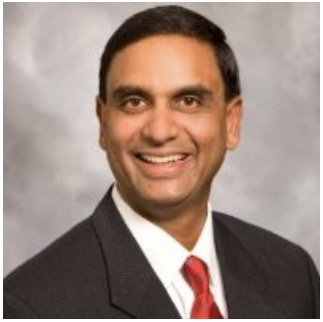
The Container Whisperer Running a Global Security Layer
Somewhere in your bank's cloud infrastructure, your hospital's patient records system, or the platform that streams your entertainment - there is software from Tigera running quietly, enforcing rules nobody ever has to think about. That's by design. And Ratan Tipirneni has spent the better part of a decade making sure it stays that way.
Tipirneni joined Tigera in August 2017, stepping in as President and CEO following founder Andy Randall. He inherited something that companies rarely get handed: a genuinely useful open-source project with real production traction. Project Calico was already shipping in serious environments. The question wasn't whether the technology worked. It was whether someone could build a company around it.
Being an entrepreneur, you have to be slightly insane to be an entrepreneur.
- Ratan TipirneniHe had the right kind of insanity. Before Tigera, Tipirneni had built software businesses from the ground up twice - IPTouch and PersonalMD.com, both SaaS companies before SaaS was a word anyone used in a pitch deck. He'd run a cloud business at Actifio. And he'd done the hardest version of startup work inside Cisco's bureaucracy: incubating a SaaS business unit from zero, then growing it to $200 million in annual recurring revenue in six years. That's the kind of track record that makes a board hand you the keys.
What drew him to Tigera specifically? The combination of a visionary founding team, strong early customer adoption in production environments, and a culture that valued excellence and openness. He describes himself as "a bit of a geek at heart" - and Calico, with its deep roots in eBPF and kernel-level networking, was the kind of technically rich problem that appealed to that instinct.
When Free Is the Product and the Strategy
The Tigera story starts not with a product launch, but with a GitHub repository. Project Calico - an open-source container networking and security project - was already widely adopted before Tigera built a commercial offering around it. In the Madrona interview, Tipirneni was direct about how to think about this dynamic:
"The best way to get started is to get out of the starting gate, build something, put it out there, and get some conversations going with the community."
But he's equally direct about the trap most open-source companies fall into. You can over-index on free. You can build a beloved project and a starving company simultaneously, and never figure out the bridge between them. Tipirneni talks about managing two separate inflection points: "project-market fit" for the open-source community and "product-market fit" for commercial customers. They require different motions, different metrics, and different teams running in parallel.
His metric for gauging real open-source traction? Not GitHub stars. Not conference buzz. "Signs of daily usage of your software are probably one of the best metrics and most objective metrics you can get." The number that actually matters is whether engineers come back tomorrow.
"If I were starting today, I'd switch directly to a SaaS model because it gives you so many levers and better ability to experiment rapidly."
Calico today runs in more places than Tigera can fully track. The commercial products - Calico Cloud and Calico Enterprise - sit on top of that foundation and offer the advanced security, observability, and compliance capabilities that Fortune 100 companies need but that the open-source version doesn't provide. Tipirneni's playbook: build trust with the community, convert trust into a sales pipeline, don't let free eat the business.
Prevent, Don't Just Detect
Most security vendors sell you an alarm system. Tigera sells you the ability to lock the doors before anyone tries them - and to slam them shut if something does get through. The distinction matters in a world where "detection and response" has become a euphemism for "we'll tell you after you've been compromised."
Tipirneni talks about microsegmentation the way a surgeon talks about limiting a wound: you want to be able to "limit the blast radius." If an attacker gets into one container, the damage should stop there. The network policy layer that Calico provides makes that possible at Kubernetes scale - across clouds, across distributions, across hundreds of nodes.
You want to be able to microsegment your workloads so that if you do come under an attack, you can actually limit the blast radius.
- Ratan TipirneniHe sees zero trust not as a marketing term but as an architectural commitment. Where competing solutions focus on detecting threats after the fact and raising alerts, Tigera's platform is designed to actively prevent lateral movement, enforce compliance, and terminate suspicious workloads before they cause damage.
The philosophy also extends to how he thinks about the relationship between developers and security teams. Most enterprises treat these as opposing forces. Tipirneni's view: "Developers and security teams are working toward the same goal: meeting business goals and maintaining development and deployment speed while prioritizing security." The friction isn't philosophical - it's tooling. Give both sides better tools and the conflict evaporates.
Securing What Nobody Can Predict
The AI agent problem is, in Tipirneni's framing, the hardest version of the container security problem. With containers, you at least know roughly what software will run and what it will try to do. With AI agents, the whole point is that you don't know in advance.
Agents are autonomous and non-deterministic. You cannot predict which agents are going to talk to other agents or what actions they will take. This presents a complex problem for security, monitoring, and observability.
- Ratan TipirneniTigera's response to this problem is the same as its response to every complex security problem: deep visibility first, then enforcement. Before you can enforce policy on AI agents, you need to see exactly what they're doing - which services they're calling, which data they're touching, which other agents they're communicating with. That observability foundation is precisely what Calico was built to provide.
Meanwhile, Tipirneni has been turning AI back on the product itself. Calico AI, launched in 2024, is a conversational interface that lets engineers interact with their Kubernetes security posture without needing deep expertise in network policy syntax. As he put it: "a great mechanism to help them understand some of the nuances and intricacies of how to troubleshoot these things without having to get a PhD in networking."
"Our solution is rich, but it can also be very comprehensive and a little intimidating to use. We figured out a mechanism using AI to simplify the user experience, allowing users to chat with the solution and unlock more value."
He's also experimenting internally - building agents for marketing, engineering, and operations. "We are seeing an explosion of ideas," he says. For Tipirneni, the AI moment isn't a threat to Tigera's business model. It's the next chapter of it. Kubernetes was the platform for containers. Now Kubernetes is becoming the platform for AI workloads. And Tigera has been building for that world for years.
What Ratan Tipirneni Says Out Loud
"Signs of daily usage of your software are probably one of the best metrics and most objective metrics you can get."
"With every start-up you have to be insanely focused on finding a product-market fit."
"They would rather go self-serve, educate themselves on the product, and enjoy the process of getting to know new tools."
"Calico AI is a great mechanism to help them understand the nuances without having to get a PhD in networking."
"We should lean in and do this. We are experimenting internally by building agents to automate functions from marketing to engineering."
"Many of our customers really want a single vendor to manage all the solutions so they are not dealing with multiple vendors."
Three Decades of Building Software That Scales
Tipirneni's education covers the full stack of what you need to build technology companies: a BS in Electrical Engineering from Osmania University in India, an MS in Computer Science from Louisiana State University, and an MBA from Santa Clara University - right in the heart of Silicon Valley. He started at Sun Microsystems in 1994, the same year Linux 1.0 was released. He has watched the entire arc of open-source software go from curiosity to infrastructure.
What He Has Actually Built
- Grew Cisco's SaaS business unit from $0 to $200M annual recurring revenue in six years
- Founded two SaaS companies (IPTouch and PersonalMD.com) - in the era before SaaS was a recognized category
- Scaled Project Calico to power 100M+ containers across 8M+ nodes in 166 countries
- Led Tigera through $53M in total funding including $30M Series B
- Built Tigera to $35M+ annual revenue with 130 employees across San Jose and distributed teams
- Secured Forbes America's Best Startup Employers recognition for Tigera's culture
- Established Calico as the de facto open-source standard for Kubernetes networking and security
- Positioned Tigera as the pioneer in the $7.3B cloud-native application security market growing toward $19.3B by 2027
The Full-Stack Curriculum
Fun Facts
- Tigera's software runs in 166 countries - more countries than are members of the United Nations Security Council combined
- He started his career at Sun Microsystems in 1994, the same year Linux 1.0 was released - he's been watching open-source transform infrastructure for three decades
- Holds three degrees spanning electrical engineering, computer science, and business - literally covering hardware, software, and money
- Founded companies in healthcare SaaS and networking before landing in Kubernetes security - the breadth explains his ability to talk to both engineers and enterprise buyers
- Tigera's Calico is one of the most widely deployed open-source projects you've never heard of - but the infrastructure running your financial services, healthcare platforms, and media streaming almost certainly depends on it
- The name "Calico" evokes the complex, distributed pattern of a calico cat - fitting for software that manages equally complex, distributed network topologies