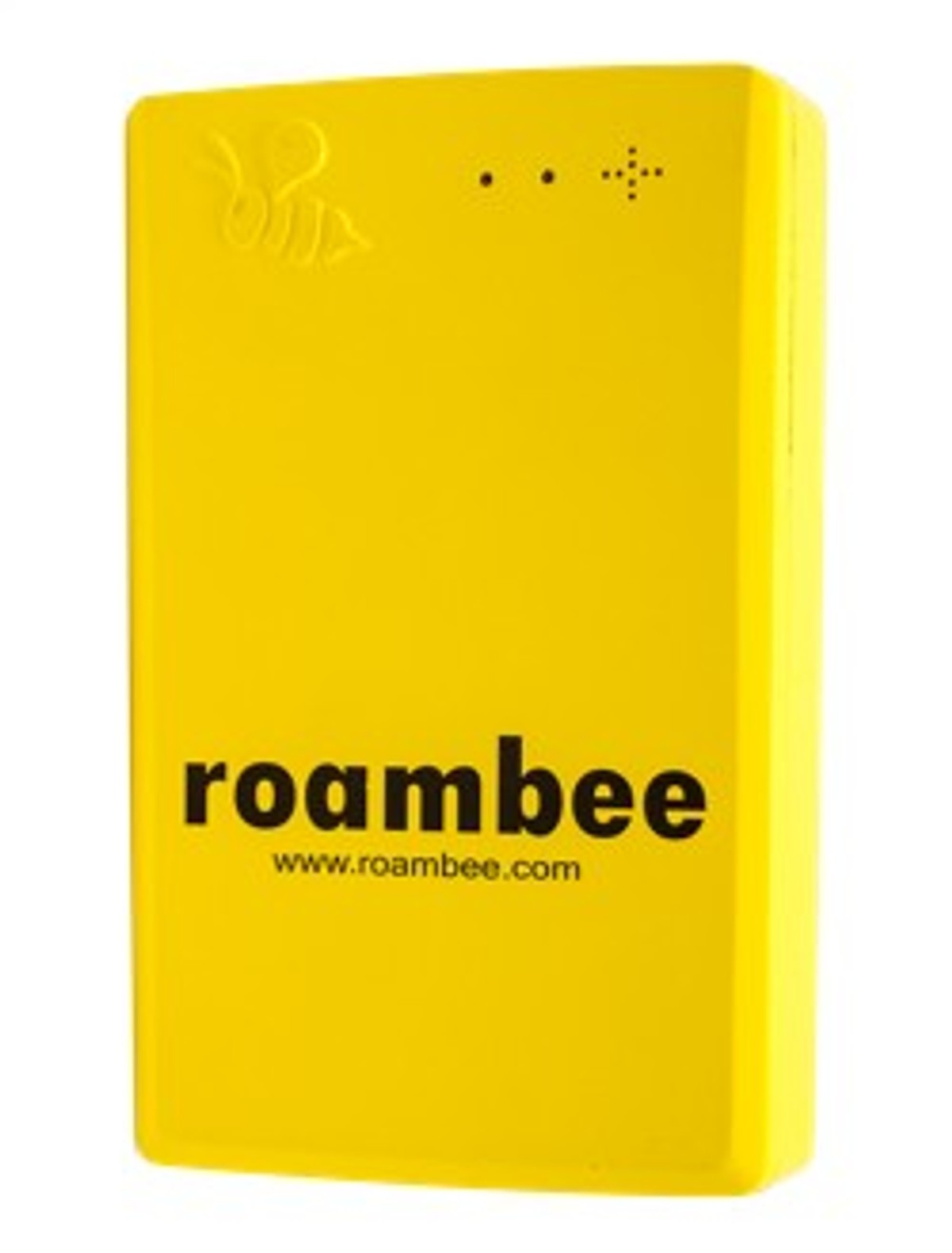
The most revealing object in Roambee’s history is a yellow plastic box. It is not glamorous. It does not resemble the future. It resembles something a careful traveler might pack around a bar of soap. But place this “Bee” beside a pallet of medicine or inside a container of groceries and the dumb cargo begins to speak: here I am; this is my temperature; someone opened the door; I have stopped where I should not have stopped.
That was the original wager made in Santa Clara by Sanjay Sharma and Vidya Subramanian. Sharma had already helped build an RFID company that made assets visible inside buildings. After that business was acquired, he noticed the absurdity just beyond the loading bay. Enterprises could count what sat within four walls, yet goods crossing oceans and borders were frequently represented by delayed calls, borrowed carrier data and cheerful estimates. The truck might be visible. The shipment was another matter.
- What it did: bundled connected sensors, cloud software, APIs and operations support to track cargo and reusable assets directly.
- What it cost: custom pricing; historically pay per shipment or asset, with devices and connectivity included and no upfront sensor purchase.
- What changed: customers needed a response to an exception, not another dashboard describing it.
- What to copy: own the critical data, sell a narrow outcome, then build the workflow around the next expensive decision.
The small rebellion on the loading dock
Roambee was founded in 2013 with a literal-minded distinction: track the thing, not merely the vehicle carrying it. Its devices measured location and, depending on the model, temperature, humidity, shock, light or tampering. Its Honeycomb platform mixed those readings with carrier feeds and enterprise systems. BeeCentral added people - a 24-hour control tower able to watch exceptions and coordinate intervention.
The arrangement looked less tidy than conventional software. Roambee designed hardware, wrote software, assembled analytics and ran a service operation. Industry advisers told the founders to choose one thing. The company’s reply was a culture it called “responsible rebels,” which is corporate language with at least a useful confession inside it: a reliable signal depended on all the messy layers working together.
Telecommunications partners gave the contraption reach. Deutsche Telekom invested and paired Roambee with T-Systems’ networks and cloud infrastructure in 2017. T-Mobile later sold BeeAware on its US narrowband-IoT network. The economic pitch was equally important: a customer could pay by shipment or asset instead of buying a private colony of sensors. Public plan material bundled devices, cellular data, apps, APIs, onboarding and support. Prices today are negotiated rather than posted. Anyone promising you a neat monthly figure is decorating the unknown.
“The days where a simple dot on the map… was defined as supply chain visibility is over.”Sanjay Sharma, after Roambee’s 2021 funding
Then the world stopped moving
COVID-19 supplied the ugliest stress test. Sharma has said the company entered the shutdown with little or no cash. Sales cycles did not merely slow; the old notion of an 18-to-24-month startup runway became a luxury. Roambee shifted to a more immediate operating plan. Its team stayed. Then the market moved in the opposite direction: the safe passage of temperature-sensitive medicine became a matter of public consequence.
Roambee monitored the cold chain for an unnamed large US vaccine maker. In March 2021 it announced more than $18 million in Series B1 funding led by Reefknot Investments, following a $15.2 million round in 2020. Two months later it bought Arnekt, an analytics specialist in machine learning, natural-language processing and data science. Hardware had supplied the evidence; capital and acquisition supplied the ambition.
The Tesco test: first-hand facts
The cleanest public demonstration came from Tesco. The retailer had relied on third-party data to follow containers through terminals, roads, rail lines and stores. With solar-powered sensors on its UK container fleet, it gained direct location signals across more than 23,000 journeys, 6.21 million miles and 3,000 locations. Roambee’s platform connected those signals to scheduling data, arrival and departure times, dwell time and estimated arrival.
This is where the difference from a broad transportation-visibility network becomes sharp. Platforms such as project44, FourKites and Shippeo are formidable at combining carrier feeds across many modes. Roambee’s closer sensor-led rivals include Tive, Controlant, Sensitech and Overhaul. If the question is “When will the carrier arrive?”, network data may be enough. If the question is “Did this particular load remain cold, sealed and physically where everyone claims?”, a device traveling with the cargo has an evidentiary charm.
Tesco said it could resolve missing-delivery questions faster, reduce dependence on internal phone calls and improve stock accuracy. The claim is not that a yellow box abolished delay. It replaced hearsay with a signal. In supply chains, that is often the first honest luxury.
The dashboard admits defeat
By 2025, the company had accumulated a decade of movement and condition data. Its leaders also spoke with more than 50 supply-chain executives across four continents. The message, according to Sharma, had changed. Buyers no longer wanted simply to know that a shipment would be late. They wanted the system to judge the risk, choose the next move, alert the right person, write back to the enterprise system and preserve the reasoning for audit.
On September 10, 2025, Roambee became Decklar, a name stitched from “Decision Clarity.” The rename was awkward in the way consequential changes often are: the bee was memorable, but the business no longer wished to be mistaken for a box of trackers. Its new pitch was a real-time “system of action.” RADAR, launched that November, became the most explicit expression of it - a control tower meant to close the loop rather than create a longer queue of alerts.
The current menu ranges from dynamic replenishment and detention reduction to automatic quality release, security-risk anticipation, revenue forecasting, goods receipt and reusable-asset performance. The firm says its knowledge graph contains more than one billion historical logistics events, while 12 million live signals arrive daily. Those are company-reported figures, but they explain the strategic logic: the old sensor business was quietly constructing the training ground for the new decision business.
The price of knowing - and the price of pretending
This model is not a universal remedy. Cheap, low-risk goods on predictable lanes may not justify a sensor. Poor cellular or satellite coverage can turn real time into eventually. A temperature alert is useless if nobody has authority to intervene. Automated decisions are dangerous where policies are vague, source data is contradictory or the cost of a false action exceeds the cost of waiting. And companies unwilling to connect ERP, TMS and warehouse systems will receive an unusually accurate island.
The most portable lesson is not “add AI.” It is more prosaic. Begin with the expensive uncertainty. Collect evidence at its source. Remove the capital obstacle to a pilot. Prove value on one lane and one exception. Only then automate the decision - with escalation rules and a record of why the machine acted. Roambee’s long route to Decklar works best where the clock is short, the cargo is valuable and someone can still change the ending.
Twelve years in six stops
The cargo gets a voice. Roambee is founded to monitor goods and assets beyond the warehouse walls.
The network arrives. Deutsche Telekom invests and T-Systems helps take the service global.
Tracking goes narrowband. T-Mobile launches BeeAware nationally on its US NB-IoT network.
Cold chain meets capital. Vaccine monitoring, an $18M+ round and the Arnekt acquisition accelerate analytics.
Tesco scales the proof. More than 23,000 container journeys turn first-hand visibility into an operating tool.
The bee becomes Decklar. The company trades a tracking identity for a bet on autonomous decisions.
At the end of 2025, Decklar reported 48 percent year-over-year revenue growth, three adjusted-EBITDA-positive quarters and cash-neutral operations. Company-reported, yes; also a cleaner ending than the pandemic moment when the runway vanished. Yet the better conclusion belongs to the yellow box. It made invisible cargo visible. Then it made visibility feel insufficient. A product has done something useful when it solves a problem. It has done something rarer when it reveals the next one.