A trailer without power is a remarkably good place to hide from the digital economy. So is a tank, a pump, a cable reel, a generator or any of the other blunt, indispensable objects that spend their working lives beyond Wi-Fi and polite office temperatures. They move. They wait. They earn money. Occasionally they vanish. For years, the connected enterprise lavished attention on the truck and driver while much of the equipment behind them remained stubbornly anonymous.
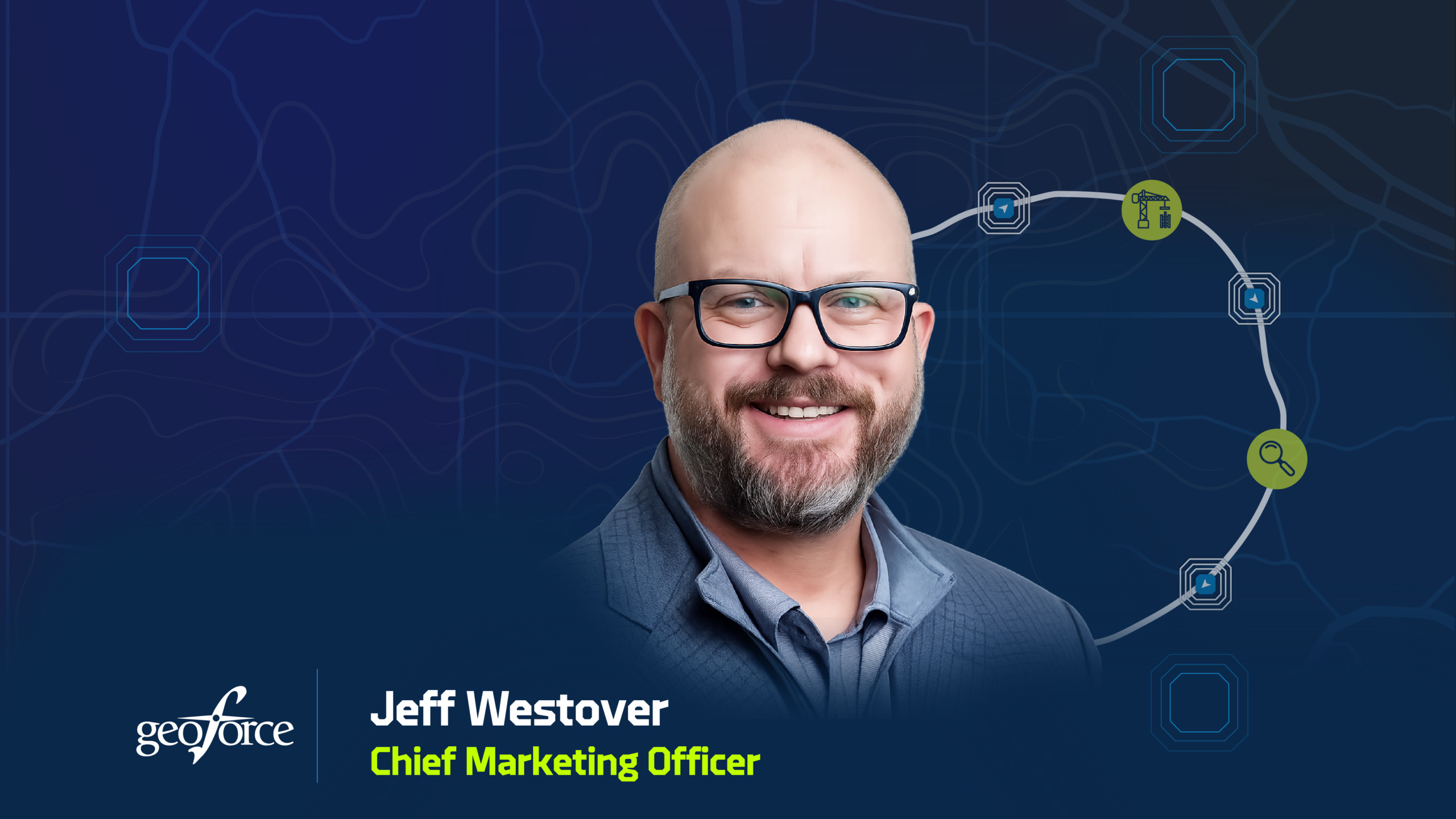
Jeff Westover has made a career of translating technology into a commercial reason to care. In March 2026, he became chief marketing officer at Geoforce, the Plano-based company that puts rugged GPS devices on industrial assets and turns their movement into usable data. His appointment added another stop to a long route through Microsoft, Siebel Systems, HP, OpenText, Omnitracs, InMoment, Hyperscience and Rand McNally. It also handed him a marketing problem with excellent bones: How do you explain the value of finally seeing what a business has learned to operate without seeing?
Westover's answer begins with a category. He talks about asset-centric intelligence and Field Asset Intelligence, language meant to pull the conversation beyond dots on a map. A dot says where the equipment is. A working system can say whether it moved, how it is being used, when it may need attention and whether the organization owns more idle machinery than it needs. Location is the opening sentence, not the whole book.
A career spent between the promise and the purchase order
The durable thread in Westover's resume is neither marketing nor sales alone. It is the awkward seam between them. Geoforce describes him as someone who aligns brand, demand generation, product and sales, then builds the teams and systems required to make the arrangement hold. James MacLean III, the company's founder and chief executive, praised his combination of strategic marketing leadership and a deep revenue orientation. The compliment is more revealing than the usual executive-arrival confetti. Westover is a marketer whose work has repeatedly moved close to the cash register.
His preparation started at the University of Puget Sound, where he studied business administration, marketing and communication from 1988 to 1992. He was a Trustee Scholar, led the campus chapter of the American Marketing Association and won a Microsoft co-op internship. The young marketer arrived at precisely the moment software was escaping the specialist's desk and becoming a fact of ordinary working life.
Leadership roles at Microsoft and Siebel Systems were followed by HP and the contact-center software business that moved through Autonomy and later OpenText. The products changed, but the assignment remained recognizable: complicated systems needed a clear place in a customer's operations. From 2018, Omnitracs brought that work onto the road. Westover held responsibilities across sales, channels, small business and marketing, including a period as chief marketing officer. Fleet software has no patience for decorative strategy. A route either improves, a driver either gets home safely, or the customer soon develops an allergy to the slide deck.
Westover's commercial route
Three decades moving from enterprise software toward the untidy physical edge of technology.
InMoment, where he served as senior vice president of experience and transformation, widened the lens from software capability to what customers actually encounter. Hyperscience placed him inside the enterprise AI rush as senior vice president of growth. Then, in 2024, he returned to transportation as Rand McNally's global sales and marketing leader and chief revenue officer.
That move carried an unusually personal bit of brand memory. Westover wrote that, as a child, he connected Rand McNally with adventure and road trips. The old atlas maker was building a newer business in fleet navigation, tracking and safety. He saw the trust stored in the name as something to extend rather than polish and admire. In his announcement, he thanked former colleagues and the executives who connected him to the role, calling his departure from Hyperscience bittersweet. For an operator in the habit of discussing growth engines, he is notably specific about the people who hand him the keys.
The small device and the larger argument
Geoforce presented Westover with the physical proof for his category thesis. Its devices are built for non-powered equipment in oil and gas, construction, rail, utilities, logistics, mining and defense. This is hardware expected to tolerate vibration, extreme temperatures, hazardous sites and long stretches without a wall socket. In May 2026 the company launched the GT1c, an intrinsically safe cellular tracker built for up to ten years of battery life and priced to reach smaller and mid-tier assets.
The revealing figure came from a pilot with Black Diamond Equipment Rental. The company expanded its tracked inventory by 26 percent and expected to save more than 500 hours of operational time a year. Those numbers let Westover move the pitch from gadget to economics. A tracker becomes interesting when it changes what is worth tracking. Once the cost falls enough, the neglected middle of the equipment yard can acquire a history.
Westover sees another advantage in the data itself. Generative AI makes algorithms abundant, he argues, which increases the relative value of information that is difficult to collect. A software interface can be imitated. Years of reliable location, movement and utilization signals from machines working in remote or hazardous environments are less obliging. Geoforce says its broader system processes billions of device readings annually. The marketing opportunity is to connect that technical accumulation to the practical decisions hiding inside it.
His first months at Geoforce were busy in the telling. The company launched the GT1c with AT&T Business, appointed a global partnerships director, expanded a program for resellers, integrators, manufacturers and connectivity providers, and continued building its leadership team. In July, Geoforce's AssetLink Global subsidiary received an ordering vehicle under a $72 million US Army NGT-II contract for global in-transit asset visibility. Westover publicly called that work a point of pride. The assets here are not theoretical inventory. In the right setting, knowing where equipment is can shape logistics under pressure.
The human being beside the sensor
Westover's clearest writing is often about the moment technology collides with a person's sense of dignity. In a 2026 article on driver-facing cameras, he begins with the resistance: drivers worry they are being watched, rumors spread and veteran operators question management's real motive. His counsel is direct. Explain what triggers a recording. Say who can see it. Define how long it remains. Show how the footage can defend a driver as well as correct one.
He calls the exercise a trust rollout. It is a neat phrase because it refuses the fantasy that installing equipment equals adoption. A lens may be a sensor; to the person sitting in front of it, it may also feel like a verdict. Westover's advice is to deal with both realities at once. The instinct echoes the colleague testimonials on his public profile. Former teammates describe someone analytical and creative who still makes time for one-to-one conversations, invites other perspectives and cares about setting people up to succeed.
His life outside the executive suite supplies smaller evidence of the same instinct. Westover and his wife, Tricia, live in Dallas and have four children. His public volunteer record includes nearly two decades at Trinity Christian Academy and ongoing service at Watermark Community Church. The church roles range from camera production to something he cheerfully calls the “parking posse.” A title that combines logistics, hospitality and a mild Western comedy is perhaps irresistible to a fleet executive.
Three of the Westover children completed undergraduate degrees at Texas A&M; the fourth was headed to Auburn when Geoforce published his biography. The family details matter because his career announcements make room for them. The week he started at Rand McNally, he posted with equal delight about his daughter's graduation from Texas A&M. Corporate life loves a grand beginning. Westover noticed two.
Making the field legible
The risk in category-making is that the vocabulary outruns the customer. Westover's career suggests he knows the cure: return to the operator. Does the rental branch spend less time hunting? Can the fleet avoid buying equipment it already owns but cannot find? Does a maintenance manager see utilization before a machine fails? Can a partner combine the device data with the system a customer already uses? A new category earns its capital letters one ordinary decision at a time.
That is the appealing tension in Westover's Geoforce chapter. He speaks in the expansive language of markets, AI and category creation, but the product's truth is stubbornly physical. It is a box bolted to another box. It must wake up, find a network, report honestly and survive weather that would send most marketers indoors. There is wit in that arrangement. The abstract strategy depends on a tracker refusing to die.
For three decades, Westover has worked where technical possibility meets commercial belief. Now the possibility sits on equipment that enterprises have overlooked, and the belief is that visibility can become intelligence. If he succeeds, the industrial world will not merely know where its things are. It will remember where they have been, understand how they work and make fewer expensive guesses about what to do next.