The revealing detail in Christie Marsh's account of CopadoCon Bengaluru is not the size of the crowd or the choreography of a keynote. It is the interval. She remembers the conversations between sessions, the bits that happen after a badge has twisted backward and before the next slide deck appears. For an executive who has spent much of her career in alliances, this makes sense. A stage can send a message to a thousand people. A corridor lets two of them decide to build something together.
Marsh is the chief marketing officer and head of alliances at Copado, the enterprise software company known for Salesforce DevOps and now trying to establish AgentOps as a working category. Her brief includes global marketing, brand, go-to-market strategy and growth. It sounds like a familiar CMO bundle until the last part of her title lands. Alliances remain in the room.
That pairing is the interesting thing. Marsh did not arrive at the CMO chair by treating partnerships as a sideline. She came through them. Her public career stretches from RSA Security and SilverStream Software to Autodesk, Splunk, MuleSoft, Optimizely and BigID. The products changed. The recurring problem did not: complex software needs more than a buyer and seller. It needs implementers, advocates, complementary vendors and people willing to translate one company's promise into another company's daily work.
The long way to the marketing chair
Marsh began in marketing programs at RSA Security in 1997, then moved into field marketing at SilverStream. At Autodesk she worked in channel sales and education marketing. Splunk brought a partnerships program role. MuleSoft added partner marketing and strategic partnerships. By the time she reached Optimizely and BigID, her titles centered on strategic alliances.
Read as a list, the resume is a brisk tour of the enterprise software economy. Read as training, it is more coherent. Security taught the cost of misplaced trust. Channels taught the difference between distributing a product and creating demand for it. Integration platforms made the ecosystem visible: software becomes useful when it can cooperate with the rest of the stack. Experimentation and data privacy added their own languages, constituencies and anxieties.
marketing
channels
partnerships
alliances
CMO
She joined Copado in 2021 as senior director of alliances. A promotion to vice president followed in 2022, then senior vice president in early 2025. In May of that year, she became CMO. The sequence matters because it suggests the marketing role widened around work she was already doing. At Copado, partnership was not the detour to the top job. It was the preparation.
“Technology is powered by people first.”Christie Marsh, reflecting on a visit with Copado's Jaipur community
A conference with fingerprints on it
CopadoCon India is the clearest expression of Marsh's instincts. In September 2025, the Bengaluru gathering brought together more than 1,000 attendees and over 40 volunteers. The program included developers, architects, consultants, administrators and company leaders. It was technical, commercial and communal at once, which is another way of saying it resembled the ecosystem the product has to serve.
Colleagues publicly credited Marsh with proposing the event in the first place. Gaurav Kheterpal, who would later become Copado's chief evangelist, recalled how emotionally invested she was in the trip. He joked that she probably got no sleep, then noted that she kept returning to the stage. The anecdote has more texture than the usual corporate compliment. The polished moment had an unpolished price: jet lag, preparation, nerves and another appearance under the lights.
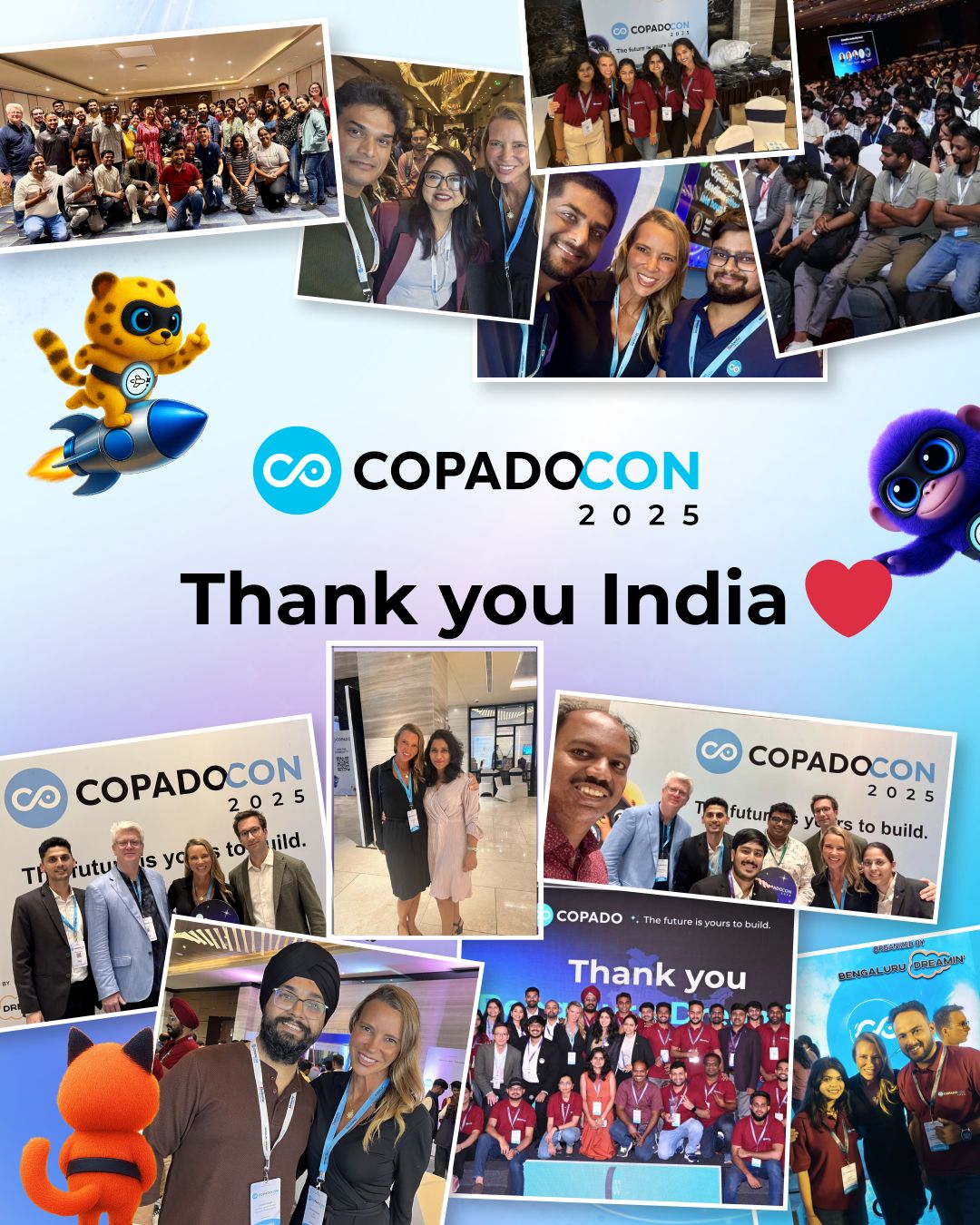
Marsh's own post after the event spread the credit widely. She thanked the Salesforce and Copado communities, the volunteers, local organizer Bengaluru Dreamin', sponsors and company leaders. This may sound like standard gratitude until one notices its order. The people who made the room were named before the executive who imagined it.
A year later, Marsh said nearly 5,000 people had registered for CopadoCon, with more than 1,600 attending in person. She again pushed attention from the count to the contributors. “What makes me most proud isn't the numbers - it's the people behind them,” she wrote. Metrics were evidence of participation, not a substitute for it.
Turning relationships into infrastructure
Community is a generous word and, in business, an easily abused one. Marsh's work is most persuasive when it becomes operational. Copado's partner portal offers a useful example. Built with Studio Science on Salesforce Experience Cloud, the portal centralized training, co-marketing material, campaign assets and deal registration. It removed manual handoffs and gave partners a clearer route to the things they needed.
The portal is not stirring copy. It is plumbing. That is precisely why it matters. If a company claims to value partners while making them hunt through inboxes for the latest deck, the inbox wins the argument. Marsh described the portal in terms of faster enablement, smoother workflows and smarter collaboration. The verbs are practical because ecosystems are experienced through friction.
The Marsh loop / how an ecosystem compounds
partners
proof
community
trust
The same sensibility appears in external partnerships. In 2022, announcing work between Copado and nCino, Marsh framed DevOps for financial institutions as a balance: speed without surrendering quality, compliance or customer trust. In 2026, she supported an expanded relationship with Capgemini in Brazil and across Latin America, linking local delivery expertise to Copado's AgentOps ambitions. The partner is not an afterthought in either story. It is the mechanism by which an enterprise promise becomes credible.
Her career offers a modest rule for partner strategy: shared incentives must eventually become shared routines. The relationship becomes real when somebody can find the training, register the deal, solve the deployment and call the person they met between sessions.
Marketing the machinery behind AI
The CMO job now asks Marsh to tell a broader story. Copado describes AgentOps as the discipline around building, deploying, governing and scaling AI agents. Category-making invites inflated language because the future is conveniently unable to object. Marsh's background supplies a useful restraint. She has spent years around customers for whom a failed deployment is not a metaphor. Financial institutions, public agencies and large enterprises need auditability, security and a way back when software goes wrong.
Her public comments repeatedly pair speed with confidence. AI has to reach production, but it also has to arrive through a process people can govern. The proposition is less cinematic than the idea of autonomous agents roaming the enterprise. It is also closer to the buyer's Monday morning.
There is a sales lesson tucked inside that language. Enterprise customers rarely purchase novelty alone. They purchase a tolerable path from the system they have to the system they want, with controls that let lawyers, security teams and operators sleep. Marsh has spent enough time beside partners to know that the people implementing a promise will expose every loose phrase in it. Her AgentOps story therefore returns to governance, delivery and confidence. The vocabulary faces forward; the obligations remain reassuringly concrete.
This is where her combined title becomes unusually logical. Marketing can give AgentOps a vocabulary. Alliances can place it inside systems integrators, regional markets and adjacent platforms. Community can let practitioners test the claims in public. Each group keeps the others honest. A story that partners cannot carry is probably too vague. A product practitioners will not discuss has probably not earned a category. A community with no useful work to gather around becomes an audience wearing name tags.
“What makes me most proud isn't the numbers - it's the people behind them.”Christie Marsh, after CopadoCon 2026
Credit as a leadership habit
Public recommendations describe Marsh as smart, passionate, humble and warm. One former colleague wrote that she makes the people around her better by spotting their talent and ensuring the organization recognizes it. Professional recommendations are a flattering genre, naturally, but the same pattern appears in Marsh's own writing. Names accumulate. Volunteers receive attention. The work is narrated as a network.
Her public volunteer record reinforces the point without requiring a grand theory. She has listed service with the Golden Gate National Parks Conservancy since 2012 and Bay View Senior Services since 2016. She also co-founded a professional meetup network in San Francisco. Her memberships include two Bay Area yacht clubs, and a Copado team post from Amsterdam includes a charming logistical footnote: when a teammate was absent from a group photograph, the team dialed the person in. Even the missing colleague made the frame.
None of this means Marsh is indifferent to winning. Her posts are full of momentum, expansion and confidence. She talks about stronger regional presence, faster delivery and the chance to shape a new market. But ambition in her telling is usually plural. Teams align. Partners collaborate. Communities grow. Relationships become foundations for whatever comes next.
That may be the advantage of taking the long route through alliances. Marketing can become fascinated with the message leaving the building. Partnership work forces attention onto what happens when it arrives: who repeats it, who adapts it, who objects and who decides to help. Marsh now occupies a role with a large microphone. Her career has taught her to keep listening for the conversation after the microphone is switched off.