A friend tried to make a job at Schlumberger sound unbearable. There were repeated transfers, inconvenient hours and a succession of crises. James MacLean heard an invitation. The parts of the story that sounded like reasons to leave sounded to him like reasons to apply. Some people read a job description for reassurance. He appears to have been shopping for complications.
He became a wireline engineer in the Gulf of Mexico. Calls could come in the middle of the night at his home in Houma, Louisiana, sending him by helicopter to an offshore platform. Before the work could begin, he had to assemble people and locate equipment. The adventure came with an inventory problem.
Geoforce, which he founded in 2007, is often explained as the obvious answer to those experiences. MacLean's own account is less tidy. After moving to Dallas, he had tracking technology and was looking for somewhere useful to put it. His old industry supplied the problem. An oilfield equipment rental business in Keller became his first customer.
An engineer learns what a map leaves out
MacLean grew up in Jacksonville, Florida, earned his mechanical engineering degree at Georgia Tech in 1999 and completed an MBA at Duke in 2007. Between field operations and founding Geoforce, he worked in sales and business development at a technology startup developing RFID systems and GPS tracking devices. He had encountered both the equipment and the business of making it visible.
That combination matters. A location on a screen is useful only if somebody can act on it. Equipment needs collecting, transporting, servicing and returning. A tracking business has to understand those chores well enough to make the information fit the work. Otherwise, it has produced a rather elaborate pin.
In an article he wrote in 2012, MacLean described companies juggling equipment locations in spreadsheets while maintaining separate records for servicing and compliance. His argument was practical: combine the information. A manager should be able to see where something is and whether it is ready for the next assignment.
His examples included EOG Resources, managing more than $2 million of field equipment, and Gator Tank Rentals in the Gulf of Mexico. Gator gave rental customers their own secure access to equipment information. A shared view could help both sides of a rental arrangement. The map was becoming part of how companies worked together.
Monday meetings, then the crawfish
MacLean's early approach to running a company had a social calendar. In 2013, when he was a Tech Titans Emerging CEO Award finalist, Geoforce's routines included Monday stand-up meetings. Departments discussed what they had accomplished and what they intended to do next. There were also taco feasts, crawfish boils, intern graduation parties and office poker nights.
It is an appealingly concrete picture of company culture: people stating their plans, then occasionally eating something that requires both hands. A mission statement can be revised indefinitely. A crawfish boil requires someone to organize the crawfish.
One consequential relationship had begun outside the company. Vincent Hsieh, who became Geoforce's CFO, met MacLean at Duke in 2005. They shared team assignments and late-night poker. Hsieh later described a leader who could work comfortably with executives and field crews, and emphasized his willingness to build agreement.
That account gives the business-school chapter some texture. The lasting connection was formed while doing work together and spending unstructured time together. When MacLean later needed colleagues for a company spanning engineering and operations, he already knew somebody beyond the polished introduction.
“Everything’s going to be connected.”James MacLean, 2022
The ambition gets a number
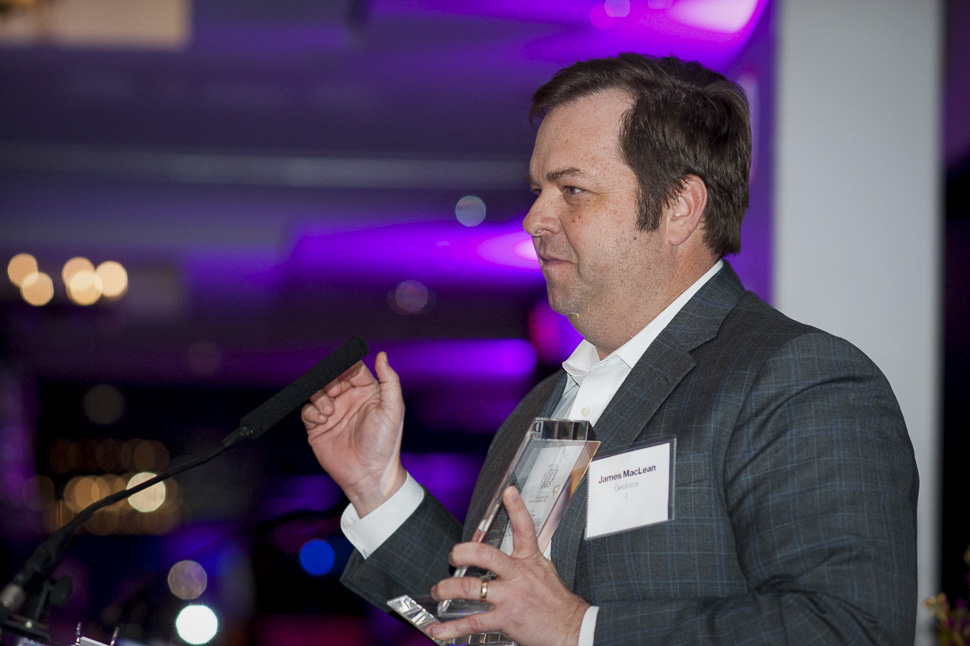
By the time Geoforce won the Innovation in Energy category at the inaugural D CEO and Dallas Innovates Innovation Awards in January 2020, its technology had travelled beyond the oilfield. Applications included agriculture, mining and transportation, with examples involving ocean currents and California grape harvests. The variety came from a simple common requirement: objects move, and somebody needs to keep track.
MacLean was thinking about millions of connected assets. That aspiration is useful to distinguish from the counts the company had already reached. A founder's target describes the business he wants to build; a dated operating figure describes the business customers are using. Both belong in his story, provided the dates remain attached.
In 2022, he put the direction plainly: “Everything’s going to be connected.” His focus was equipment working off-road and in remote places. Phones and vehicles were already familiar connected objects. He saw a large remaining population of physical assets whose movements still escaped a digital record.
A founder chooses more company
In December 2019, LLR Partners acquired a majority stake in Geoforce and invested growth capital. At that point, the company reported more than 900 customers tracking over 140,000 assets across more than 70 countries. MacLean remained CEO. The transaction brought an investor into a business whose field experience was already being used at international scale.
MacLean's explanation emphasized industry knowledge, operating resources and potential acquisitions. That is a specific shopping list. He wanted help entering markets and developing the offering, with acquisitions available as another way to expand. Building a company that connects scattered equipment was beginning to involve connecting other businesses.
The next month, Geoforce's Canadian subsidiary acquired substantially all the assets of Trakopolis SaaS Corp. The announcement welcomed more than 400 customers and described a combined business serving over 1,300. Trakopolis brought fleet management, utilization and maintenance reporting capabilities, along with a stronger Canadian presence.
Richard Clarke, Trakopolis's CEO, became general manager of Geoforce Canada. The change illustrates the people side of an acquisition: a company arrives with customers, software and colleagues who know how those customers operate. MacLean's ambition depended on keeping that knowledge useful as the organization grew.
- 2007MacLean founds Geoforce.
- 2019LLR takes a majority stake.
- 2020Trakopolis assets bring a Canadian expansion.
- 2026AssetLink adds communications and sensor expertise.
The field keeps getting wider
January 2026 brought another acquisition: AssetLink Global. It added experience in secure satellite communications, sensor integration and defense applications, alongside work involving rail, maritime operations and tank monitoring. David Goldstein continued to lead the acquired business within Geoforce. MacLean was adding capabilities for settings where a useful signal can be difficult to obtain.
The sensors broadened the information available. Door status, pressure, load and fluid levels can say something about an asset's condition as well as its whereabouts. For a founder whose starting point involved finding equipment, this was a further step into understanding what equipment was doing.
MacLean's announcement also stressed the fit between the teams, describing a shared curiosity and commitment to customers' field operations. Technical compatibility gets attention in a transaction. His emphasis on how the people worked echoed the earlier importance of finding colleagues who could bridge business decisions and practical engineering.
When the little things become affordable
The March 2026 collaboration with AT&T Business addressed another part of expansion: how customers buy and support tracking across an organization. AT&T Business customers would gain access to Geoforce's platform for rugged, non-powered industrial equipment. The arrangement placed those capabilities within an established enterprise connectivity relationship.
MacLean described a shift toward organizations standardizing their systems. His concern was broader than a device's specifications. Large deployments also need procurement, connectivity and support arrangements that can last. A promising trial still has to survive the less photogenic business of being purchased and maintained.
In May, Geoforce launched the GT1c cellular asset tracker with AT&T Business. The company positioned it as a lower-cost way to track non-powered equipment, complementing its satellite devices. It advertised battery life of up to ten years. The qualification matters: that is a stated product capability, rather than a decade of completed use.
A pilot with Black Diamond Equipment Rental supplied a more immediate example. The rental company expanded tracked inventory by 26 percent across smaller and mid-tier assets. Expected annual time savings exceeded 500 hours; the figure was a forecast. The reported inventory increase showed why price matters to MacLean's ambition. More affordable tracking can bring more of a customer's equipment into view.
across smaller and mid-tier assets
Still looking for the next piece
The leadership team was changing alongside the products. In March 2026, Geoforce appointed Jeff Westover chief marketing officer. MacLean emphasized the combination of marketing experience and attention to business results. The appointment put a named executive in charge of global marketing and growth as the company expanded across industries. It is another part of the founder's job that rarely fits inside the origin story: deciding which responsibilities need new leadership, and bringing in people to take them on. The business continues to require that work long after the original idea has found its customers.
In July 2026, Geoforce announced that AssetLink had won and begun fulfillment under a $72 million indefinite-delivery, indefinite-quantity Army contract for global tracking. The contract provides for orders over time. Its stated value should not be mistaken for revenue already received. The work extended the company's reach into demanding logistics environments.
For MacLean, the announcement linked the acquired team's communications and sensor expertise to the broader Geoforce platform. The company he started with an equipment-rental customer was now participating in a different scale of logistics, while continuing to answer questions about the movement of physical things.
Away from work, his listed interests include skiing, auto racing and travel with his family. The appetite for activity fits the young engineer who found offshore assignments attractive. Running Geoforce has given that appetite a long project, involving hardware, software, acquisitions and an expanding cast of colleagues.
There is something pleasantly unceremonious about the problem at its center. Equipment may be sophisticated, expensive and essential. Someone still has to find it. MacLean has spent nearly two decades making that ordinary requirement the basis of a company, adding new ways to answer it as the equipment, customers and geography change.