A golf cart crosses a line nobody can see. On the wrong side is grass someone would rather it didn’t flatten. FAIRWAYiQ, a golf-course intelligence company, used CalAmp technology to make that boundary audible: the device recognizes a restricted zone and warns the driver. The decision happens locally, without waiting for a trip to the cloud and back. It is a modest intervention. It also makes an unusually good introduction to a business usually described with several paragraphs of acronyms.
- Devices collect the signals. Cloud services deliver them. Applications help people act.
- Buyers include fleets, equipment makers, schools and automotive businesses.
- A 2024 debt reset changed the finances; the hardware and software business kept operating.
The missing piece is usually the connection
CalAmp sells ways to monitor, track and protect vehicles and equipment. A position on a map is one output. Others include engine information, driver events, cargo conditions and maintenance alerts. The customer might want a finished fleet application. Or it might already have software and need reliable information from machines scattered across the countryside.
That second buyer is easy to overlook. CalAmp sits inside other companies’ services as well as selling applications of its own. Its expertise runs through radio communications, vehicle interfaces, embedded programming and cloud delivery. Making those pieces cooperate is the product. A sensor that works beautifully beside an incompatible application is an expensive ornament.
At FAIRWAYiQ, CalAmp supplied configurable sensors and the cloud platform, helping the company avoid manufacturing its own devices. CalAmp’s case study reports that new functionality went from proof of concept to market launch within two months. The customer’s problem was keeping up with demand without building every technical layer itself.
“The configurability of the sensors is way beyond what we imagined”Dave Vanslette, FAIRWAYiQ CEO
A small box with several possible careers
Consider the LMU-4350LB, introduced in July 2025. It is an in-cab gateway: a physical bridge between a vehicle, its sensors and the outside world. LTE provides cellular connectivity. CAN interfaces read vehicle networks. Bluetooth connects peripherals. Programmable logic lets a service provider decide which events matter and what the device should do about them.
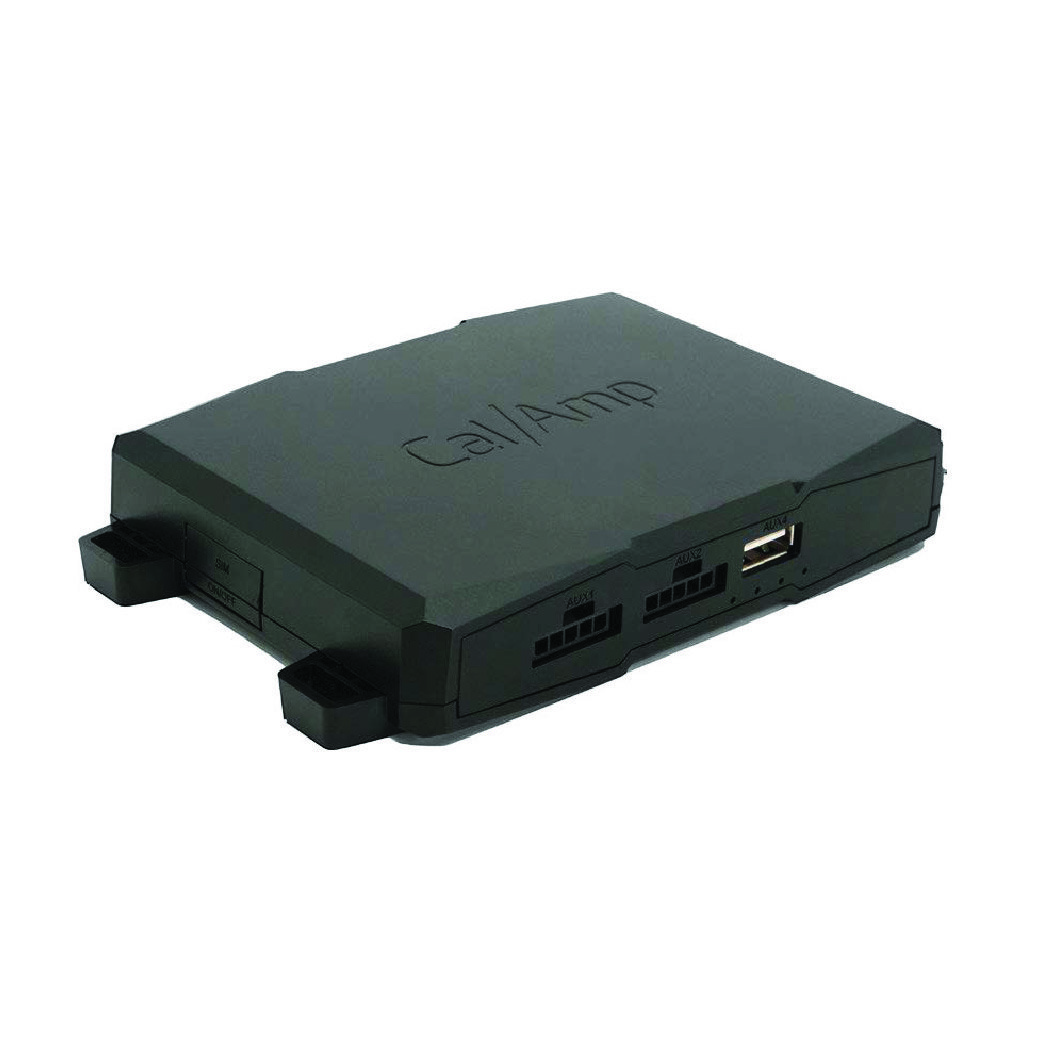
Buyers can take the hardware alone, add cloud data streaming, or choose an integrated application. That is a meaningful purchasing distinction. A telematics provider building its own service needs different help from a public works department trying to find a truck. CalAmp can occupy different positions in that chain, with different amounts of engineering left to the customer.
- 01MachineLocation + condition
- 02GatewayRead + process
- 03CloudTranslate + deliver
- 04ActionDispatch + maintain
The money follows those choices: hardware sales alongside recurring software, platform and connected services. For K-12 customers, CalAmp advertises monthly billing per vehicle, no upfront cost, free installation and unlimited training. A buyer should price the actual combination of devices, connectivity, application features and support. The subscription is only one part of the operational commitment.
The bus stop is a user interface
Here Comes The Bus gives the industrial machinery a familiar face. Parents can see a school bus on a map; optional features include arrival notifications and student boarding alerts. In February 2026, CalAmp released an updated app with additional security controls, simpler onboarding and support for selected third-party telematics hardware. The company cited more than 1.7 million users across North America.
The benefit extends to the transport office. A parent who can see the bus has less reason to call for its location. CalAmp’s customer materials also describe Ann Arbor displaying snowplow positions to residents. Both examples put information in the hands of people who would otherwise ask someone else to retrieve it. The map changes the workload.
Connected vehicle protection adds a different kind of response. CalAmp’s European Toyota and Lexus recovery program supported more than 200,000 vehicles by April 2026. It combines telematics with security operations centers and law-enforcement coordination. Geography matters here: Spireon bought the U.S. LoJack stolen vehicle recovery business and holds the exclusive brand license in the United States and Canada.
The balance sheet needed an intervention, too
Useful technology did not spare CalAmp financial trouble. In the quarter ended August 2023, revenue fell to $61.7 million, down $11.1 million from a year earlier. By June 2024, deteriorating performance and looming lending defaults had brought the company to Chapter 11. These were financing and operating pressures, not evidence that every customer application had stopped working.
Lynrock Lake, its principal secured lender, agreed to exchange debt for ownership. CalAmp announced the completed restructuring in August 2024, reporting that it had eliminated $230 million of debt. Management’s stated rationale was practical: lower interest expense and public-company overhead would leave more money to invest in customers. The transaction changed the ownership and the financial room available to the business.
Company-reported figures. Different measures, different years.
For 2024, CalAmp reported $197 million in revenue and more than 2.7 million subscribers across its business units. Its March 2026 update reported $41 million in 2025 free cash flow and $64 million of cash entering 2026, with no debt. It also announced Maurizio Iperti’s succession as CEO. The improvement deserves attention; those figures measure different things and do not establish a guaranteed trajectory.
Start with the decision you want to change
Recent releases sharpen the proposition. Google Pub/Sub integration, added in March 2026, streams telematics into customers’ Google Cloud environments. Expanded Modbus support followed in July, bringing readings from pumps, generators and other specialty equipment into operational applications. RAC Connected added CrashBoxx collision intelligence in April, including event reconstruction and predictive damage assessment.
Fleet buyers can also consider Geotab, Samsara and other specialists. CalAmp’s particular appeal is the ability to combine programmable devices, a data platform and finished applications. That flexibility is useful when an existing system needs better inputs. It also means compatibility, cellular coverage and responsibility for integration deserve attention before a rollout.
The lesson worth copying is to name the intervention first. Warn a driver. Redirect a plow. Service a pump. Then choose the information and equipment required. If nobody owns the response, another dashboard will have little to contribute. Somewhere, a golf cart is approaching a patch of grass. The useful question is how soon somebody will know.