A camera can show a truck holding its lane. It can show the car in front, the bend ahead, the weather. Yet a safety manager reviewing that footage still has questions. Did the driver brake? Did the truck’s automatic braking system intervene? Was a warning system working? The picture is useful. The machine has another account of the journey.
This is an unexpectedly good place to find Rand McNally. The familiar name on a road atlas now belongs to a business selling navigation hardware, fleet software and tools for reading the signals inside commercial vehicles. Its acquisition of SafetyDirect in 2024 brought that last activity into sharper focus. The mapmaker wants to help explain the trip, as well as plot it.
- For drivers: truck GPS tablets, electronic logs, headsets and cameras.
- For operators: one platform for tracking, maintenance, safety and fleet records.
- The distinctive detail: SafetyDirect connects incident video with onboard safety-system data.
- The business lesson: old expertise becomes useful again when it answers a costly new question.
01A camera has a blind spot
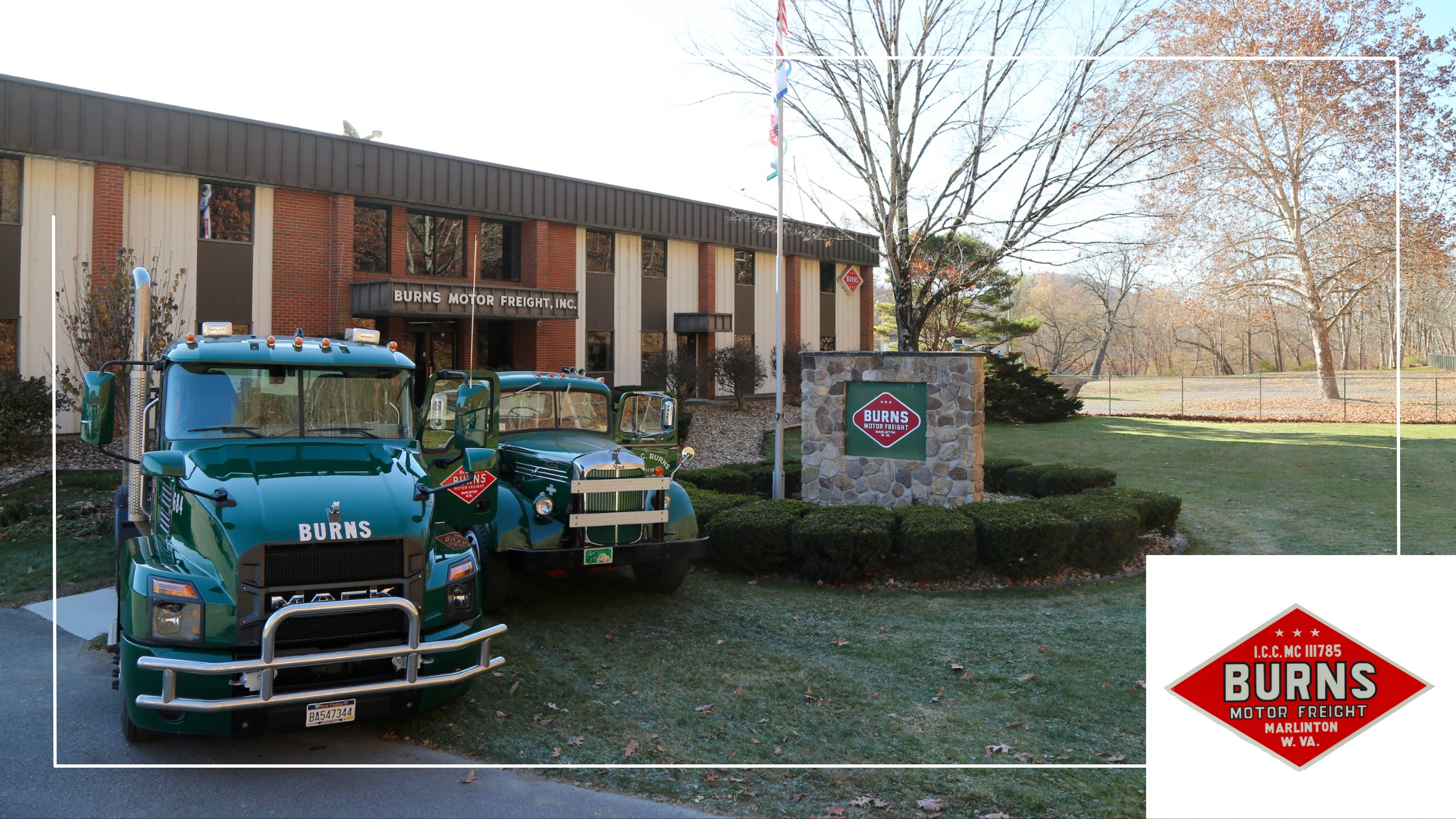
At Burns Motor Freight in West Virginia, that question has a practical audience. The carrier’s all-Mack flatbed fleet works routes that include Appalachian terrain. In Rand McNally’s published account, safety director Doug Burns describes using SafetyDirect since 2017, including to establish how drivers reacted during collisions. One rear-end incident could not be seen directly in the camera view. Speed and lane evidence helped him explain the truck’s behavior.
“I don’t know how you can sleep at night without the most comprehensive information out there.”
Doug Burns · Safety director, Burns Motor Freight
That account is a customer testimonial, rather than a controlled safety study. But it identifies a specific purchase motive: an operator needs enough evidence to understand an event and discuss it fairly with a driver. A recording of the road is one piece. Data about the vehicle’s response is another.
02The printer who kept finding new passengers
William Rand opened a Chicago print shop in 1856. Andrew McNally joined in 1858, earning $9 a week. The partnership took the Rand McNally name in 1868. Railroad tickets and timetables were early work. Its first map appeared in a railway guide in 1872; wax engraving made maps cheaper to reproduce. Geography became something a printer could distribute at scale.
The customers changed with the transport. The company published its first automobile road map in 1904 and introduced Auto Chum, the predecessor of the Road Atlas, in 1924. The title sounds like a small, agreeable passenger. By 1980, buying Transportation Data Management connected its map database to electronic trucking mileage and routing. The commercial-software thread therefore predates today’s connected-fleet vocabulary.
Paper has not vanished from this story. Rand McNally Publishing introduced its 2027 Road Atlas in April 2026. It also made 52 state and regional maps available through Avenza in 2024, with offline mobile use. Its website names Publishing Holdco, Inc. as the operator. Readers meet the same familiar brand across print and technology, although the websites identify different legal businesses.
03A famous name still went to bankruptcy court
There is a temptation to describe every old company as a graceful procession of inventions. Rand McNally’s record is less obliging. The Encyclopedia of Chicago describes a sale to AEA Investors, ambitions for a multimedia business, and financial and strategic missteps. In 2003, the company entered Chapter 11 and emerged with Leonard Green & Partners as majority owner. Recognition did not spare it a restructuring.
That episode puts useful friction into the transformation story. A recognizable name and a valuable archive do not, by themselves, explain how a company will earn money in a changed market. The later fleet strategy has to be judged by the products it supplies and the problems its customers can solve.
TELEO Capital acquired Rand McNally in 2020. MidCap Financial announced a secured revolving credit line and term loan in September 2021 for growth and working capital. Then came two acquisitions with identifiable functions: Australia’s Fleetsu in 2022, bringing a connected-vehicle platform, and SafetyDirect from Bendix in 2024, bringing its safety connectivity product line, portal and operations. Bendix also received an equity stake in the combined Rand McNally/SafetyDirect operations and a board observer seat.
04The map now includes the machine
Today’s catalog serves several jobs. A driver can buy a Rand Tablet for truck navigation. A fleet can track vehicles and equipment, set location alerts, review trip histories and monitor engine faults through Rand Platform. Electronic logging devices and the Rand ELD app handle driver records and hours-of-service reporting. Video telematics adds camera-based safety tools.
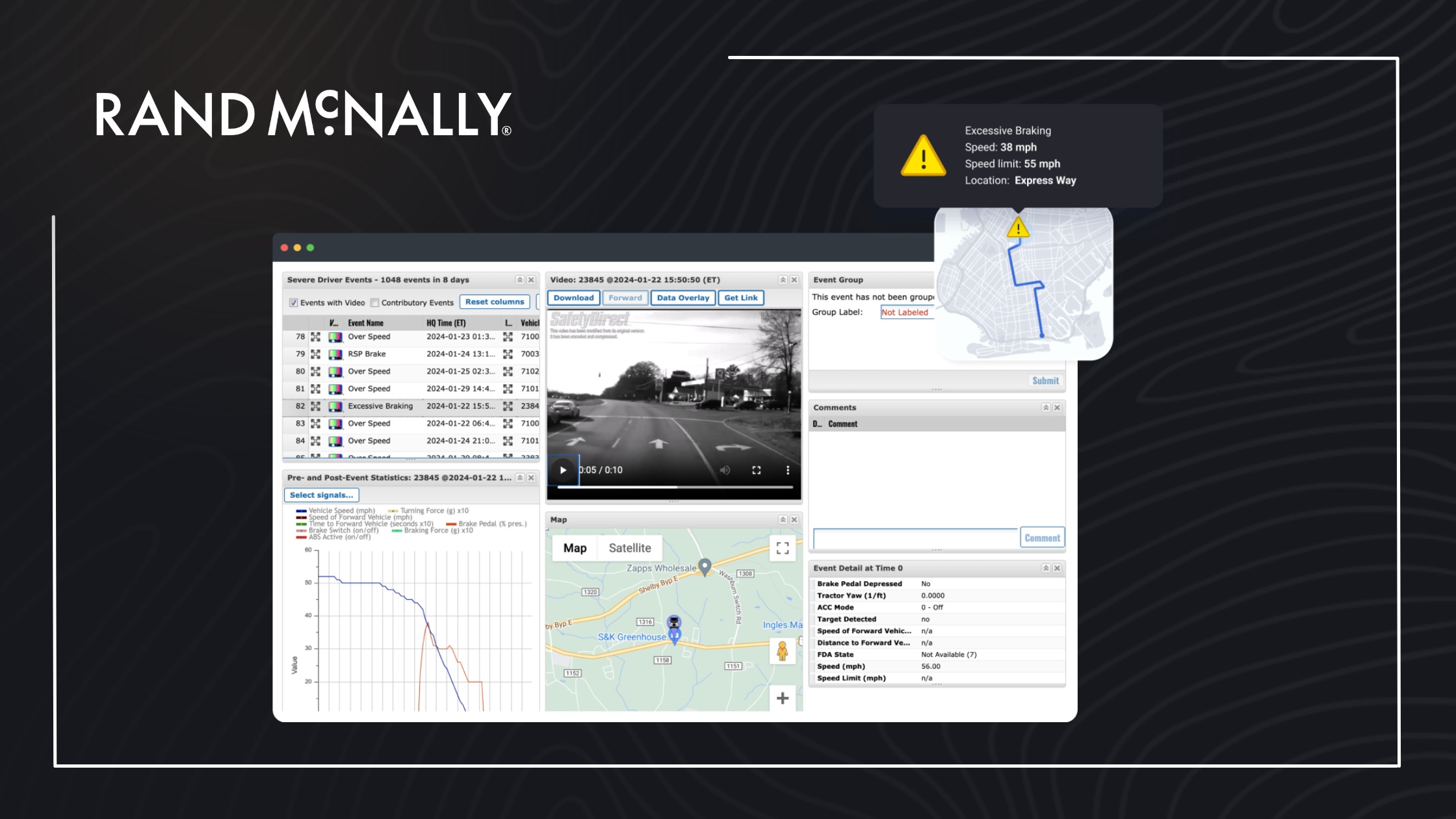
SafetyDirect reaches into onboard advanced driver assistance systems, usually shortened to ADAS. It links safety events with video, distinguishes driver braking from automatic intervention, and monitors safety-system health. Existing factory-installed equipment can make activation simpler on compatible trucks. The important word is compatible: a fleet should check its actual vehicle and system configuration.
The navigation expertise remains visible in Rand Road IQ, a database of commercial-road attributes such as bridge clearances, weight limits and hazardous-material restrictions. Partners can embed navigation in their own software. In October 2025, Rand McNally announced navigation for Platform Science’s Virtual Vehicle ecosystem, extending distribution into an existing in-cab environment.
Truck routing makes the value of specialization easy to grasp. A road can be present, paved and perfectly suitable for a car, yet unsuitable for the loaded vehicle approaching it. Rand McNally’s opportunity is in those details. Garmin’s dēzl range also offers truck-specific routing; Geotab competes in fleet management. Buyers should compare coverage, vehicle support and integrations for their operation. Age alone settles none of those questions.
05Seventy percent less queue
Collect enough events and the next problem is deciding which ones to review. In a published case study, Rand McNally describes Freymiller’s nationwide refrigerated-freight operation as having approximately 750 trucks and 2,500 trailers. Its Automated Event Ranking prioritizes safety events so the team can concentrate on the ones demanding attention. The reported result was a 70% reduction in data-review time.
Index: before = 100. After = 30, calculated from the reported 70% reduction. Company-published case study; not a fleet-wide guarantee.
This is a more useful claim than a vague promise to transform safety. It describes a task, a change to that task, and a measured outcome reported for one customer. It does not establish that every carrier will save the same time or avoid the same number of incidents. The gain also depends on what the team does with the events that remain: review them, coach drivers and follow up.
06Three ways to buy the same expertise
The business has a retail counter, a subscription relationship and a partner channel. On October 2, 2026, the Rand Tablet page listed sale prices of $299.99, $379.99 and $499.99 for the six-, seven- and eight-inch models. The smallest was marked out of stock. Fleet software is quoted to the customer’s configuration, while SafetyDirect’s agreement describes a subscription license and separately contracted communications services.
Partners can sell the technology under another name. Toyota Halo is a Toyota-branded fleet platform powered by Rand McNally in Australia. A capability launched in January 2026 lets customers add compatible non-Toyota light vehicles using the approved GX6 telematics device. That limit matters: the announcement covers light vehicles and light commercial vehicles, rather than every mixed fleet imaginable.
Aramex offers another example of fit. Its 2022 announcement described an initial rollout to 11 locations across the Middle East and North Africa. The fleet included vans, motorcycles, trucks and warehouse vehicles. Rand supplied a mix of plug-in and hard-wired equipment, apps and a customized portal. The variety of vehicles helped explain why device flexibility and integration mattered.
07The useful thing to copy
An operator evaluating these tools can begin with one expensive uncertainty: an incident that takes too long to reconstruct, a route that ignores truck restrictions, or a maintenance fault discovered too late. Test whether the proposed system shortens that particular job. Count the time spent reviewing events, check compatibility, and give someone responsibility for the resulting action.
There are ordinary limits. Rand Tablets need Wi-Fi for updates and advanced navigation features. Map-update eligibility depends on registration and device life; Rand’s terms permit an end-of-life designation after a model’s 24-month anniversary. Safety software requires people who can interpret the evidence. A dashboard cannot arrange its own coaching conversation.
Rand McNally’s interesting inheritance is the habit of making travel information usable. Once, that meant engraving a map cheaply enough to sell. Today, it can mean putting a braking signal beside a video or routing a truck around a restriction. The customer still has a journey to make. The questions along the way have become more specific.