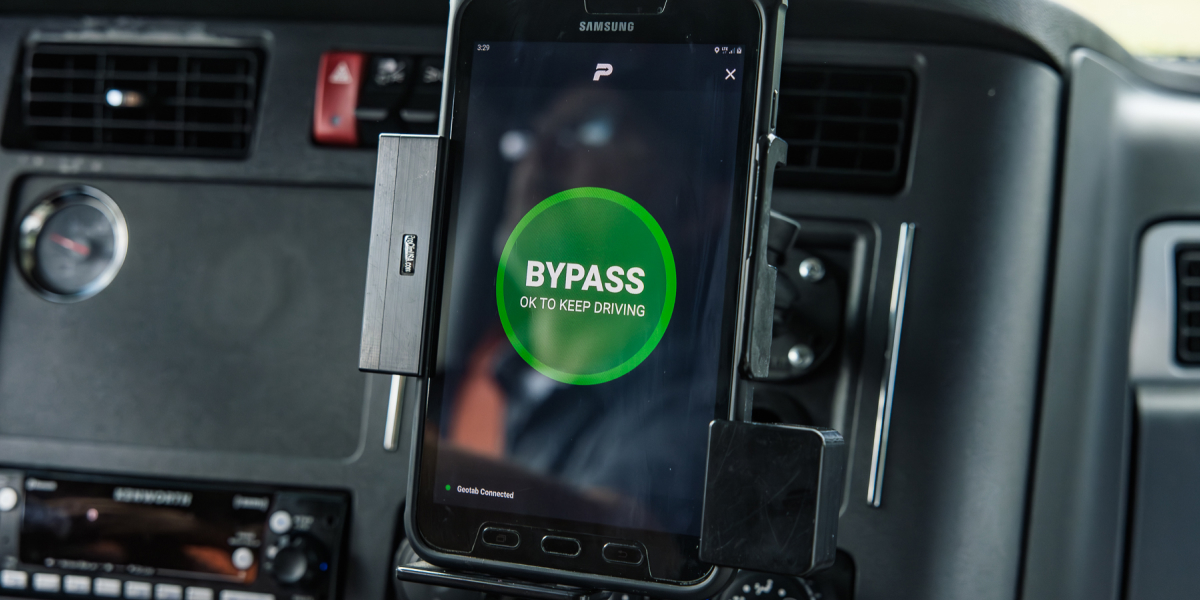
The most satisfying word in American trucking may be bypass. It appears in a green circle on a driver’s phone or as a light on a windshield transponder, usually a couple of miles before a weigh station. It means the truck can keep rolling. No ramp. No queue. No slow crawl across a scale. No merge back into traffic with 80,000 pounds asking for an opening.
PrePass sells that moment to safe, credentialed fleets. Behind the plain instruction is an exchange among carrier records, inspection history, roadside sensors, state rules and enforcement priorities. The fleet wins back driving time. The state can spend its limited inspection attention on vehicles that present more risk. PrePass, operated within the nonprofit PrePass Safety Alliance, charges fleets for access and reinvests net proceeds into technology, infrastructure and transportation collaborations.
That is what the company actually does. Not “mobility transformation.” Not a cloud with a truck pasted on it. It helps qualified commercial vehicles avoid unnecessary stops, then sells adjacent tools for toll payment, toll disputes, safety analysis and regulatory compliance. Its customers range from two-person owner-operator teams to carriers running thousands of trucks, with public agencies occupying the other side of the system.
A five-minute product with 30 years of compounding
The origin was institutional, not garage-mythology. State transportation officials and trucking executives ran a multi-state test of electronic screening, then formed a nonprofit in 1993. Its wonderfully bureaucratic first name was Heavy-Vehicle Electronic License Plate, a nod to the early bumper-mounted tags. Lockheed Martin developed the original system. California’s Santa Nella site on Interstate 5 became the first mainline showcase, and the PrePass service followed in California in the mid-1990s.
The technology operator changed hands over the decades, passing through Lockheed Martin, Xerox and Conduent. In 2018 it became the standalone CVO Holding Company. HELP Inc., the nonprofit behind the program, renamed itself PrePass Safety Alliance in 2019. The Alliance then acquired CVO in 2022, bringing the technology and the public-private program under common ownership. PrePass LLC now operates the commercial platform; the Alliance supplies governance that includes state-agency and motor-carrier voices.
This history matters because roadside screening is not a normal app category. A clever interface cannot persuade 40-plus jurisdictions to trust its signals. Infrastructure must be deployed, maintained and accepted by agencies. Carrier data must be handled within rules. The product needs fleets to want in and enforcement officials to believe the system makes their work sharper, not weaker. PrePass’s moat is therefore equal parts code, concrete and committee meeting.
The product ladder follows the places work gets stuck
Bypass is the wedge. Fleets can use an RFID transponder, the PrePass mobile app, or both. The hardware serves equipped fixed sites with high reliability and can double as a toll device. The app reaches mobile or app-enabled locations, runs on iOS and Android, and integrates with selected telematics and electronic logging platforms. It also gives drivers alerts for parking, traffic, weather, work zones, steep grades and other hazards. Using both is the broad-coverage play: hardware where roadside readers exist, cellular screening where they do not.
Toll Management attacks the next mandatory annoyance. Instead of juggling agencies, tags, receipts and violations, a fleet receives consolidated billing and support for reconciliation and disputes. PrePass Plus bundles tolls and bypass into one service and one device. INFORM Tolling adds a dashboard. GPS Toll Verification compares a vehicle’s location with a toll transaction, looking for a bill that does not match the trip. In February 2026, AI Toll Insights added machine-learning analysis intended to catch device mismatches, misuse and patterns a manual invoice review can miss.
Safety and compliance complete the climb up the back-office stack. INFORM Safety exposes inspection history, Inspection Selection System scores and trends that affect bypass outcomes. A 2025 partnership with NECS Fleet Solutions added managed compliance expertise. The December 2025 acquisition of FleetDrive 360 brought software for driver qualification files, drug and alcohol programs, vehicle records, maintenance and deadlines. The same company that began by removing a roadside stop now wants to remove the spreadsheet scavenger hunt behind the truck.
What did it cost? Start with the cost of stopping
PrePass does not post one universal current price. Fleet pages steer buyers toward enrollment or a quote, while compliance offerings mix monthly or annual subscriptions with one-time and recurring services. The useful calculation starts on the other side of the invoice: how often does each truck encounter an eligible station, and what is an interruption worth?
The company’s 2026 impact report uses roughly five minutes, half a gallon of fuel and about $10.65 in operating cost per successful bypass. Those are modeled averages, not cash guaranteed to every subscriber. Yet repetition makes them interesting. J & M Tank Lines, a carrier with more than 500 trucks, reported over 14,000 bypasses in a 12-month period, along with $152,000 in operating savings and $37,000 in fuel savings. D&H Transportation, with 23 tractors, reported 300-plus bypasses over eight and a half months, saving 25 hours and at least $2,400 in fuel.
At network scale, PrePass reported more than 1.16 billion completed bypasses from 1997 through January 2026. Its detailed impact table estimates 136.5 million driver hours saved, nearly 585 million gallons of fuel avoided and roughly $12.46 billion in operating savings. The Alliance reported $1.3 billion reinvested in weigh-station infrastructure. These are PrePass’s calculations from state data and stated assumptions, useful as a scale indicator but not a forecast for any particular fleet.
What failed first: the workaround
Phoenix Transportation offers the rare customer story with a plot twist. The Kentucky carrier had a safety-score problem. It deliberately dropped PrePass for nearly two years, hoping that sending trucks into weigh stations would produce clean inspections and improve its record. The gambit worked. What failed first was not the safety plan; it was everything bundled around it.
Without toll management, the team collected receipts, tracked violations and challenged questionable charges. Executive Mark Barnes described the work with three words: “It was a pain.” Toll agencies could send repeated violations under different statement IDs, creating a risk of paying the same toll twice. Drivers missed the bypass benefit, too. When freight shifted west and exposed the fleet to more toll authorities, consolidation became more valuable. Phoenix returned to PrePass Plus.
What changed its mind was not a new slogan. It was the accumulated cost of clerical fragments. Barnes’s sharper hindsight was that Phoenix could have kept toll service while suspending bypass. The copyable lesson is unusually practical: if a bundled product is producing the wrong incentive in one department, do not tear out every useful component. Unbundle the behavior you want to change.
Where PrePass is different - and where it is not
Drivewyze is the obvious bypass rival, built around software delivered through phones and a wide set of in-cab platforms. Bestpass, now part of Fleetworthy, approaches the market from toll management and can be paired with bypass services. State programs and regional toll tags cover narrower jobs. PrePass’s pitch is integration: mobile plus RFID, bypass plus tolls, and increasingly safety plus compliance, supported by one organization with long-standing agency relationships.
That does not make it the automatic answer. Coverage changes, and marketing comparisons from competitors rarely use identical definitions of fixed, mobile and partner locations. A fleet should map its actual lanes against each current network, ask which devices already live in the cab, and calculate observed green lights per vehicle. It should also inspect toll-agency coverage, service fees, hardware return rules and dispute performance. The winning logo is the one that works on Tuesday’s route.
The honest fit test
- 01Routes: Do trucks repeatedly pass participating locations, or is the network mostly elsewhere?
- 02Eligibility: Are credentials and safety scores strong enough to produce regular green lights?
- 03Economics: Do observed time, fuel and admin savings exceed every per-vehicle and service fee?
- 04Workflow: Does the fleet need a combined transponder, or would an existing ELD and separate toll vendor fit better?
- 05Proof: Will someone review bypass rates, toll errors and disputes monthly instead of trusting the brochure?
The bit worth stealing
PrePass found a compulsory pause attached to an expensive moving asset. It made the pause measurable, earned permission to remove it selectively, and let the savings prove the value. Then it followed the customer backward: from the driver’s interruption to the toll clerk’s invoice, the safety manager’s score and the compliance team’s files.
A founder can copy that sequence without touching transportation. Look for a delay that is boring, frequent and governed by rules. Build trust with both the person waiting and the institution causing the wait. Make the first benefit visible in one glance. Measure outcomes in the customer’s native unit. Only then move into adjacent workflows where the same data can remove more friction.
The conditions matter. This playbook fails when permission is impossible, the delay is too rare, the underlying customer is high-risk, or savings cannot be audited. PrePass itself works under the same constraints. A carrier with poor safety performance may be pulled in more often. A fleet running outside covered corridors may see little value. Random inspections still happen. Cellular and hardware systems have different gaps. And no bypass product replaces compliance; eligibility is the product’s fuel.
The company’s recent expansion makes strategic sense, though execution will decide whether it remains a focused platform or becomes a crowded toolbox. AI Toll Insights must find recoverable mistakes, not merely colorful anomalies. FleetDrive 360 must connect compliance data to safer operations and more bypass opportunities without adding another dashboard. Partnerships with Motive, Samsara, Geotab, Eleos, RunBuggy and NECS need to reduce setup rather than multiply logins.
Still, the original interaction remains hard to improve: a truck approaches a place where stopping is normally mandatory; a screen turns green; the road stays open. Thirty years of infrastructure, data and institutional compromise collapse into two words. Keep driving.
Keep rolling
Explore the company, its product demonstrations and its public channels.