The peculiar thing about Drivewyze is that a successful transaction can leave almost nothing to look at. A truck approaches a weigh station. An instruction arrives inside the cab. The truck keeps going. Nobody buys another gallon of diesel for the queue. Nobody spends the next few minutes admiring the trailer ahead. The absence is what the customer paid for.
Software companies usually promise to help you do something. Drivewyze found a recurring task that, under the right circumstances, a driver could be excused from doing. The clever part is arranging the excuse with the people who run the inspection station.
- What it sells: authorized weigh-station bypass and safety information delivered inside the cab.
- Who buys: owner-operators and commercial fleets; public agencies use its roadside technology.
- How it earns: vehicle subscriptions, premium safety services and infrastructure offerings.
- What changed: acquired in 2024, Drivewyze joined the unified Fleetworthy brand in February 2026.
Permission to keep moving
PreClear, the bypass service, runs on compatible electronic logging devices, smartphones and tablets. An ELD is the device that records a driver’s hours. Put bypass on a screen already in the truck and the fleet has one less piece of equipment to install.
The service recognizes an approaching inspection site and communicates a screening decision. Registered vehicles may receive permission to continue on the highway. Others receive a pull-in instruction. The decision reflects agency requirements, credentials, safety records and random selection. A subscription buys access to this process; it does not buy immunity from inspection.
That distinction explains the company. Drivewyze occupies the space between the carrier that wants to move freight and the agency that needs to decide which vehicles deserve a closer look. Its expertise combines in-cab software, location-based notifications, roadside screening and the less glamorous work of connecting records across organizations.
The green light is conditional. Enforcement keeps the decision.
The price of a queue
Consider Josh Rickards, whose route into trucking passed through the music business. He hauled touring production equipment and started Rickards Transportation Services in 2018. He discovered Drivewyze through Omnitracs, his ELD provider, and activated bypass without adding hardware.
In one monthly report described in a company-published customer account, three enrolled trucks received 41 bypasses. Drivewyze estimated three hours saved and roughly 16 gallons of fuel avoided. These are vendor estimates for that fleet and period, rather than a promise about everyone’s results.
“As a small business owner, any time and money I can save makes a difference.”
Josh Rickards · Rickards Transportation Services
The public mobile FAQ lists a US$17.99 monthly subscription after a 30-day trial. Fleet pricing varies. At that posted rate, three subscriptions would cost US$53.97 monthly; that is illustrative arithmetic, not Rickards’s disclosed bill. Whether the return is attractive depends on the queues encountered, fuel prices and the value of the time recovered.
Time recovered + fuel avoided− subscription cost
Use measured route results. A national network count cannot do this calculation for you.Avoided time can be useful without becoming extra revenue. An earlier arrival may create room in a schedule, reduce stress or absorb a later delay. Fleet managers should distinguish those benefits from cash savings rather than counting the same minute twice.
The other customer wears a badge
There is a pleasing complication here. A company helps trucks avoid some stops while also selling technology to the people responsible for stopping them. Those interests can coexist because electronic screening gives an agency information before a vehicle reaches its inspection area.
Drivewyze’s roadside portfolio includes Smart Roadside for commercial-vehicle screening and Smart Truck Parking for monitoring parking availability. The public-sector work helps explain why this business cannot be understood as a phone app alone. The screen in the cab is an endpoint in a relationship with physical infrastructure and public agencies.
The roots go back to Intelligent Imaging Systems, founded in Edmonton in 2003. Brian Heath and Fred Ko co-founded Drivewyze; Heath’s account for Alberta Enterprise recalls an early workspace in a local coffee shop. IIS launched the Drivewyze division in 2012. By its August 2013 financing announcement, PreClear was available at 223 locations in 16 states.
That same announcement reported US$7.5 million in funding led by Emergence Capital Partners and iNovia Capital. In 2020, Sageview Capital supplied US$60 million in minority financing to IIS and its Drivewyze subsidiary. The investment backed a connected-truck platform with both commercial and government applications.
A warning before the bend
Bypass is only one reason to send a message into a truck. Another is that the road ahead contains something a driver would appreciate knowing about before arriving there: a sharp rollover-prone curve, a steep descent, a work zone or an unexpected traffic slowdown.
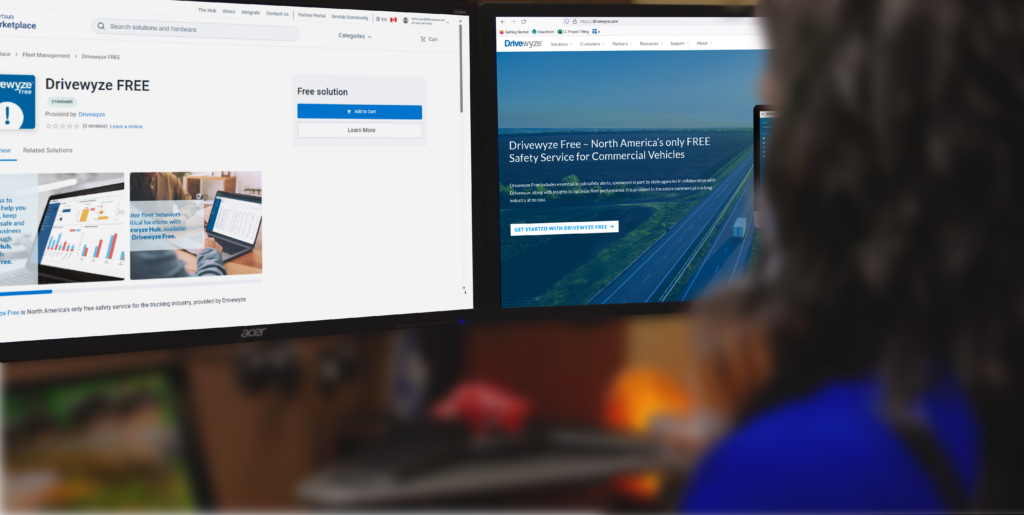
Drivewyze Free provided basic hazard advisories and participating agency-sponsored alerts. Its current product FAQ identifies that offering as Fleetworthy Foundations following the brand transition. Low-bridge alerts cover selected locations; the product explicitly does not cover every bridge or overhead obstruction. A driver still needs appropriate routing and attention to clearance.
Safety+ adds premium alerts, fleet-defined zones and reporting for coaching. A manager can attach instructions to a particular location, including a customer warehouse. That makes the service useful for operational reminders as well as road hazards. The practical test is whether a message gives the driver useful information at a moment when it can still change a decision.
Expedited Inspection addresses the stops that do happen. It transfers registration information and electronic hours-of-service records to enforcement, reducing manual data entry. Its published deployment specifies Nevada sites for fleets using Geotab or Platform Science ELDs. Availability deserves checking separately from ordinary bypass coverage.
An app with friends
Drivewyze lists more than 40 ELD and telematics integrations. Its partner roster includes Geotab, Samsara, Platform Science, Omnitracs and others. These companies can be the route to the customer, rather than an obstacle to acquiring one. Rickards’s experience is a neat example: compliance hardware became the doorway to another service.
A direct bypass alternative is PrePass. It offers both an app and RFID transponders, and its app extends coverage to mobile sites and locations without transponder readers. Describing the choice as modern software versus an old plastic box would therefore be misleading. Both businesses offer mobile capabilities.
The useful comparison is narrower and more demanding: which service covers the stations on your lanes, works with your devices and produces worthwhile results for your fleet? Drivewyze’s published materials describe more than 900 bypass locations in the United States and Canada. That establishes breadth, but a dispatcher needs the map, not applause for the number.
The name on the door changed
Bestpass-Fleetworthy acquired Drivewyze in August 2024 for an undisclosed price. The combination brought weigh-station bypass alongside toll management and safety and compliance services. In February 2026, Fleetworthy announced that the Bestpass and Drivewyze sub-brands had transitioned into one Fleetworthy brand.
There was a commercial reason to bring these functions together. In an interview about the acquisition, CEO Tom Fogarty told Commercial Carrier Journal that Bestpass had sometimes lost customers to providers offering multiple products under one umbrella. The combined offering gave the company more of those products to sell.
For the buyer, the promise is fewer separate relationships to manage. Fleetworthy’s 2026 announcement described shared access points, aligned interfaces and reporting integration between toll management and bypass. Those were initial changes in progress. A combined name is easy to print; a combined customer experience requires continued work.
Take the experiment, not the slogan
A fleet can copy the purchasing method without copying anyone else’s results. Choose representative trucks and lanes. Record inspection-site visits and delays. Check compatibility and current pricing, then use the trial to compare bypass activity with what those trucks ordinarily encounter. Ask drivers whether the instructions are clear.
When results disappoint, look at the dependencies. Cellular communications, activation, credential status and agency screening can affect bypass. Rickards’s account describes a New Mexico permitting-information problem that interrupted service until addressed. The failure was administrative, which makes it especially useful to remember.
Keep the trial ordinary. Routes with little participating coverage may produce little value; unusually congested weeks may exaggerate the result. Judge alerts and inspection-data transfer on their own merits. The most persuasive demonstration is a month of familiar work with fewer expensive interruptions. For a product whose best moment can look like nothing happening, that is quite enough to measure.