The vans were supposed to sip fuel. Instead, their drivers discovered a little extra shove. In Lightfoot founder Mark Roberts’ account, a diesel-hybrid van project delivered promising efficiency in testing, then disappointed on the road. Drivers were using the hybrid assistance for performance. The engineering had met its least predictable component: the person with a foot on the accelerator.
That experience supplied the idea behind Lightfoot, launched in 2013. Make efficient driving visible while it is happening, then give the driver a reason to keep doing it. Today the British company sells dashboard coaching devices, fleet software and driver rewards, with cameras and electric-vehicle tools widening the package. Its unusual sales proposition comes down to a familiar workplace problem: the person who can save the money is not necessarily the person who gets to enjoy it.
The fuel-saving plan met a right foot
Roberts recalled that the hybrid project’s testing suggested a 15% fuel saving. When that benefit disappeared in service, the team investigated the vehicles before recognising the effect of driving style. “We found this out the hard way,” he said in a 2021 company article. The episode changed the question from how to improve the van to how to influence the person operating it.
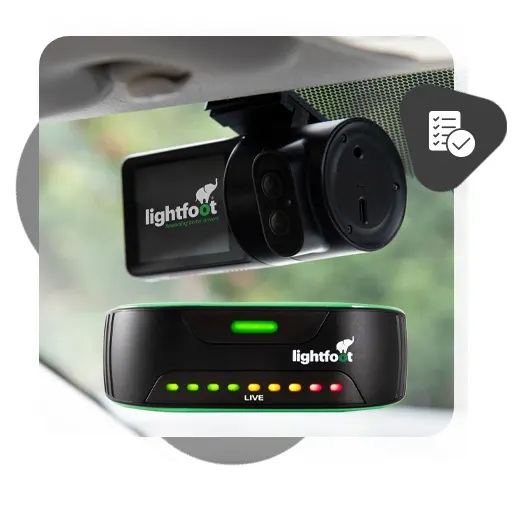
Lightfoot’s answer sits within sight of the driver. Connected to the vehicle’s onboard diagnostics, the unit reads operating data and offers visual and audible feedback. Its lights make a complicated calculation legible: ease off, adjust, settle into a smoother rhythm. The driver can respond on the same journey, while the action still makes sense.
The device is read-only. It does not take command of the accelerator or change vehicle settings. Lightfoot’s expertise lies in interpreting vehicle data and translating it into feedback people can use. That distinction matters: this is coaching, and the person behind the wheel remains responsible for the road.
A little lottery in the dashboard
The lights are only half the pitch. Lightfoot’s driver app adds scores, leagues and rewards, turning efficient driving into something colleagues can compare. Reach its Elite Driver threshold and prize competitions become available. The fleet pays for the service; the driver gets an individual reason to participate.
The weekly target is 85%. That number leaves room for the messy business of actual traffic. Lightfoot’s guidance acknowledges that joining a motorway or accelerating at a junction can require an inefficient burst. An amber or red light is therefore not, by itself, proof of bad driving. A useful score must tolerate sensible judgement.
Rewards supply the more playful part. Alongside cash prizes, Lightfoot has advertised giveaways ranging from consumer electronics to longbow lessons and dinner at the Shard. The prizes are deliberately more personal than a procurement department’s fuel spreadsheet. A driver may never see the company’s annual savings, but can certainly picture an evening out.
The business logic is straightforward: make the desired action easy to recognise, give feedback quickly and attach a benefit to repeating it. The approach can reduce the need for managers to reconstruct every poor journey afterwards. It still requires an employer willing to explain the system and treat participation fairly.
Currys puts a price on a smoother journey
Currys provides a concrete account of the switch. According to Lightfoot’s customer study, the retailer adopted the system in 2016 after finding retrospective telematics insufficient to influence everyday driving. A test group generated baseline data before live coaching was activated. The reported improvement persuaded Currys to expand the deployment.
The same account reports annual fuel savings above £400,000, a 10.8% improvement in miles per gallon and a 15.8% reduction in at-fault accidents. Those are useful, distinct measures. A reduction in harsh driving events describes what the system records; an accident reduction describes an outcome a fleet actually experiences. They should never be swapped casually.
These are supplier-published customer results, rather than a promise to every buyer. Their value is in showing what to measure. Fuel use, distance travelled, incidents and driver participation belong in the same discussion. A fleet can achieve an attractive score without establishing how much money it has saved.
Annual fuel savings in Lightfoot’s customer account. Gross fuel savings, before the cost of the system.
Tesco offers a different buying context. Its home-delivery operation already used cameras, tracking and driver trainers. Lightfoot’s case study describes adding live coaching as delivery demand expanded during the pandemic. It reports a 7.5% MPG increase and 7,346 tonnes of CO₂ avoided in the first year of deployment.
The interesting point is the existing equipment. Tesco was adding another intervention to an established programme. For a buyer with telematics already installed, the question is therefore specific: what additional change does this system produce? The answer needs a baseline, not a catalogue of features.
The bill behind the better score
Lightfoot’s commercial model combines an upfront hardware payment with an ongoing monthly service subscription; lease-purchase options are also offered. Buyers obtain a quotation. The app’s prizes help sell the behaviour, but the recurring contract is paid by an organisation expecting lower operating costs and better fleet performance.
Its free trial runs for four or eight weeks depending on fleet size, according to the company’s FAQ. That makes the trial design worth attention. A representative sample should include the routes, loads and drivers that make the fleet difficult to manage, not just the easiest vehicles to demonstrate.
A buyer can copy the discipline without copying anyone’s savings forecast: measure a baseline, activate coaching, compare fuel consumption per mile and examine participation. Then put hardware, subscriptions, installation effort and staff time beside the measured benefit. Changing fuel prices or a lighter workload can flatter a comparison; a useful trial accounts for them.
The person who can save the fuel needs a reason to care about the saving.
The incentive at the centre of Lightfoot’s model
This is also where the market gets crowded. Samsara and Geotab offer fleet telematics and driver-coaching alternatives. Camera specialists address overlapping safety needs. Lightfoot’s distinctive emphasis is the combination of vehicle-aware feedback and driver rewards. Buyers should compare that combination against their actual requirements, including integrations and the effort needed to run it.
The camera watches. The van still needs charging.
Lightfoot Vision extends the offer into video telematics. Configurations range from road-facing cameras to driver-facing systems that identify distractions such as phone use. The company says automated footage analysis helps separate meaningful incidents from false triggers, including potholes, reducing the material managers must review.
That is a second job alongside efficiency coaching: documenting and responding to risk. Footage can help explain a collision; an alert can prompt a driver to correct a distraction. Neither turns every event into an open-and-shut conclusion. Operators still need to understand the context of what a camera records.
The EV offering addresses another operational headache. Managers can see charge levels, track charging and handle home-charging expenses. Drivers can receive reminders to plug in. Smooth driving matters to range, but a beautifully driven electric van with an empty battery will still miss its morning departure.
A July 2025 partnership with Drax Electric Vehicles connects this data to electrification planning. Drax describes using Lightfoot’s journey distances and dwell locations to assess vehicle suitability and charging needs through its My Electric Vehicles portal. Here, telemetry can inform a decision before the replacement vehicle is ordered.
The wider suite also includes Locate asset tracking, Connect and fleet reporting. Together they move Lightfoot further into the everyday machinery of running a fleet. That opens more purchasing conversations, while making dependable installation, data exchange and support increasingly central to the product.
100,000 units, and a less glamorous hardware fix
There is a dated growth record behind that expansion. BGF invested £3.2 million in 2018. Its account says vehicles using Lightfoot rose from 14,000 to about 50,000 over three years, while revenue increased from £3 million to more than £11 million. Volpi Capital acquired the business in 2021, providing BGF’s exit.
2018 and 2021: fleet vehicles, reported by BGF. April 2026: connected units, reported by Lightfoot. Measures differ.
In April 2026, Lightfoot announced more than 100,000 connected units across fleets in the UK and overseas, and a team exceeding 100. Its published values stress care, innovation, customer focus and individuality. Those describe the culture the employer wants to build; they are not a substitute for employees’ own accounts.

The milestone announcement also contained a useful admission about execution. An updated connection setup introduced in 2025 had reduced installation issues, the company said, and would become standard across new installations, upgrades and service work. Even a business selling behavioural science needs the plug to behave.
Lightfoot’s proposition ultimately depends on cooperation. Drivers need to understand the feedback, managers need credible comparisons, and schedules need to leave room for safe driving. Privacy settings and clear explanations of data access matter because employees are the people living with the equipment.
The portable lesson is modest and practical. Put feedback close to the action, share some of the upside and measure what changes. Lightfoot has built a business around giving the driver that opportunity, one small lift of the accelerator at a time.
Take it for a spin
Explore Lightfoot · Product demos and customer films · YouTube · Company news · Blog · LinkedIn · X · Facebook