At highway speed, four frames per second can be a rather stingy witness. Fortune Transportation discovered this with its old video system: the footage was difficult to interpret. In March 2019, the refrigerated carrier announced that it was putting Trimble Video Intelligence into 135 trucks. The product descended from PeopleNet, a company whose central problem had always been distance. How do you make something happening in a cab useful to someone sitting in an office?
- PeopleNet joined onboard computers to web-based fleet management.
- Its customers bought logs, communications, diagnostics and safety tools together.
- Legacy equipment exposed the cost of keeping that connection alive.
- The telematics business moved from Trimble to Platform Science in 2025.
Four frames can leave a lot out
Fortune’s general manager, Kent Kelly, explained the switch in practical terms. Twelve frames per second gave the carrier “a manageable video file size and a clear perspective”. That is a refreshingly unglamorous buying criterion. The footage had to be detailed enough to explain an incident, yet small enough to handle. A camera that produces evidence nobody can comfortably review has merely moved the problem from the road to the screen.
The carrier was also connecting video with its existing driver and vehicle information. A safety manager could examine an event in context and look for patterns worth discussing with drivers. The announcement described intended benefits, rather than a measured reduction in crashes. Still, the purchasing logic was clear: better information had to improve a specific job.
Three times the frame rate. The buyer wanted clearer evidence at a workable file size.
A browser with diesel on its boots
PeopleNet was founded in 1994. Ron Konezny, a documented co-founder, helped build a cellular communications and fleet management system called Intouch. The consequential choice was to deliver fleet information through a web interface. A truck remained a large piece of machinery travelling far from headquarters; its information became something the office could reach through a browser.
That shift sounds ordinary today because so much enterprise software now arrives that way. In a trucking operation, however, distance creates several different problems. Dispatch needs to know where a vehicle is. A driver needs instructions. The office needs usable records. Maintenance needs to hear about trouble before a roadside breakdown turns a delivery into an explanation.
PeopleNet’s business sits between those needs. Onboard hardware gathers and communicates information; software presents it to drivers and fleet staff. Its Fleet Manager portal is the familiar office doorway. Electronic driver logs are one application within the larger system. Buying the system means choosing how the cab and the business will talk to each other.
Sell the decision, not the dot
A dot on a map answers one question. PeopleNet gradually built around the questions that followed it. Its historical customers included truckload carriers, less-than-truckload operations, private fleets and energy-services fleets. In 2015, the company reported serving more than 2,000 fleets across the United States and Canada. Those operations had different routes and cargo, but all had to coordinate people and expensive equipment.
Kenworth’s 2015 selection of PeopleNet for TruckTech+ remote diagnostics illustrates the distinction. The system covered new Class 8 trucks with PACCAR MX-13 engines. It combined a vehicle gateway, communications, cloud services and an online portal. Fleet managers and dealers could receive vehicle-health notifications and recommendations about what to do. VUSION contributed analytics; TMW Systems supplied interface and maintenance expertise.
The important design choice was who received the warning. An engine fault becomes more useful when the person arranging service can see it too. The equipment manufacturer, dealer and fleet were being connected around a shared operational event. That is a stronger proposition than asking dispatch to admire another dashboard.
- 01 / TRUCKA device captures an event.
- 02 / CONTEXTSoftware joins it to vehicle and driver information.
- 03 / ACTIONA dispatcher, dealer or safety manager responds.
PeopleNet also acquired Cadec’s assets in 2015, adding expertise in foodservice and private fleets, web enterprise tools and analytics. Such businesses involve work at stops as well as miles between them. That acquisition reflected an appetite for the details of fleet operations, rather than a belief that every transport business could be served by the same location screen.
The price lives in the truck
PeopleNet’s commercial model paired equipment with recurring software, communications and services. In 2018, reported Video Intelligence pricing was $600-$800 hardware and $12-$15 monthly per truck; those figures are historical.
A fleet buyer therefore has two clocks running. One measures the subscription. The other measures the useful life of the equipment and the work required to install, support and replace it. A lower recurring fee cannot settle the decision if the device is awkward to deploy or the driver needs too much help to use it.
Here is the useful calculation to copy: count the whole deployment, then connect it to the work it changes. Include installation time, training, data services, maintenance and replacements. Compare those costs with the operational task you intend to improve. This is an analytical framework, not a promised return. Better footage has value only if someone reviews it; better diagnostics have value only if someone can arrange the repair.
The morning the connection broke
On January 1, 2020, a subset of customers using legacy PeopleNet g3 onboard devices experienced a software rebooting problem. Some fleets returned to paper logs. Trimble said it made a software update available that evening. The failure belonged to particular older equipment, rather than every PeopleNet customer.
The incident makes a useful distinction. This was a reported software problem; cellular-network retirements were a separate source of pressure on older equipment. PeopleNet had already introduced newer gateways, and announced LTE connectivity for ConnectedFleet in the United States, Canada and Mexico in 2017. A working vehicle and an ageing communications device can have very different remaining lifetimes.
For the buyer, the lesson is to ask about the entire chain. Can the onboard device still communicate? Can it be updated? Who handles the replacement? What does the driver do when it fails? A cloud service has physical dependencies, and each deserves a place in the operating plan. The subscription invoice is much tidier than the system it pays for.
Continuity has changed owners twice
PeopleNet’s sale to Trimble in August 2011 was partly a decision about continuity. Contemporary reporting described management’s concern that another private equity transaction could add debt and narrow the company’s room to manoeuvre. Customers expected their onboard investments to last for years. A new owner’s appetite for development and support mattered.
“Once you have a static product, people start looking around.”
Ron Konezny / Commercial Carrier Journal, 2011
The company later became Trimble Transportation Mobility. Then, on February 10, 2025, Platform Science completed its acquisition of Trimble’s global transportation telematics businesses. Trimble became a shareholder and received a board seat. The transaction gave the PeopleNet lineage another home; it did not transfer every Trimble transportation product into a single new company.
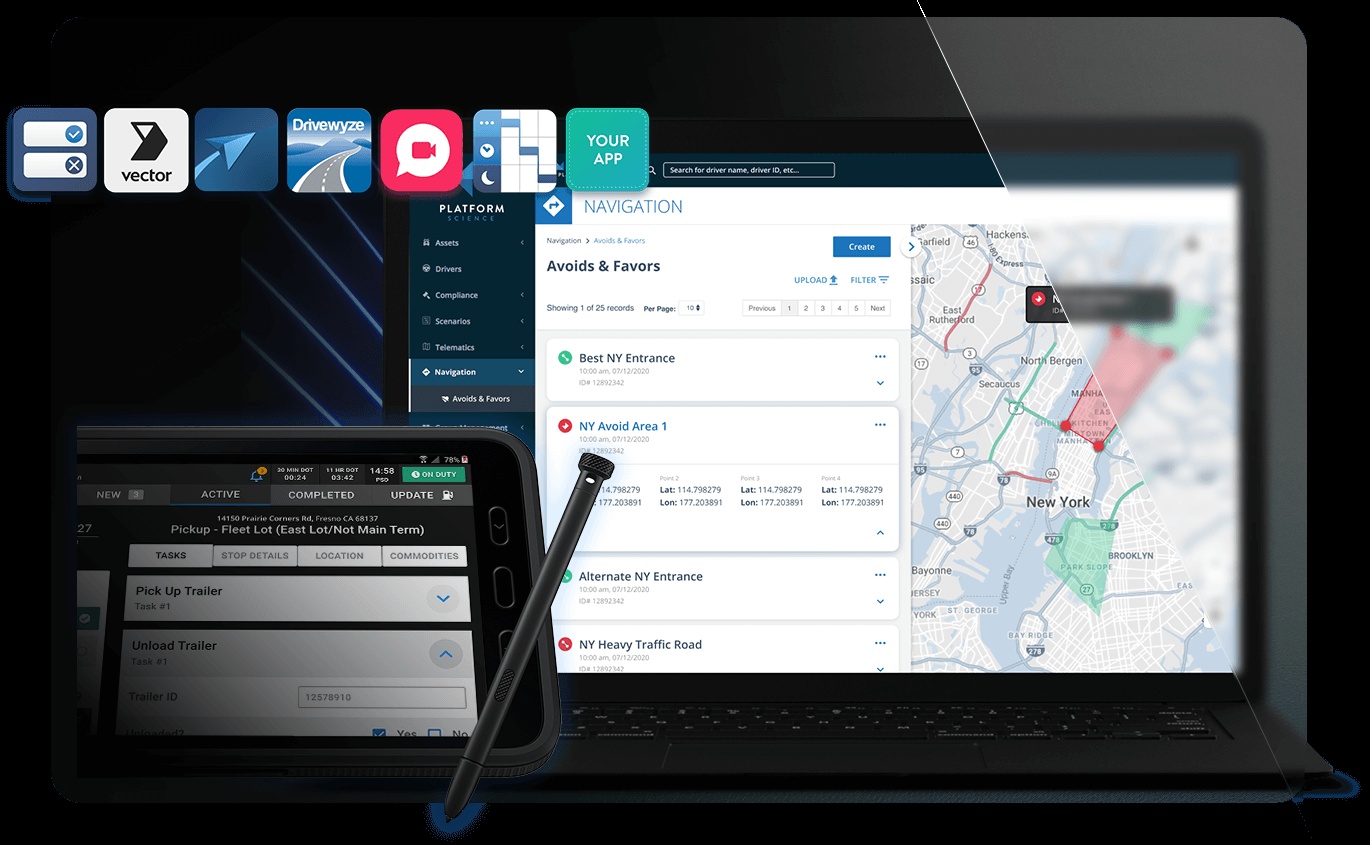
Platform Science’s direction is Virtual Vehicle: an application platform spanning compatible factory-installed architecture and aftermarket hardware. Its stated goal is to let customers choose software without having to change hardware. That is an ambition buyers can test in their own fleets. Compatibility, integration and deployment conditions still determine how much freedom a particular truck actually offers.
Copy the workflow, budget for the replacement
PeopleNet now occupies an unusual position in the market: a familiar name and login attached to a business whose ownership and branding have evolved. Alternatives include Samsara, Motive, Geotab and Omnitracs/Solera, with Lytx among the video-safety options. The relevant comparison is the buyer’s mix of logging, cameras, diagnostics, integrations and driver tasks.
PeopleNet’s distinctive historical approach joined truck hardware, fleet communications and industry-specific software, including factory diagnostics relationships. Its value was the connection between an observation and someone able to act on it. That can matter to a complex fleet with an established back office. A simpler operation may have fewer reasons to pay for a broad system or undertake a substantial installation.
The most portable lesson is also the least theatrical. Start with a task that fails expensively. Make the information usable by the person responsible. Test it with drivers and office staff before extending the deployment. Budget for the equipment to change. And keep a workable fallback. Fortune needed a clearer view of the road. The rest of PeopleNet’s history explains the work required to keep that view available.