Coast raises $40M Series B led by ICONIQ Growth Nearly $100M total equity raised Revenue up roughly 10x in 18 months Customers save ~10% on fuel & 16 hrs of admin a month Partners: Visa, 7-Eleven, Casey's, RaceTrac, Cumberland Farms Second HQ opens in Utah Coast raises $40M Series B led by ICONIQ Growth Nearly $100M total equity raised Revenue up roughly 10x in 18 months Customers save ~10% on fuel & 16 hrs of admin a month Partners: Visa, 7-Eleven, Casey's, RaceTrac, Cumberland Farms Second HQ opens in Utah
YesPress Profile / Fintech

Coast.

The card that knows where your truck is - and what its gas tank can hold.

Founded 2020 New York, USA Fuel & Fleet Payments ~$100M Raised
Coast fuel and fleet card product

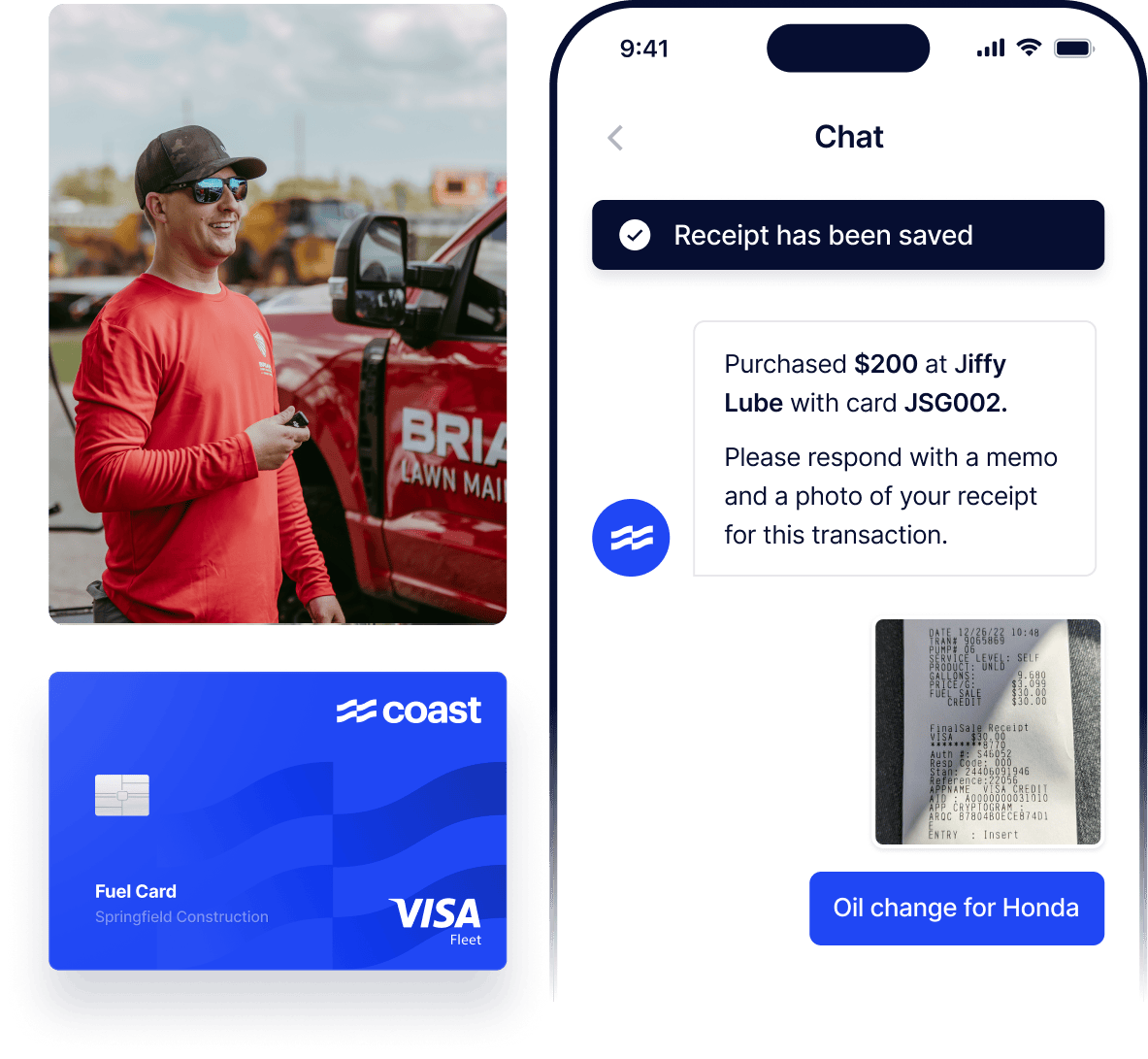
EXHIBIT A: Coast's card and software, photographed mid-shift. The least exciting object in any glovebox, doing the most arithmetic.

The Scene

A pump, a phone, and a quiet revolution

It is 6:40 a.m. at a fuel island somewhere off an interstate, and a plumber is filling a work truck. Before the pump turns on, his phone buzzes. A text. He replies with a code. The diesel flows. Behind that small exchange, a New York fintech called Coast has already checked the truck's GPS location, confirmed the tank can actually hold what's about to be pumped, applied the company's spending rules, logged the receipt, and queued a rebate. The driver noticed none of it. That is the point.

Coast sells a fuel and fleet card. Said out loud, that sounds about as thrilling as a parking receipt. And yet this is a company that has raised close to $100 million in equity, convinced Visa to write a white paper about it, and grown revenue roughly tenfold in a year and a half. The unglamorous corner of business it chose - paying for gas in work trucks - turns out to be enormous, broken, and quietly bleeding money.

Coast took the most boring transaction in American business and made it answer questions. - The thesis, in one line
The Problem They Saw

Fuel cards that trusted everyone

Here is the tension that Coast exists to resolve. Millions of businesses - landscapers, HVAC techs, roofers, pest-control vans, delivery fleets - run on fuel. To pay for it, most carried legacy fuel cards designed decades ago. Those cards were generous in the worst way: they trusted whoever was holding them. A card could be swiped at a station 200 miles from any job site, for a tank twice the size of the vehicle, and the system would shrug and approve it.

The result was fuel theft, a problem measured in billions of dollars a year, and an administrative swamp on top of it. Every gallon meant a paper receipt, a spreadsheet, an expense report, and a manager squinting at line items trying to tell fraud from a legitimate fill-up. Fleet operators were paying twice: once at the pump, and again in the hours spent reconciling what happened there.

Old fuel cards had exactly one security feature: hope. - The status quo Coast set out to retire

The incumbents - WEX, Fuelman, Comdata - had scale, station networks, and decades of relationships. What they did not have was software anyone enjoyed using. The data arrived late. The controls were blunt. The fraud kept happening. Into that gap walked a founder who had already built a payments company once before.
The Founder's Bet

A second act, on four wheels

Daniel Simon had done this before. He co-founded Bread, a digital-payments platform that Alliance Data Systems bought for more than $500 million in 2020. He could have done almost anything next. He chose fuel cards. That decision tells you most of what you need to know about Coast: this is a company that ran toward the part of fintech nobody puts on a conference poster.

The bet was specific. If you rebuilt the fuel card from the payment rail up - on the Visa network, wrapped in software, with controls that could be set per card, per driver, per vehicle - you could turn a dumb piece of plastic into something closer to a decision engine. Set the rules once. Let the card enforce them at the pump. Match every swipe against where the truck actually is and how big its tank actually is. Then hand the manager clean data instead of a shoebox of receipts.

"The last company we had major fraud issues. In the Coast System, I feel it is almost impossible." - A Coast customer, reviewing the platform

Investors noticed. Accel and Insight Partners led a $27.5 million Series A alongside a Visa collaboration. Then, in a stretch that says something about momentum, Coast raised $92 million in combined equity and debt in early 2024 - and four months later closed a $40 million Series B led by ICONIQ Growth, with consumer-finance heavyweight Synchrony joining as a strategic investor. Raising twice in a single year is not normal. Diesel, it turns out, has a smell investors like.

The Mileposts

Coast, by the odometer

2020

The engine turns over

Daniel Simon, fresh off Bread's $500M+ exit, founds Coast in New York to rebuild fleet payments from the rail up.

2022

$27.5M Series A + Visa

Accel and Insight Partners lead the round; Coast begins its collaboration with Visa to put real controls on the card.

2023

Fivefold

The business grows more than 5x in a single year and signs fuel partners including 7-Eleven, Casey's and RaceTrac.

2024 / Q1

$92M and a white paper

Coast raises $25M equity plus $67M in debt, deepens the Visa partnership, and lands in a Visa fleet-card white paper.

2024 / Q3

$40M Series B

ICONIQ Growth leads; Synchrony joins as a strategic investor. Total equity raised approaches $100M.

2025

A second home

Coast expands product and partnerships and opens a second headquarters in Utah to support its growth.

The Product

One card, doing several jobs

Strip away the funding and what's left is a deceptively simple object: a Visa card that works anywhere Visa is accepted, paired with software that comes at no extra cost. Fuel, maintenance, supplies, travel, office runs - all of it lands on one card, auto-coded and synced to accounting. The expense report, that great American ritual of staplers and resentment, simply stops happening.

Spend Controls

Rules by card, driver, or vehicle - fuel type, dollar limits, and how often someone can fill up. The card enforces them at the pump.

GPS & Tank Matching

Telematics integrations check each transaction against the vehicle's location and tank capacity. Ghost gallons get flagged.

Expense Software

Receipt capture, automatic coding, real-time reporting, accounting sync - bundled in, not sold as an upsell.

Rebate Network

Per-gallon rebates and cashback at roughly 30,000 stations nationwide, including major fuel-brand partners.

A fuel card that declines a purchase because the truck isn't there is a fuel card that finally earns its keep. - On the GPS-match feature
The Proof

The numbers that do the arguing

Skepticism is fair. Plenty of fintechs promise savings and deliver dashboards. Coast's customers report something more concrete. Surveyed businesses that switched said they saved an average of 9-10% on their fuel bills and reclaimed about 16 hours of administrative work every month. One operator put a round number on it: roughly $10,000 a year, plus ten-odd hours back.

~10%Avg fuel savings
16 hrsAdmin saved / mo
~10xRevenue, 18 mo
30kRebate stations

Equity raised, round by round

USD millions, approximate / disclosed equity portions
Series A '22
$27.5M
Equity '24
$25M
Series B '24
$40M
Total equity
~$100M
Bars scaled to the largest figure. Excludes ~$67M in committed debt capital raised alongside the 2024 equity.

Then there's the company Coast keeps. Visa is both a network and a strategic partner. The fuel side reads like a road-trip map: 7-Eleven Fleet (including Speedway), Casey's, RaceTrac, EG America's brands such as Cumberland Farms, and Discount Tire for the maintenance bay. Thousands of businesses now run on Coast - some with a handful of cards, some with more than a thousand.

"We're saving an average of $10,000 a year on fuel and 10+ hours of admin a month. We love how easy the cards are to use." - A Coast customer review
The Mission

Fintech for the people who fix things

Most fintech aims at office workers with laptops. Coast aimed at the person in steel-toed boots at a fuel island before sunrise. Its stated mission is plain: modernize how businesses pay for and manage fuel, fleet, and field expenses - replacing decades-old cards and manual reports with controls that actually work. The customers are the trades. Construction. HVAC. Plumbing. Landscaping. Roofing. Solar. The economy's load-bearing wall.

Things that amuse and inform

  • Coast's design is SMS-first - drivers can unlock the pump from a text message, no app gymnastics required.
  • The card can decline a purchase based on the truck's GPS location and tank size before a single gallon flows.
  • Founder Daniel Simon's previous company, Bread, sold for more than $500 million in 2020.
  • Coast raised $40 million just four months after a $25 million equity round - twice in one year.

There is a mild irony here worth naming. The most futuristic thing Coast built isn't a chatbot or a token - it's a way to make sure the right truck got the right gas. Sometimes innovation looks like subtraction: fewer receipts, fewer fraud cases, fewer hours lost to reconciliation.

Why It Matters Tomorrow

Back at the pump

The fleet-payments market is vast and still mostly running on legacy plastic. Coast's bet is that every one of those cards is a candidate for replacement - and that the businesses carrying them are tired of trusting hope. With a near-$100M war chest, a Visa partnership, and a second headquarters in Utah, the company is wagering that the boring middle of the economy is exactly where the next big fintech gets built.

Return to that fuel island at 6:40 a.m. The plumber is still there, still filling the same truck. But the morning is different now. No paper receipt to lose. No 200-mile-away phantom charge to dispute later. No expense report waiting at the office. The pump clicks off, the rebate posts, the books update themselves, and he drives to the first job of the day. The revolution was quiet because it had to be. The best plumbing usually is.

Coast didn't make paying for gas exciting. It made it invisible. For a fleet manager, that's the same thing. - The closing argument

Spread the word on Coast

LinkedIn Twitter / X Facebook Instagram Copy URL

Share the most over-engineered gas card in America.