Five ships, more than 130,000 nautical miles and a decision to buy more. Eastern Pacific Shipping’s August 2026 expansion with Orca AI offers a useful answer to the question hanging over industrial artificial intelligence: what happens after the pilot? In this case, the customer committed to deploying the platform on dozens of additional vessels. The sales pitch had survived time at sea.
The reported results were specific: close encounters fell 48% per 1,000 nautical miles, while average minimum passing distance rose 10%. EPS technical director Sachin Saharawat said the pilot’s operational evidence gave the company confidence to expand. These are the companies’ reported observations, rather than a controlled experiment. Still, buying more equipment is a more consequential response than applauding a demonstration.
Orca AI sells ships an extra set of eyes and gives their managers a way to learn from what those eyes see. Its SeaPod watches surrounding traffic; FleetView turns navigational events into information for the office. The immediate proposition is wonderfully unglamorous: spot trouble sooner, make a better decision, and get through the watch with fewer nasty surprises.
02The lookout has a replay button
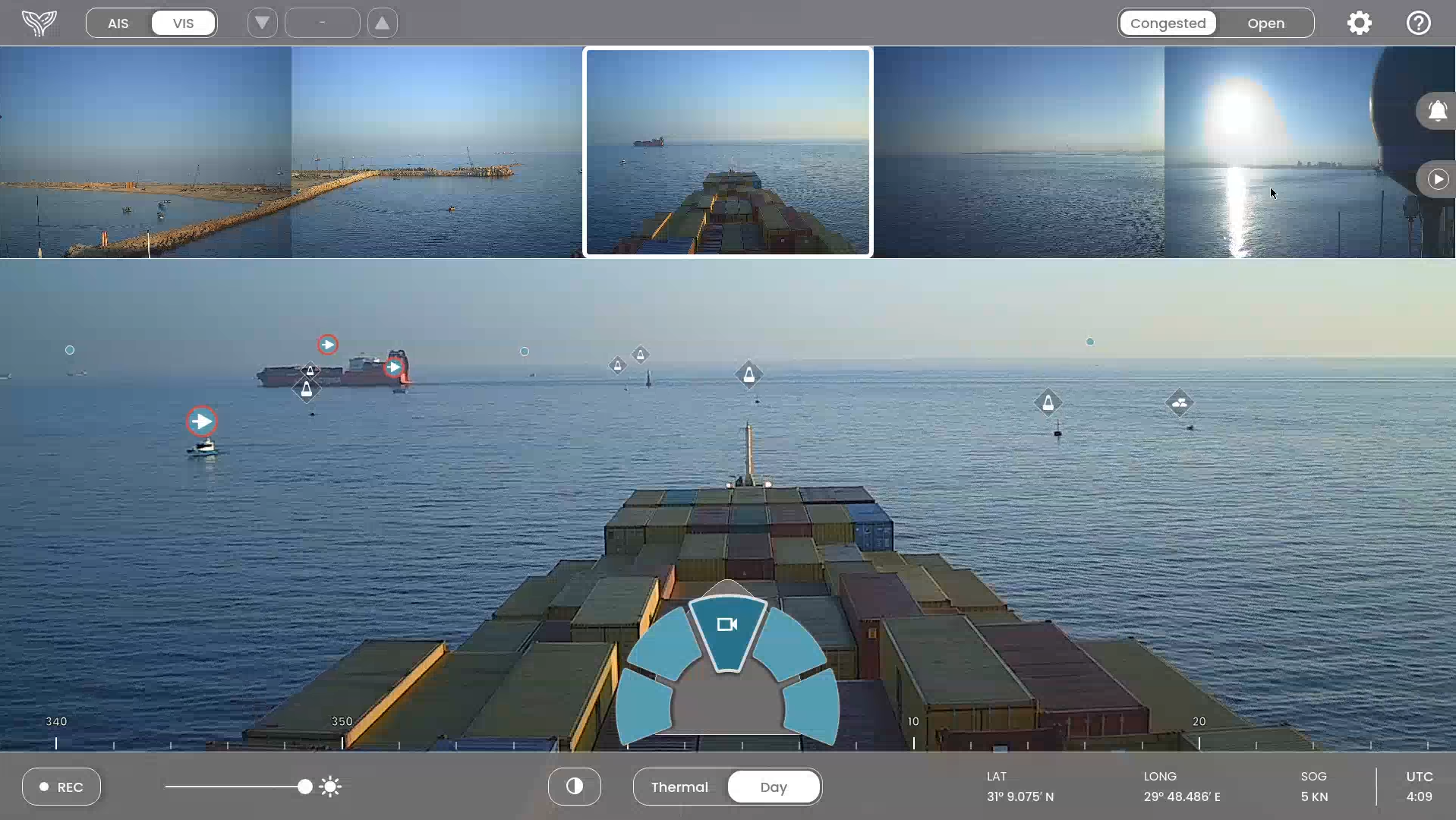
SeaPod combines cameras, computer vision and information from onboard navigation equipment. It detects and tracks objects, estimates their distance and prioritizes possible hazards on a bridge display. Fishing boats and buoys that do not transmit through the Automatic Identification System, or AIS, are part of the problem it is designed to address. An object does not become harmless because it has neglected to introduce itself electronically.
The product’s useful translation is from a crowded scene to a short list of things requiring attention. Closest point of approach describes how near another target is expected to pass; time to closest point of approach tells the watchkeeper how soon. SeaPod presents those parameters alongside its visual picture. Officers can spend more attention judging a situation and less stitching together scattered clues.
There is serious hardware behind the interface. Orca AI’s January 2024 SeaPod release described a 10-kilogram unit with five day cameras and three thermal cameras, engineered for installation high above the bridge. It said installation could take a day. The company even explained that tilted lenses help water run off. Maritime AI has to contend with weather before anyone gets to admire the algorithm.
FleetView carries the record ashore. Operations staff can examine trends, replay events and use video during debriefs. A close encounter that ends without damage can still become a training opportunity. That changes the raw material of a safety meeting: a particular ship, a particular crossing and a sequence everybody can examine, instead of a vague instruction to be more careful.
03A good score, with the sea conditions attached
Lloyd’s Register put the system through a live assessment on a feeder containership over five days and 828 nautical miles. Its April 2026 account covered a Mediterranean itinerary through Italy, Montenegro and Malta, including congested approaches and open water. The assessor compared detections with radar, AIS and visual observations. The reported scores were 98.6% recall and 94% precision, with no system downtime during the voyage.
Recall asks how many relevant targets the system finds. Precision asks how many reported detections are correct. They describe different kinds of mistakes; neither means a ship is 98.6% collision-proof. The trial also included human-factors work and crew feedback. A display has to be understandable to the person standing in front of it, especially when there is little time for interpretation.
A separate Orca AI-NorthStandard study examined 139 vessels over more than 10.8 million nautical miles. Published in April 2026, it reported a 52% reduction in high-severity close encounters across a year. The comparison was between the first three months after installation and months ten through twelve. In other words, the baseline already involved installed equipment.
That makes adaptation part of the story. The result describes what happened as crews lived with the platform, rather than a clean comparison between ships with AI and identical ships without it. Traffic exposure, operating routines and training matter when interpreting such evidence. A buyer should preserve the study’s definitions and time windows before copying its percentage into a budget proposal.
139 vessels · 12-month observation
Months 1-3 compared with months 10-12 after installation. Orca AI-NorthStandard study.
04The office gets the same ocean
Orca AI’s customers include container fleets, tanker operators and bulk-carrier owners. Its website now reports more than 1,600 vessels operating with the platform and a dataset exceeding 200 million nautical miles. Those are company figures. Named users include MSC, NYK and Seaspan. This is an enterprise sale to people responsible for expensive moving assets, backed by onboard installation and continuing software services.
The company’s business model follows that combination: fitted equipment and a software subscription relationship with fleet operators. In a 2023 interview, chief executive Yarden Gross linked maritime SaaS to improving satellite connectivity. When ships can exchange substantial data with shore, software can be updated and managers can receive something richer than a delayed report. Connectivity makes the commercial relationship useful between port calls.
The Seaspan case study puts a financial marker on the argument: about $100,000 in annual fuel savings per vessel, as reported in Orca AI’s customer material. Earlier awareness can reduce avoidable maneuvers and the speed changes that accompany them. The same study describes office teams using FleetView to examine events and spread lessons across the fleet. The economic case combines operating discipline with fuel economy.
That savings figure is a benefit estimate, not the purchase price or a guaranteed return. A sensible procurement calculation compares the actual contract and installation expense with benefits measured on the buyer’s routes. Crew training, support and connectivity belong in that calculation too. If an operation makes few avoidable maneuvers to begin with, the fuel-saving opportunity will be smaller.
- 01 / SEESeaPod detects and prioritizes targets.
- 02 / DECIDEThe bridge team judges the encounter.
- 03 / REVIEWFleetView makes the event available for learning.
05Their first underestimate was the ocean
Yarden Gross and Dor Raviv founded Orca AI in 2018. Both had served in the Israeli Navy before working in technology; Gross became CEO and Raviv CTO. The company’s stated ambition is to bring data and automation into shipping, eventually helping make fully autonomous vessels practical. Its expertise combines maritime operations, computer vision and deep learning.
Gross has described building the business as “much more challenging than expected.” The obstacle he identified was concrete: conservative customers and ships spending weeks away from land, requiring remote work and substantial data collection to improve models. His account suggests the early underestimate was the difficulty of deployment. A floating workplace does not offer the convenient debugging conditions of an office down the street.
The hiring philosophy he described emphasized experienced people willing to execute through uncertainty. That is the founder’s account of the culture, not an employee satisfaction survey. The more observable cultural choice is to connect engineering with seamanship: the products put recorded encounters, crew feedback and navigational judgment close to the center of the improvement process.
Capital has bought room to pursue it. Orca AI announced a $13 million Series A in 2021, followed by $23 million in funding in 2024. A $72.5 million Series B led by Brighton Park Capital arrived in May 2025, with Ankona Capital and Hyperlink Ventures participating. The company put total funding at approximately $111 million. That is money raised to build the business, not customer revenue.

“much more challenging than expected”Yarden Gross on building Orca AI
Maritime Reporter interview, 2023
06Autonomy needs more than a pair of eyes
The ambition already has a notable test voyage behind it. In 2022, the cargo ship Suzaku completed a 40-hour demonstration with full autonomy activated for 99% of the journey’s time, according to the project announcement. Orca AI supplied perception using 18 cameras. The effort involved the DFFAS consortium, led by NYK group companies, and the Nippon Foundation.
Its models had been trained on a year of data collected from Suzaku. That preparation matters as much as the headline percentage. The achievement belonged to an integrated consortium project, with perception providing one essential function. Installing a lookout on a merchant ship should not be confused with delivering every system needed to navigate it autonomously.
A memorandum of understanding with Samsung Heavy Industries, announced in April 2026, shows how Orca AI wants to connect those functions. The companies plan to combine situational awareness with Samsung’s berthing assistance and speed-control technology. Orca AI is also intended to become standard on newbuilds equipped with Samsung’s autonomous-ship solution. This is a phased integration plan, with opportunities in retrofits as well as new vessels.
Competitors occupy overlapping parts of that market. SEA.AI also uses optical and thermal cameras to detect objects conventional equipment can miss, with products for commercial, government and recreational users. Orca AI’s distinguishing proposition is the connection between its bridge lookout and the fleet’s operational learning process. A comparison should examine the whole workflow, rather than treat having an AI camera as a unique invention.
07The next ship can learn from yours
Co-Captain extends that connection between vessels. Introduced in November 2025, it combines reports from equipped ships with external information, including weather and vessel traffic, to deliver alerts relevant to intersecting routes. GPS spoofing and other navigational hazards feature in its product description. Its usefulness depends on timely, relevant information reaching the next crew; sparse or stale reporting would weaken that advantage.
MasterView brings another audience into focus: the master of an individual ship. It organizes safety events, recurring risk areas and performance by shift, with video and track data for debriefing. Giving the onboard team a way to inspect its own record makes operational learning a task that can happen at sea, as well as in a distant fleet office.
For another industrial company, the copyable lesson is the sequence: begin with a bounded operational problem, collect evidence during normal work, give users a way to review it, then earn the expansion. For shipowners, the boundary is equally practical. Orca AI’s published guidance treats its platform as complementary to radar and electronic charts, with navigation decisions remaining with the master and watch officer.
An alert has value only if a crew can interpret it and act in time. A useful fleet rollout therefore includes trained users, working equipment and repeated review of actual encounters. EPS’s expansion makes that process tangible. The customer tested five ships and decided to equip more. For an AI company selling into shipping, that is a persuasive kind of progress.
Go aboard
Orca AI website · LinkedIn · YouTube
Watch: SeaPod product demonstration
Watch: Yarden Gross interviewed by Maritime Reporter
Watch: Maran Tankers officers discuss Orca AI
Watch: Singapore Maritime Week panel
Read: Eastern Pacific Shipping rollout
Read: Lloyd’s Register live-vessel assessment
Read: Orca AI-NorthStandard safety study