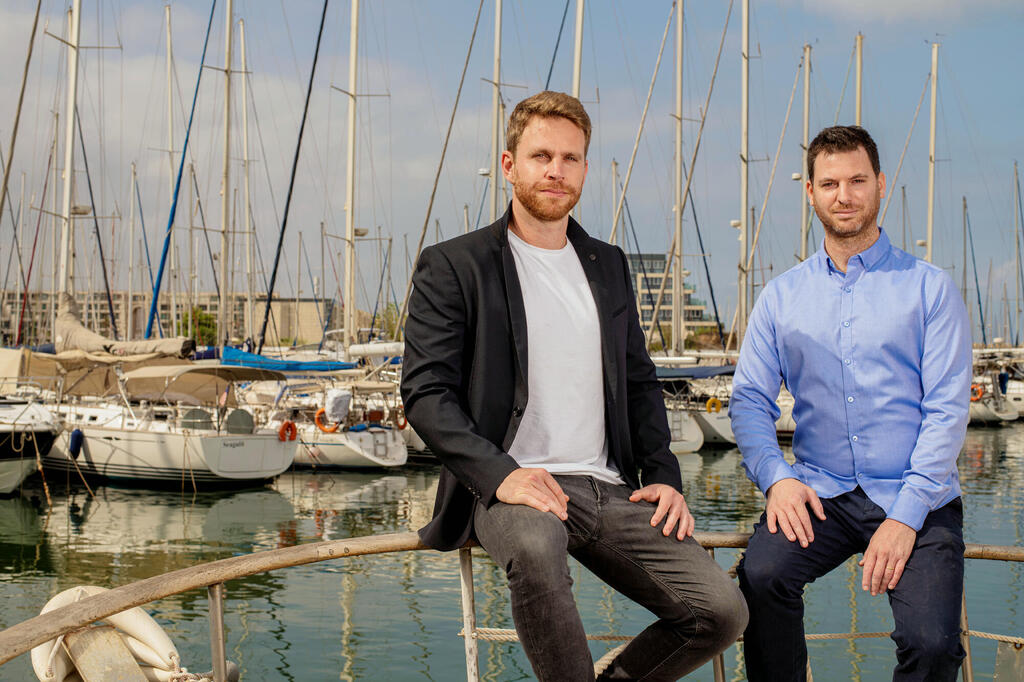
Yarden Gross went to Indonesia to surf with his brother. He had left his automotive startup, Engie, and was spending his days in the water. Yet the traffic kept intruding: large ships moving through the same seascape. An earlier conversation with an old Navy friend, Dor Raviv, began to acquire a business shape. When Gross returned to Israel, he called him. The sea had interrupted a holiday with an assignment.
That is one way into the story of Orca AI, the company they founded in 2018. Another begins much earlier, with a small boy on a tourist boat on Lake Galilee. Between those scenes came military service, a business degree and an attempt to make car ownership less mysterious. Gross’s career has followed a surprisingly consistent question: how do you help people understand what their machines are telling them?
The water came first
His family operated tourist boats and restaurants beside the lake. Gross remembers sitting on a captain’s lap as the boat carried visitors, watching and learning how it moved. Water was part of the family business before it became the setting for his own. The inheritance included customers, operations and the practical demands of getting something done.
He would later name his father and grandfather when asked who represented success to him. His grandfather had built the boat business; his father expanded into restaurants. These were the entrepreneurs nearest at hand. Their work gave the word a local meaning long before Gross had a venture-backed company to run.
Sailing became a passion. By his own account, he was a licensed skipper at 17. He joined the Israeli Navy, where he served as a diving course instructor. He and Raviv met during a commanders course. Their later partnership would bring together business experience and technical experience, with a shared familiarity with the environment in which they intended to sell.
A useful detour through the garage
Gross studied economics and business at IDC Herzliya, now Reichman University. His first startup took him toward cars. Engie connected vehicles with smartphones, helping drivers understand faults and compare repair options. Anyone who has stared at an unfamiliar warning light can appreciate the appeal. Information becomes useful when someone can act on it.
Engie eventually ceased operating in 2020. Gross has spoken candidly about problems with its business model and the lessons he took away: recruiting people, raising money, building a product and developing a strategy. The experience belongs in his story because it complicates the tidy version of a founder progressing from one inevitable success to the next.
One relationship travelled with him. He has described Waze co-founder Uri Levine, chairman of his earlier startup, as an influential mentor. The connection makes sense alongside Gross’s interest in connected vehicles: a machine’s observations can have value beyond the person sitting inside it. Across a fleet, those observations can become a picture that no individual operator possesses.
In shipping, he saw an opportunity to connect that picture to the people ashore. Computer vision could help crews interpret their surroundings; data could help managers review events. The return to maritime work brought his earlier commercial experience into contact with something he had known since childhood. Familiarity supplied a starting point. It did not supply a finished product.
“much more challenging than expected”
Gross on building Orca AI
A ship is an awkward place to debug
The founders’ early workplace was his brother’s restaurant, Gross recalled in a 2022 interview. It is an appealing detail in a business concerned with oceans and automation: the first office was somewhere people ordinarily went for dinner. The ambitions were expansive. The arrangements were available.
Shipping then imposed its own timetable. Gross has described the difficulty of building technology for vessels that spend weeks away from land. Collecting data, improving models and supporting installations had to happen across distance. A customer’s workplace could sail away from the development team. That adds a certain discipline to the phrase “we’ll take a look.”
Orca AI’s approach combines cameras and computer vision with navigational information. SeaPod supports the bridge’s view of nearby vessels and objects. FleetView gives shore teams a way to examine operations and encounters. The names sound straightforward because the jobs are concrete: see the surroundings, understand the risk, and make the information usable where decisions happen.
A Japanese demonstration gave that work a demanding setting. From February 26 to March 1, 2022, the DFFAS consortium conducted a trial between Tokyo Bay and Ise Bay. NYK described a route of approximately 790 kilometres. The project involved 30 Japanese companies, including several within the NYK group, under the Nippon Foundation’s MEGURI 2040 programme.
Orca AI supplied perception technology for the Suzaku. Its account described 40 hours of navigation, with autonomous operation active for 99 percent of the journey time, and 107 automatic collision-avoidance manoeuvres on the outbound leg. Those figures describe a particular trial. They also explain why the voyage became a milestone for the founders: the idea had encountered actual traffic.
The crew gets a vote
Gross’s longer ambition is autonomous commercial shipping. His near-term language keeps returning to the people already aboard. In 2025, discussing AI’s role alongside Lloyd’s Register’s Dipali Kuchekar, he put it plainly: “AI is replacing tasks, not people.” The distinction matters when the proposed technology is arriving at somebody else’s workplace.
In later comments, he has emphasized reliability, training and fitting into existing bridge routines. An officer needs a useful picture of the situation. A shoreside team needs information it can review. Adding another workflow creates a demand on the very people the system is supposed to assist. The purchase decision and the crew’s everyday acceptance are separate achievements.
There is a human scale to that argument. A shipping contract may cover many vessels, but the encounter with the product happens one watch at a time. Someone decides whether the screen deserves attention. Someone learns how its information relates to what is visible outside. Training, repeated use and consistency give the commercial promise its working meaning.
Gross has also argued that efficiency depends on the operation’s objectives. Going faster does not automatically make a voyage more efficient. The useful answer depends on what the operator needs to achieve. That leaves the technology with a harder job than producing a bright display: it must help people make decisions within the demands of a real voyage.
Five ships, then the next decision
Eastern Pacific Shipping provides a recent example of that progression. An August 2026 announcement described a five-vessel pilot spanning more than 130,000 nautical miles, followed by expansion to dozens of additional ships. It is a useful scale at which to examine Gross’s argument about trust: a bounded deployment, operating data, then a decision to go further.
Figures reported for this pilot. The bar represents the remaining encounter rate against a baseline of 100; these results are not a forecast for every vessel.
The reported reductions concern encounters and passing distances, rather than a count of accidents prevented. That precision is part of what makes the example useful. A crew can review how a situation developed; an operator can assess a pattern across voyages. Gross’s case for the system becomes easier to examine when the outcome has a defined measure.
It also moves the founder’s story beyond a demonstration ship. The question after a successful test is how the equipment becomes ordinary enough to use across a fleet. Routine is an unglamorous achievement. In navigation, a tool that earns its place in routine may have more staying power than one that performs beautifully on a conference screen.
A longer horizon, with company
Money has given the company more room to pursue that work. Orca AI announced a $72.5 million Series B in May 2025, led by Brighton Park Capital with participation from Ankona Capital and Hyperlink Ventures. It put total funding at $111 million. Gross described the investment as a way to accelerate research, data acquisition and partnerships while retaining a focus on decision support.
The product and partnership map has continued to expand. Co-Captain was introduced to let connected vessels share operational information. In April 2026, Orca AI and Samsung Heavy Industries announced a memorandum of understanding covering a phased collaboration on autonomous vessel technologies, including navigation, berthing and speed optimization. Such agreements set out work to pursue; their value will depend on what reaches operations.
Ask Gross about leadership, though, and the scale contracts again. His stated motto is “Hiring the right people to do the right job.” In describing his proudest moments, he has singled out discussions in which colleagues understood a particular problem better than he did and argued about it because they cared. The chief executive’s satisfying meeting contains informed disagreement.
That answer fits a career built from several kinds of knowledge: family enterprise, seamanship, automotive data, software and shipping operations. Gross has urged founders to be persistent and to plan years ahead. His own route suggests why both might help. The next destination can be clear while the work of reaching it remains full of adjustments.
The boy on the tourist boat was learning how a vessel moves. The founder is trying to give many vessels a better account of what surrounds them, and a way to share it. Between those two versions of Gross sits a garage, a restaurant and a surfing holiday. He has returned to the water with rather more people to call.
Continue the voyage
- Orca AI website
- Yarden Gross on LinkedIn
- Watch: Maritime Reporter interview
- Read: his career and leadership outlook
- Read: the founders’ early years
- Read: the Eastern Pacific Shipping rollout
- Read: the Samsung Heavy Industries collaboration
- Read: NYK’s trial documentary
- Read: Gross on AI and decision support