Amir Hever’s business began with an inspection that seemed to inspect very little. He and his brother Ohad were entering a sensitive facility in Israel when they watched a security guard check beneath their vehicle with a mirror. The procedure had an obvious purpose: find something dangerous before allowing the car inside. The equipment invited a question. How much could anyone really see?
For the brothers, that question became a company. They founded UVeye in 2016, combining computer vision with cameras and a drive-over scanner. A vehicle would pass across the system; software would examine its underside and flag an anomaly. The proposition was practical enough to explain at a gate. Make the hidden parts visible, then help someone decide what deserved attention.
There is a pleasing indignity in this origin story. While much of the technology industry was busy improving what happened on a screen, Hever was interested in the grimy territory below a car. It was an unglamorous place to look for a business. It also happened to be a place where expensive, consequential things could go unnoticed.
In an early parking-lot test, after months spent refining the algorithms, the team’s interface flagged a prototype explosive device beneath a vehicle. Hever remembers the red alert appearing on the screen. He called it “a genuine WOW moment.” The idea had acquired a visible result. For an engineer, a little red box can be quite a substantial occasion.
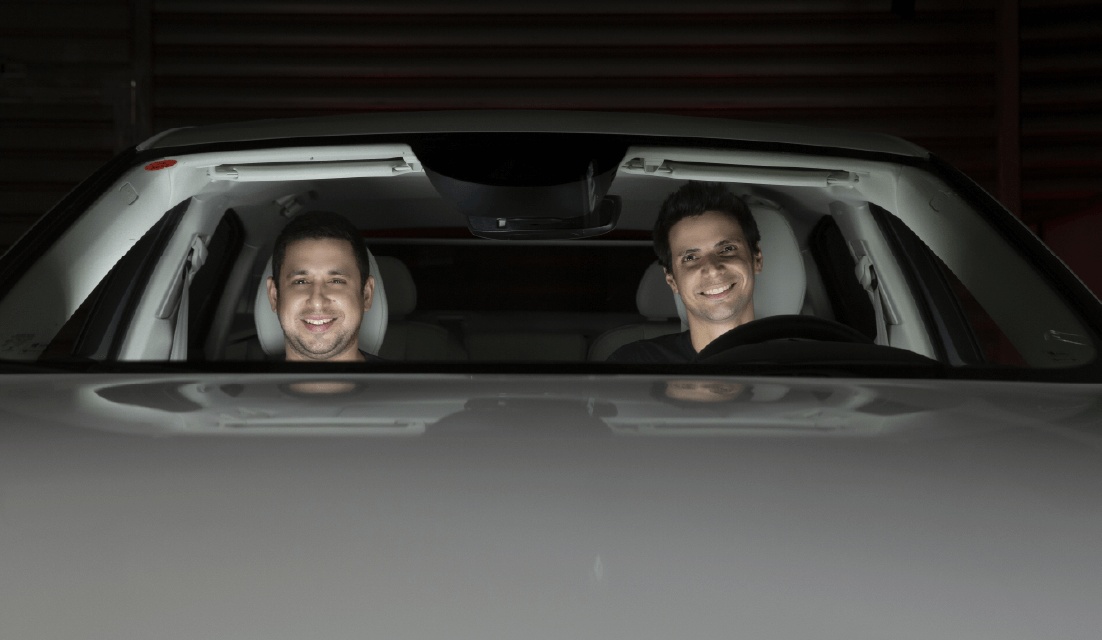
An oil leak changes the question
The scanner went into security settings, including airports, seaports and other controlled facilities. Then it began reporting things that were wrong with the cars themselves. Oil leaks. Broken components. Missing parts. The system had been built to notice what did not belong under a vehicle, and ordinary mechanical trouble kept volunteering for the role.
That discovery created a choice. The brothers could treat these alerts as distractions from their original security mission, or ask who might want to pay attention to them. Around the same period, three European car manufacturers approached UVeye. A tool for finding threats was also producing information useful to people responsible for building and maintaining cars.
Hever describes the transition as a process of learning where the technology fitted. The applications expanded from underbody scanning into inspection of tires and exterior bodywork. Assembly-line quality checks offered one route. Dealerships, auctions and fleets offered others. The same vehicle could need an inspection at several different moments, for several different reasons.
The detail that matters is the sequence. Hever had a working way to look beneath vehicles before he had settled every commercial use for what it revealed. The customers and the images helped define the business. In his telling, the eventual focus took years to work out. The oil leak supplied a clue; it did not arrive with a finished sales plan.
Two brothers, two kinds of expertise
Hever came to UVeye with a background in image processing. He had worked at Correlsense, which made software for managing enterprise application performance, and served as vice president of research and development at Visualead. That company developed visual and mobile technology and was later acquired by Alibaba. UVeye is his third venture.
Ohad brought complementary experience with hardware and cameras. Amir has described their combination in straightforward engineering terms: his own computer-vision background alongside his brother’s ability to work out the physical camera setup. At UVeye, Amir became chief executive and Ohad chief operating officer. The family connection sits inside a division of responsibilities.
The product requires both kinds of thinking. An algorithm needs useful images to examine. A camera installation needs software that can turn those images into a finding someone understands. A service lane introduces further constraints: vehicles must pass through it, staff must use the result, and a customer needs to see why a repair is being proposed.
Hever’s work consequently stretches beyond identifying a defect. He has talked about adapting the equipment’s footprint and improving the customer experience while learning from American automotive professionals. The scanner has to belong in the workplace around it. Even a persuasive red box is of limited use if nobody knows what to do next.
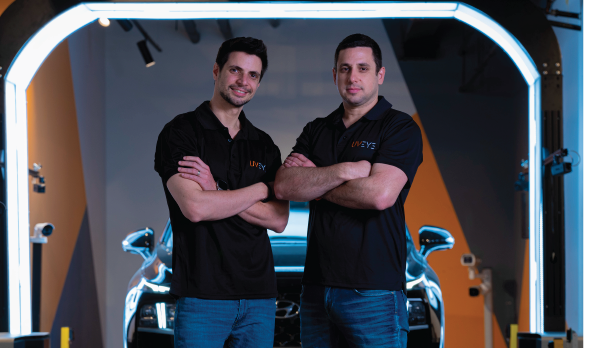
New Jersey, with a change of accent
Building the American business also changed Hever’s own geography. By a November 2022 interview, he had relocated to New Jersey with his family more than a year earlier. He joked that his daughter already had a better American accent than he did. International expansion had acquired a domestic soundtrack.
UVeye established its US headquarters in Teaneck and an office in Cleveland. Hever liked the New Jersey location for reasons that sound more like a working calendar than a relocation brochure: proximity to Manhattan, nearby automotive relationships and access to people with relevant experience. Volvo’s headquarters in Mahwah was among the advantages he mentioned.
There is a useful scale change here. A founder can explain a company through international offices and customer networks. Hever’s aside about his daughter brings the story back to a household making a move. The company’s American expansion was also the place where his family was learning to live.
His accounts of actual vehicle scans have a similarly concrete quality. He has described seeing pliers used to hold an exhaust pipe together. Cars, it turns out, sometimes contain repairs that are difficult to admire and easier to photograph. For a business built around visual evidence, the improvised exhaust is a memorable demonstration.
The picture before the repair bill
In a dealership, the finding has two audiences. A technician needs to understand the work. The person who owns the car needs to understand the recommendation. Hever has repeatedly returned to transparency: a vehicle’s condition should be something a customer can examine, rather than simply accept on somebody else’s authority.
The systems split that examination into parts. Helios looks underneath. Artemis examines tires. Atlas addresses the exterior. Together, cameras and software can give staff images of damage and wear that would otherwise require a separate inspection. The Greek names lend a little mythology to the workshop; their assignments remain admirably earthly.
CarMax became both an investor and a customer. Its January 2023 announcement with UVeye concerned automated inspections at wholesale auctions. That setting makes the value of a consistent visual record especially clear. A vehicle is being assessed for a transaction, and its condition influences what somebody believes it is worth.
General Motors’ collaboration, announced in 2022, made more than 4,000 dealerships eligible to purchase UVeye equipment. Eligibility is a doorway, not an installation count. For Hever, the relationship opened a route into an established network while leaving the work of adoption ahead: equipment, integration, staff routines and a useful result for each store.
The finding has two audiences. A technician needs to understand the work. The person who owns the car needs to understand the recommendation.
The service-lane question
Amazon adds the daily round
Amazon brought a different rhythm. A dealership sees cars arriving for service or sale. A delivery fleet needs to keep checking vehicles that return to work day after day. In October 2023, Amazon and UVeye announced Automated Vehicle Inspection, with deployment planned across delivery stations in the United States, Canada, Germany and the United Kingdom.
The collaboration had involved roughly three years of adaptation. Amazon’s range of vans and its own roadworthiness standards required the companies to train the models for the job. The partnership illustrates a less theatrical part of Hever’s story: winning a recognizable customer can mean a long stretch of fitting the product to that customer’s operations.
In Amazon’s description, a van travels through an archway and over camera-equipped plates at about five miles an hour. Findings are classified by severity and delivered into the fleet’s existing software. The inspection has to survive the handoff from image to action. Someone still needs to decide which vehicle can go out again.
That routine widens the significance of the original mirror. At a gate, the question concerned the vehicle entering a facility. At a delivery station, it concerns the vehicle leaving for another day’s work. Hever’s company has followed the inspection into another setting, where repeated observations can become part of the operating routine.
The capital behind the cameras
Physical systems make growth a manufacturing problem as well as a software problem. In January 2025, UVeye announced $191 million in additional financing. The package comprised $41 million in equity and a $150 million debt facility structured by Trinity Capital. Woven Capital, Toyota’s growth fund, led the equity financing.
The debt facility included an initial $100 million commitment and an option for another $50 million. UVeye linked the financing to producing and deploying more systems. Those distinctions matter. A funding headline can look like one large number, while the underlying arrangement separates ownership investment from money intended to support physical expansion.
By then, the company said it was approaching a million vehicle scans each month. In 2024, its inspection technology had appeared on TIME’s Best Inventions list. Recognition supplied a public milestone; the financing supplied resources for the next installations. Both belonged to a company still dependent on placing cameras in actual locations.
$41mEquity financing
$150mDebt facility
A longer route for the same idea
The subsequent announcements show Hever taking the inspection through more of a vehicle’s journey. In August 2025, UVeye announced operational systems at JLR’s US seaport facilities in Brunswick, Baltimore and Port Hueneme. These were cars arriving from overseas, being checked before they reached retailers. The port became another place to establish what condition a vehicle was in.
In January 2026, UVeye announced expanded support and resources available to more than 600 Subaru retailers in the United States. In July, it announced a Canadian dealership expansion, with systems operating in British Columbia and Ontario and more installations planned. Again, the distinction between a program’s reach and completed installations is essential to reading the progress fairly.
Hever’s stated ambition is to make automated inspection a standard across the automotive industry. His advice to other entrepreneurs is compact: “Be quick and agile to adapt your product.” In his own business, adaptation has meant changing the customer, enlarging the field of view and learning how an inspection fits into somebody else’s working day.
The story keeps returning to the person who needs to make a decision about a car. A guard at a gate. A technician in a service lane. A fleet manager preparing tomorrow’s vehicles. Hever’s contribution has been to give that person another way to look. The mirror started the question. The photographs, including the inconvenient ones, have kept it open.
Keep looking
More conversations with Hever, plus the work behind the photographs.