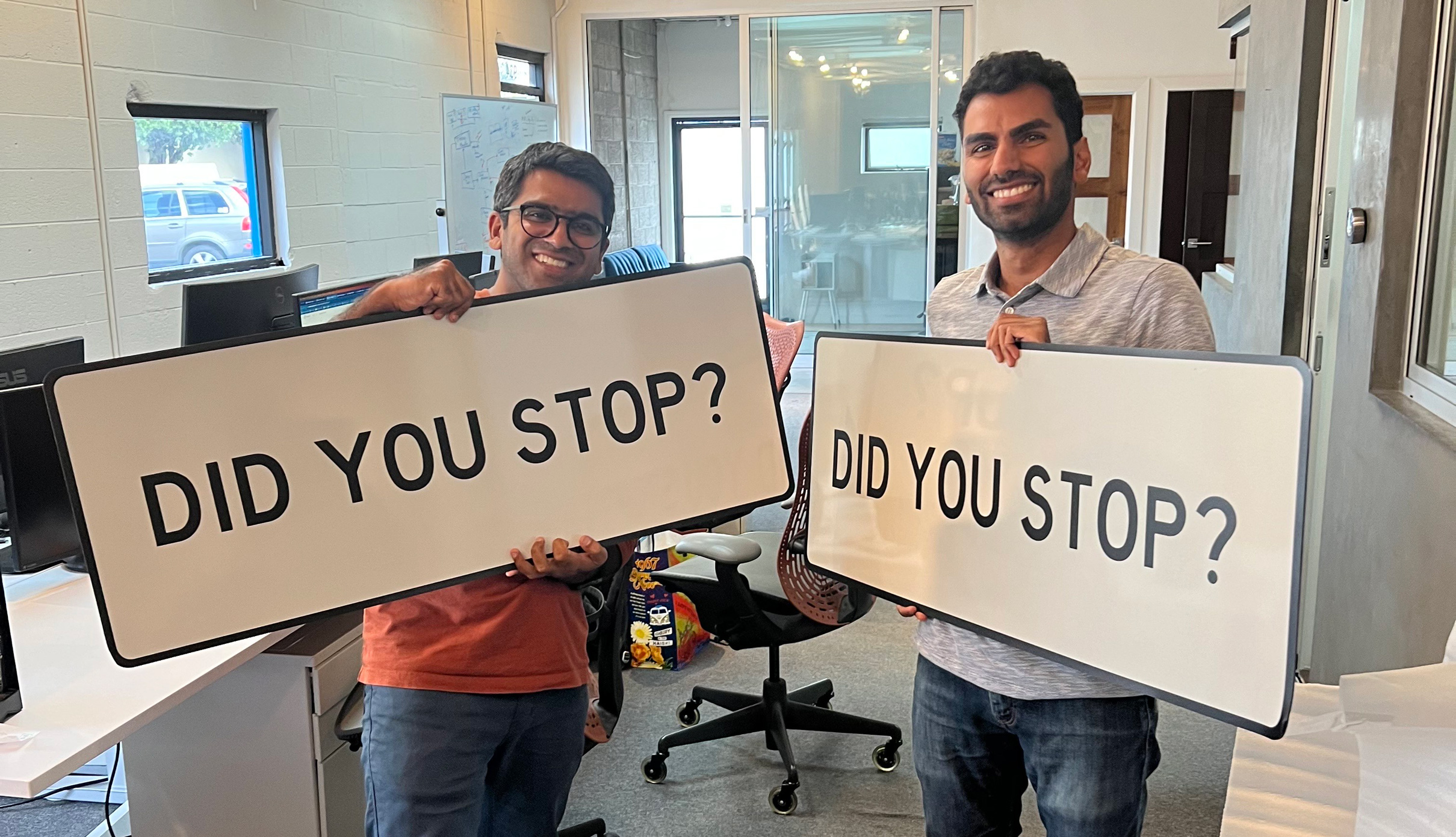
Ali Rehan and Dhruv Maheshwari are holding signs in their office. Each asks the same question: DID YOU STOP? The signs are large enough to make their holders look slightly like contestants in a very specific quiz show. It is a question built for a camera company. For Rehan, co-founder and CEO of Obvio, this is the latest destination in a career spent finding useful things for cameras to do.
Years earlier, his team’s camera software addressed a more sociable problem. Someone takes the group photograph. That person disappears from the group. The picture commemorates an occasion while quietly editing out one of its participants. Groopic, the app he helped create in Lahore, let two people take turns as photographer, then combined the shots. Everyone could get into the picture without recruiting a passing stranger.
There is an appealing distance between those two propositions. One promises a better souvenir. The other asks motorists to observe a stop sign. Follow Rehan’s work between them, though, and a consistent interest comes into view: making computer vision useful beyond the research lab. Along the way, the definition of useful has grown more complicated.
The person left out
On December 31, 2012, Rehan introduced Groopic to an online startup community. His post described a Lahore team, an iPhone app in beta and a request for feedback. It was the sort of modest invitation that can disappear beneath a later company biography. Here, it deserves to stay near the beginning.
The replies supplied a compact education in selling software. People liked the premise. They wanted an Android version. They asked about the revenue model. They needed the experience to be easier. Rehan answered, explained and encouraged them to keep trying. An algorithm could combine photographs; persuading someone to take the photographs correctly required a conversation.
That distinction gives the early story its texture. A research result can impress another researcher. A photography app has to work for a friend who would rather return to lunch. The user’s patience is part of the engineering brief, even when it never appears in an equation.
By January 2014, Groopic reported more than 150,000 iOS downloads and introduced an Android version. The pricing had changed, too. A free app offered group photographs, filters and collage features; a $0.99 unlock allowed photographs to be reused outside the app. Distribution and payment had become experiments alongside the imaging technology.
Lahore, with the door open
Rehan completed a master’s degree in computer science at Lahore University of Management Sciences in 2012. Eyedeus Labs emerged from the university’s computer vision community. The setting matters: the business grew around people who already knew how to work on difficult visual problems together.
In an early interview, he described a team that included his younger brother, a course mate and former tutors. He also called himself an introvert. His route into company building had been less predetermined than a polished founder biography might suggest. A university computer science course helped him recognize an aptitude; entrepreneurship followed the work.
His view of ideas was brisk: “A person can steal your idea but not your mind.” It is a useful sentence from someone trying to turn research into something customers can operate. The valuable part keeps having to be done again: the next revision, the awkward user question, the decision about which device to support.
“A person can steal your idea but not your mind.”
Ali Rehan, on sharing ideas and joining incubators
Plan9 supplied some of the practical surroundings. The Lahore incubator offered workspace, mentors, advice and training, with Eyedeus among its inaugural startups. Public speaking and product development belonged in the same program. A founder who could explain the mathematics still needed to explain the business.
Rehan later credited Plan9 with helping Groopic become a reality. The program also connected the team to opportunities beyond Pakistan. Blackbox Connect brought them into Silicon Valley’s startup community. The journey had institutions, introductions and colleagues all through it. The solitary inventor would have had difficulty finding a seat.
At a 2013 entrepreneurship event, Rehan told his startup story using stick figures. The presentation followed his departure from a job at Telenor, a return to the computer vision lab and the competition that helped propel Groopic forward. Stick figures seem an economical choice for explaining a career: draw the people first, then work out where the arrows go.
A different job for the same eyes
The next question was where else that technical experience could earn its keep. Ingrain worked on native advertising in video, using computer vision to help place advertising within the viewing experience. In June 2014, the team secured seed backing from Kima Ventures. Photography had opened a door; it did not determine every room that followed.
A published patent application names Rehan alongside Aamer Zaheer, Murtaza Taj, Abdul Rehman and Faraz Hassan. Its subject is dynamically targeted advertising augmentation in video. The proposal describes analyzing scenes and placing additional content within them. It is another instance of the same broad discipline being given a different commercial assignment.
The research continued to have a public record of its own. Rehan co-authored the 2014 paper NRSfM using Local Rigidity, which addressed recovering nonrigid three-dimensional structure from images. In ordinary language, it concerned how software can work out shape when the thing being observed does not remain conveniently rigid. Cameras provide images; understanding the world behind them takes additional work.
Combine the pictures.
Interpret the road.
Measure driving behavior.
By 2015, Rehan’s advice to other founders had acquired a market-facing edge. He wanted earlier experiments, faster releases and the right partners. “Technology is not enough,” he said. His point was practical: a small customer and a working result could help a startup reach a larger one. The demo needed a life after the meeting.
The camera leaves the cab
Motive gave Rehan a setting in which camera technology met commercial driving at scale. He first managed dashcam products and later led the core AI and vision team as an engineering director. A February 2023 podcast introduced him through both roles, a useful pairing for work that has to satisfy a technical specification and a driver.
That conversation ranged across AI product management, ethics and how technical a product manager needs to be. Its chapter list reads like the concerns of someone working between disciplines. The camera has a field of view. The product team needs a wider one, taking in the people who use the system and the decisions made from its output.
At Motive, he met Maheshwari, who worked on the product side of their camera efforts. The collaboration became the foundation for Obvio. The dashcam technology they worked on had a reported reach of more than 200,000 commercial vehicles. The pair had experience shipping together before they put their names on a new company.
The change in setting was substantial. A fleet buys a system for vehicles it operates. A municipality works with a public street, shared by people who have never agreed on much beyond which side to drive on. The camera’s surroundings become part of the product problem.
A street corner is a demanding customer
Obvio’s hardware brings together solar power, 5G connectivity and AI processing on the device. Its stated detection capabilities include stop-sign violations, distracted driving and failure to yield. Solar power also removes a practical dependency: a camera installation need not wait for a connection to a building’s electricity supply.
Those details give Rehan’s current work a physical vocabulary. There are devices to install, reports to deliver and streets on which the equipment has to keep working. Obvio’s careers page describes a company that writes code and pours concrete. Its open invitation to applicants puts engineering beside the work of deployment and government relationships.
Obvio’s Series A, led by Bain Capital Ventures, funded the next stage of expansion.
The company’s proposition combines observation with action. Cameras can identify behavior. Signs can give drivers immediate feedback. Municipalities can use the information to guide patrols and enforcement. A camera that produces a clip has completed only part of that sequence; people and institutions have to decide what follows.
For Rehan, the continuity is in the work of translation. Groopic turned image processing into a result friends could recognize immediately. Ingrain asked publishers to see a commercial use for scene understanding. Motive placed AI within a working vehicle. Obvio asks a town to put the technology on a street corner and use it as part of daily operations.
Obvio raised its $22 million Series A in June 2025. In 2026, Rehan publicly thanked GTMfund and its partners for their support. Even at this stage, the acknowledgments return to other people: the investors, the colleagues, the co-founder with whom he had already built before.
In the office photograph, both founders are smiling above their signs. The question below them is wonderfully short. Rehan’s career contains plenty of technical language, but its products have repeatedly had to arrive at something this legible. Everyone belongs in the group photo. Drivers should stop at the stop sign. Between the sentence and the working system lies most of the job.
Keep looking
CONVERSATIONS, PRODUCTS & PUBLIC PROFILES