The first thing Evolv Technology asks you to do is almost nothing. Keep the phone. Keep the keys. Keep walking. Two slender sensor towers watch the space between them while a tablet waits to draw a red box around the part of a person that deserves a closer look. For anyone trained by airports to empty pockets into gray tubs, the absence of choreography feels like the trick.
That small change in ritual is Evolv's big idea. The Waltham, Massachusetts company builds weapons-screening systems for places where crowds arrive in waves: stadiums before kickoff, schools before first bell, hospitals at shift change, concert halls before the lights go down. The buyer is not purchasing a sci-fi oracle. The buyer is purchasing a faster front door - hardware, software, service and operating data bundled into a multi-year contract.
It is a clever business with an unusually unforgiving promise. A calendar app can miss a reminder and apologize. A security system lives in the gap between the thing it catches and the thing it misses. Evolv's story is what happened when an appealing product, aggressive claims and messy real-world conditions all arrived at that gap together.
01 / The front-door thesis
The line was the enemy
Mike Ellenbogen and Anil Chitkara founded Evolv in 2013. Ellenbogen had already built Reveal Imaging Technologies, an automated explosives-detection company acquired by SAIC. The personal spark was closer to home: Chitkara's wife narrowly missed the Boston Marathon bombing. Their founding question was not merely how to detect a weapon. It was how to screen a mass of people without building a checkpoint so slow and intrusive that venues avoid using it.
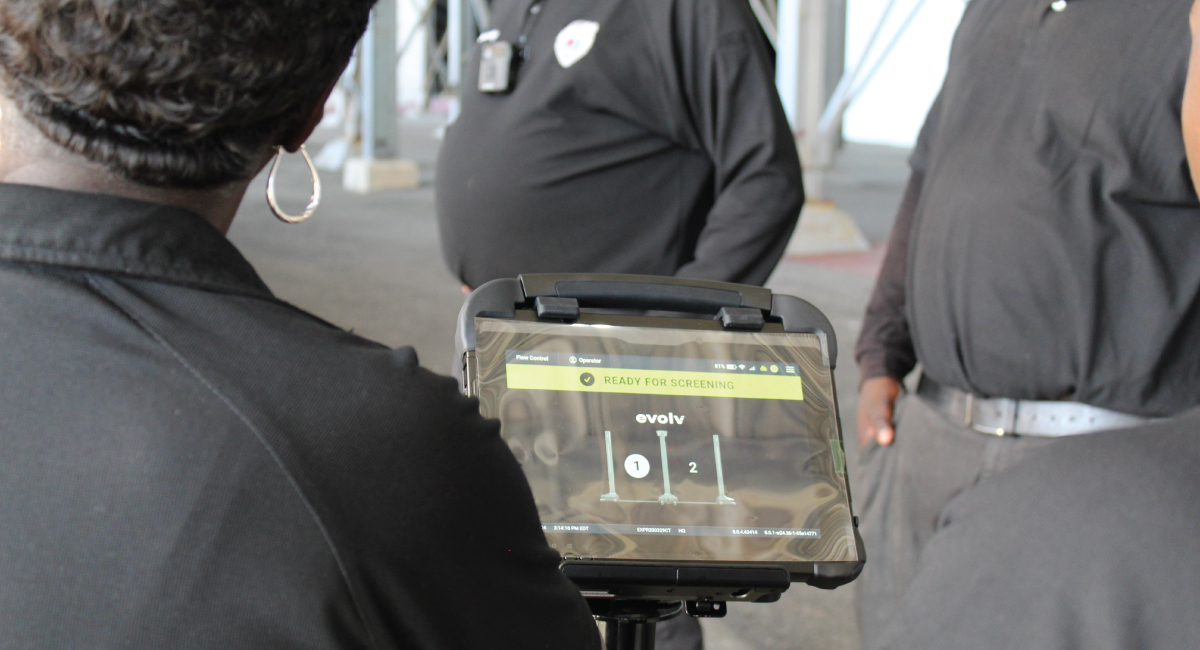
Evolv Express, launched in 2019, is the answer that stuck. Advanced electromagnetic sensors and machine-learning software look for signatures associated with metallic weapons as people pass through at normal pace. When the system alerts, its tablet shows an image with a Red Box indicating whom to stop and where to search. Evolv says a dual-lane setup can screen up to 4,000 people an hour, though throughput depends on sensitivity settings and how a venue resolves alerts.
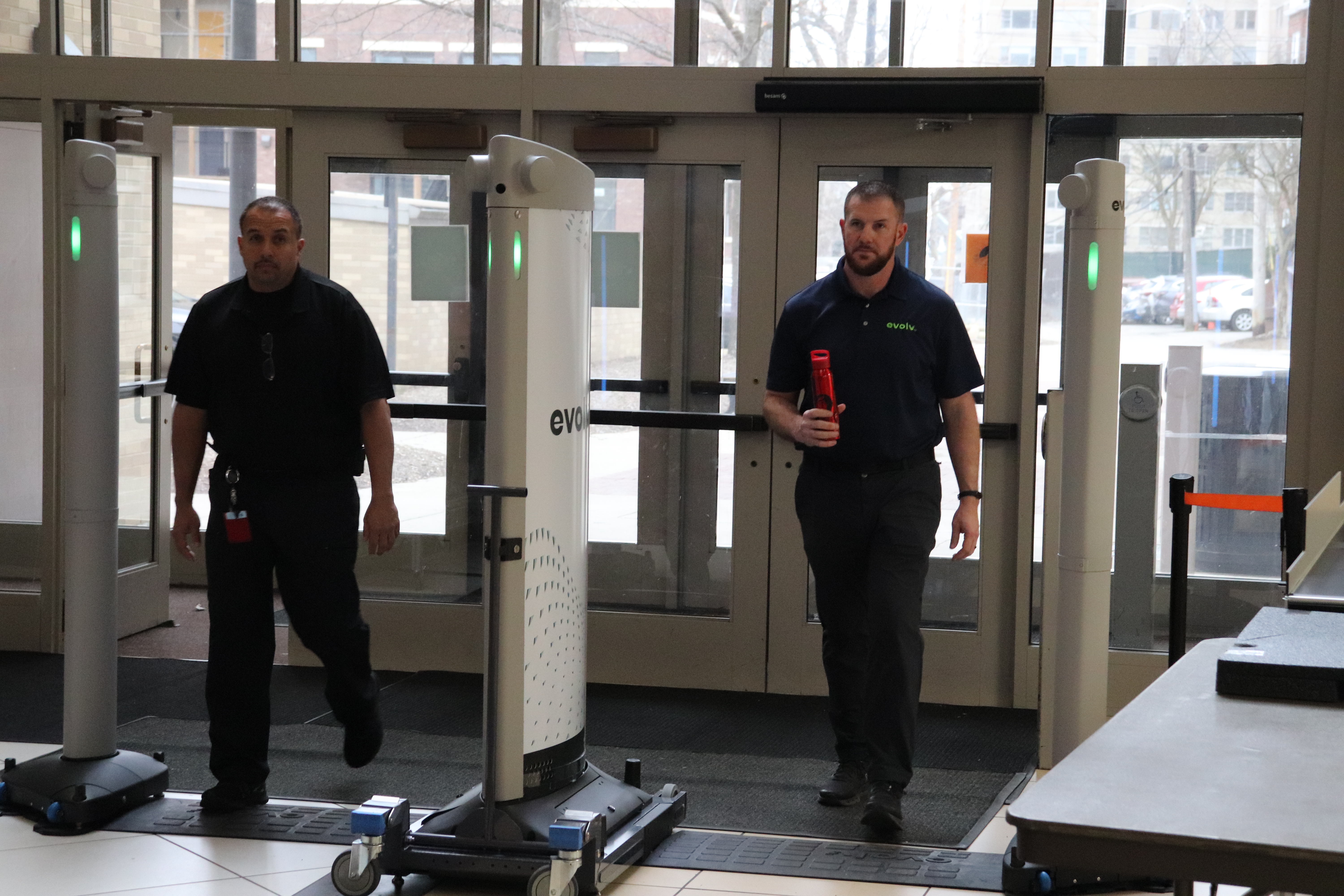
The distinction matters. Express is designed chiefly for firearms and other metallic threats; knife detection varies with size, shape and metal content. Phones and keys may pass without an alert, but laptops, metal water bottles and crowded bags can complicate the signal. The product does not replace guards. It tries to give them fewer, more specific decisions.
02 / The system around the scanner
Hardware gets the photo. Software gets the renewal.
Express is now one piece of a small security stack. Evolv eXpedite, launched in late 2024, is an X-ray conveyor for bags. Its software automatically stops the belt when it sees a potential threat, reducing the need for an operator to interpret every image. This is particularly useful where a school backpack or hospital worker's bag sends Express into a thicket of metallic clutter. Screen the person with Express, route the bag through eXpedite, then let staff inspect only what alerts.
Evolv Insights and the MyEvolv portal form the control layer. Managers can compare entrances, see arrival curves, monitor alert rates, review automated reports and adjust staffing. An open API and direct integrations can send alerts, images and metadata into platforms from Genetec, Milestone and Titan HST. The scanner is therefore not only a gate. It is a data-producing endpoint in a broader security operation.
The commercial design is equally tidy. Customers can take a full subscription, with Evolv retaining the equipment, or purchase the hardware while subscribing to software and service. Terms are typically four years. Software updates, maintenance, analytics and support keep the relationship alive after the towers roll into the lobby.
What did one lane cost?
That split is the founder lesson hiding in plain sight: the visible object can be the wedge while recurring software, field support and upgrades become the economic engine. Evolv reported $120.5 million in annual recurring revenue at the end of 2025. Its installed base had grown beyond 8,000 active systems at roughly 1,200 customers. In the second quarter of 2026, 60 percent of unit bookings came from existing customers expanding, and nearly 70 percent of new eXpedite customers also bought Express. The land-and-expand diagram from a pitch deck had become observable behavior.
03 / The collision with reality
What failed first was trust
The original pitch was seductively clean: detect weapons, ignore harmless objects, move people faster and use fewer guards. Field conditions were not. In a 2024 complaint, the Federal Trade Commission alleged that Evolv made false or unsupported claims about detecting all weapons, outperforming conventional metal detectors, reducing nuisance alarms and cutting labor. One school incident became an especially grim illustration: the system missed a seven-inch knife later used in a stabbing. After officials raised sensitivity, the FTC said, false alarms reached 50 percent.
The settlement barred unsupported performance claims and gave a defined group of K-12 customers the chance to cancel contracts signed during part of 2022 and 2023. Sixty of 65 eligible customers ultimately stayed, according to Evolv. That retention is meaningful, but it does not erase the complaint. It says some customers still valued the operating system after the marketing language was stripped back.
The most important sentence in Evolv's current product page is also the least cinematic: “There is no perfect security solution.”The disclaimer that should govern the deployment
At almost the same moment, a separate internal investigation found sales transactions with undisclosed extra-contractual terms. Evolv warned investors not to rely on financial statements stretching from 2022 into 2024 and later restated them. The board fired chief executive Peter George, saying new leadership was needed to improve the culture. Shares fell, regulators kept asking questions, and a company selling confidence had to rebuild its own.
What changed? The language became more conditional and the strategy more focused. Product pages now specify what affects throughput and knife detection. They recommend combining people, process and technology. In early 2025, Evolv cut 41 jobs, narrowed its attention to weapon screening at entrances, insourced more field service and tightened controls under CEO John Kedzierski. It also added a second product that addresses one of Express's obvious pain points: cluttered bags.
04 / The reset
Renewals are a better demo than a demo
By 2026, the comeback case was less about a spectacular algorithm and more about ordinary business proof. The Philadelphia Phillies renewed and upgraded to Gen2. TD Garden renewed, installed Gen2 across entrances and added eXpedite. The Houston Astros and Houston Texans did versions of the same. These venues have lived with the staffing, rain, bags, false alerts and halftime surges that never appear in a controlled demonstration.
Financially, 2025 revenue rose 40 percent to $145.9 million, while adjusted EBITDA reached a positive $11.1 million for the full year. In the second quarter of 2026, revenue grew 34 percent to $43.8 million and ARR reached $132.7 million. Evolv raised full-year revenue guidance to $180 million-$185 million. Express was nearing five billion cumulative people screened; eXpedite had passed 20 million bags and 100 customers. Both products held DHS SAFETY Act Designation, which may provide liability protections within the terms of that program.
The moat, if it develops, will not be a single model. It will be the feedback loop from thousands of deployed systems, the workflows built around them, the integrations into security rooms and the pain of replacing a product that staff already know. Competitors such as Xtract One, Liberty Defense and Athena Security attack the same next-generation screening market, while traditional metal detectors remain cheaper, familiar and easy to understand. Evolv wins when the cost of friction is high enough to justify the subscription.
05 / The stealable playbook
Copy the workflow, not the promise
There is a practical company-building move here. Evolv found a compulsory ritual, removed the part users resent, and made the improvement measurable. It did not ask fans to love security. It let them keep walking. It gave the operator a clearer instruction. It turned each deployment into data, attached ongoing software and created a second product that solves the first product's messiest edge case.
What a buyer - or founder - can copy
- Map the whole workflow, including the human who resolves an algorithmic alert.
- Sell the avoided bottleneck, then measure it under the customer's real conditions.
- Separate the clean signal from the clutter instead of forcing one model to do both jobs.
- Wrap physical equipment in updates, analytics, service and an upgrade path.
- Put the performance conditions beside the headline number, not three clicks away.
There are also clear conditions where the model does not work. A low-traffic site may not save enough time to justify a multi-year contract. A venue unable to staff secondary searches will merely move the queue. Bags packed with metal can generate too many alerts unless the workflow separates them. A buyer expecting reliable detection of every knife is buying the wrong promise. And an organization without a layered plan - cameras, trained staff, policies, emergency response and testing - risks treating the towers as a talisman.
Evolv's most useful contribution may be that it made the entrance legible as a software problem: flow, alerts, resolution, staffing, reporting. Its most useful warning is that physical security never becomes only a software problem. The machine still sits in a lobby full of unpredictable objects and hurried people. The guard still makes the consequential decision. The claim still has to survive contact with the morning rush.
Keep exploring