Company Dossier · Computer Vision · Est. 2014
Umbo Computer Vision
The startup that taught a security camera to do the thing security cameras never actually do - watch.
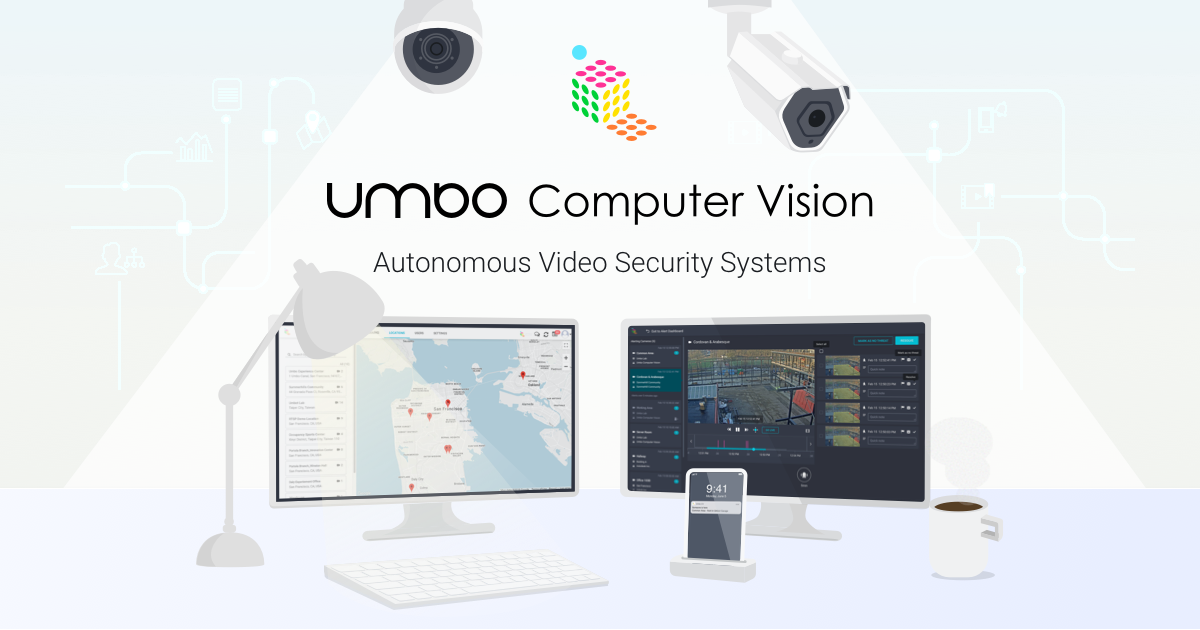
The startup that taught a security camera to do the thing security cameras never actually do - watch.
There is a peculiar dishonesty at the heart of the security camera business, and Shawn Guan noticed it after about seven years inside the industry. The pitch is safety. The product is a recording. Those are not the same thing. A camera that captures a break-in beautifully, in crisp 1080p, has done its entire job - and prevented nothing. You get a very good video of the moment you were robbed. Guan's version of the complaint is blunter: "If someone gets hurt, we can show clients a better video, but that didn't stop someone from being hurt."
This is the kind of observation that sounds obvious once someone says it out loud, which is usually the sign of a real business idea. In 2014, Guan started Umbo Computer Vision - legally Umbo CV Inc. - with two co-founders who could actually build the alternative: Ping-Lin Chang, a CTO with a PhD in robotic vision from Imperial College London, and Tingfan Wu, a chief scientist with a doctorate in the same field. The division of labor is almost suspiciously tidy. One founder knew exactly what was broken about surveillance. The other two knew how to teach a machine to see. Domain pain plus deep research is a hard combination to argue with, and an even harder one to compete against.
The pitch is safety. The product is a recording. Those are not the same thing.
The company set itself an unglamorous, specific goal: build video security that understands human behavior in real time and does something about it before the incident finishes happening. Not "record vs. store." Record vs. prevent. That reframing is the entire founding thesis, and Umbo has spent a decade following it into hardware, into cloud software, and into the deeply conservative world of the people who install cameras for a living.
Umbo's system has two halves, which is the correct number of halves for this kind of problem. On the ceiling sits the SmartDome, a 1080p camera with the un-sexy but load-bearing virtues that enterprise buyers care about: on-device recording for up to 30 days, power-over-ethernet, 256-bit encryption, and the good manners to switch to a low-bandwidth stream when the network is thin. It is, in other words, a competent security camera. That is the price of admission, not the product.
The product is the other half - a deep-learning engine named Light, which lives in the cloud and does the watching. Light is trained to understand security-relevant human behavior: intrusion, tailgating (someone slipping in behind an authorized badge), and wall-scaling. Crucially, it is also trained on what to ignore. Older analytics systems worked on geometry, matching shapes, which is how you end up with an AI that decides a wallet is a weapon and pages a guard at 3 a.m. Umbo went the other way. Light alarms on the presence of a human being and dismisses the birds, the cats, and the weather. In a category where a false alarm is worse than no alarm - because it trains humans to ignore the system - deciding what to ignore is the whole game.
It ignores non-human visual inputs such as birds, cats, and the weather while alarming on the presence of a human being.
This is the part that amuses and, on reflection, reassures. The most sophisticated thing about Umbo's AI is its restraint. A control room might have forty feeds and one pair of tired eyes; attention research says human vigilance on a monitor collapses inside twenty minutes. Light does not get bored, does not scroll its phone, and does not mistake a raccoon for a burglar. The company folds this into a hardware-agnostic cloud platform, Umbo Smart Cloud, that manages multiple feeds and surfaces "AI events" you can actually search - so the footage becomes queryable rather than an endless tape nobody rewinds.
Here is a decision that separates people who understand a market from people who have read about disruption. The security world runs on integrators - the firms that physically install and service camera systems for businesses. A newcomer's instinct is to route around them. Umbo went through them, selling exclusively via the integrator channel. It is slower and less romantic than a direct-to-enterprise land grab, but in an industry that buys on trust and relationships, the incumbent channel is the moat, not the enemy.
The customers on the other end of that channel skew commercial: small and medium businesses, a handful of Fortune 500 enterprises, plus schools in the US and some public-safety deployments abroad. Early on, before mass manufacturing had even started, Umbo had already shipped systems to clients in the US, Europe and Dubai and booked roughly $1.4 million in pre-orders and letters of intent. Demand that shows up before the factory does is the clearest signal a young company can get, and it is worth more than any deck.
Venture capital does not naturally gravitate toward physical security; it is not a category people brag about funding at dinner. Umbo raised anyway, patiently and in the right order. A $2.8 million seed in 2016, led by AppWorks with Wistron, Phison and Mesh Ventures, to prove the crime-preventing camera could exist. A $6.8 million Series A in 2017, alongside the launch of new features for Light. And an $8 million post-A round in 2019 to fund global expansion. Add it up and you get about $17.6 million across three rounds from roughly nine investors, including TransLink Capital and SIG Venture Capital. For a category most funds find boring, that is a real vote of confidence - and a reminder that the interesting startups are often hiding in the industries nobody wants to talk about.
The most sophisticated thing about Umbo's AI is its restraint.
Strip away the funding rounds and the spec sheets and Umbo Computer Vision is a bet on a single, aging-well idea: that the camera would stop being a passive recorder and become a thinking machine. When the founders placed that bet in 2014, "AI security camera" was a phrase you had to explain. It isn't anymore. Umbo is a small team - around 22 people - with a two-continent footprint straddling San Francisco go-to-market and Taipei engineering, competing in a field that now includes better-funded names like Verkada and Ambient.ai. But it got to the thesis early, built the boring hardware and the interesting brain, and proved that customers would pay to have their cameras finally pay attention. Whatever comes next for the company, that founding reframing - record vs. prevent - has held up remarkably well. It is the rare startup insight that reads as obvious in hindsight precisely because someone did the work to make it so.
Spent 7+ years in the surveillance industry before deciding that better video wasn't the point - prevention was.
PhD in robotic vision from Imperial College London; the technical spine behind the Light engine.
Doctorate in robotic vision; leads the research turning raw camera feeds into understood behavior.
1080p cloud-connected camera. On-device recording up to 30 days, power-over-ethernet, 256-bit encryption, auto low-bandwidth streaming.
The neural-net brain. Understands human behavior - intrusion, tailgating, wall-scaling - and ignores animals and weather to kill false alarms.
Hardware-agnostic, off-premise platform that manages many feeds, runs analysis, and pushes real-time alerts on unusual activity.
Tags security-relevant activity from live video so footage becomes searchable - queryable feeds instead of endless tape.
"If someone gets hurt, we can show clients a better video, but that didn't stop someone from being hurt."— Shawn Guan, Co-founder & CEO, Umbo Computer Vision
Shawn Guan, Ping-Lin Chang and Tingfan Wu set out to build AI that understands security, not just records it.
AppWorks leads a seed with Wistron, Phison and Mesh Ventures to build crime-preventing smart cameras.
Early 1080p cloud cameras reach customers in the US, Europe and Dubai; $1.4M booked in pre-orders and LOIs.
Series A closes alongside new features for the flagship autonomous video security engine, Light.
A hardware-agnostic cloud platform and AI events system debut for tagging and searching security activity.
A fresh raise pushes total funding to $17.6M and funds global expansion.
| Round | Amount | Date | Selected Investors |
|---|---|---|---|
| Seed | $2.8M | Mar 2016 | AppWorks, Wistron, Phison, Mesh Ventures |
| Series A | $6.8M | Oct 2017 | TransLink Capital, AppWorks, SIG Venture Capital |
| Post-A / Series B | $8.0M | Oct 2019 | SIG Venture Capital, TransLink Capital, AppWorks |
| Total | $17.6M | 2016–2019 | ~9 investors |
Links open curated YouTube searches - official demo and interview videos may vary by availability.
It builds autonomous video security systems - smart cameras plus a deep-learning cloud platform - that detect human security threats like intrusion and tailgating in real time and alert staff, rather than just recording footage.
Umbo CV Inc. was founded in 2014 by CEO Shawn Guan, CTO Ping-Lin Chang and Chief Scientist Tingfan Wu; two of the founders hold PhDs in robotic vision.
About $17.6M total, including a $2.8M seed (2016), a $6.8M Series A (2017) and an $8M post-A round (2019) from investors such as AppWorks, TransLink Capital and SIG Venture Capital.
Light is Umbo's neural-net engine that understands human behavior in a security context, alarming on people while ignoring animals and weather to cut down false alarms.
Businesses from SMBs to some Fortune 500 enterprises, along with schools and public-safety customers, reached mainly through security-integrator channel partners across the US, Europe and the Middle East.