A business can keep every contract and still forget what it has promised. Hemanth Puttaswamy learned the difference while working as an executive at a public company. An annual audit exposed problems in how revenue had been recognized across more than 2,500 customers. In his account, the company had to restate ten years of financial statements. The signatures had survived. A dependable understanding of the commitments had proved rather more fragile.
That experience helps explain why a career spent building enterprise software eventually led him to contracts. They are easy to regard as the paperwork around the real business. Puttaswamy had seen what happened when the paperwork came back with questions. A promise made years earlier could still affect the numbers today, whether anyone remembered making it or not.
He is now CEO and co-founder of Malbek, which he started with Matt Patel and Madhu Poolu in 2017. Its software follows agreements through drafting, negotiation, approval, signature and the obligations that come afterward. His own story travels between product engineering and the human business of getting people to work together. Along the way, there is a naming session over wine, a habit of listening to unhappy customers, and an electric guitar.
Ten years in the rear-view mirror
Puttaswamy’s preparation was technical before it was entrepreneurial. He earned a bachelor’s degree in computer science at the University of Mysore in India, followed by an MBA at San José State University. He earned his MBA in 2005. His career included Chordiant Software and technology leadership at Coremetrics, followed by senior roles at Saba and Revitas.
By 2013, he was speaking for Saba as vice president of strategy and application development, explaining a product approach that used machine learning and information from colleagues to support career development. The problem there concerned knowledge an organization possessed but could struggle to use: the abilities and experience of its own people. Software was supposed to make that information more useful.
At Saba he went on to serve as chief technology officer and senior vice president of products and development. In 2015, Revitas appointed him CTO and senior vice president of products and technology. These were jobs close to the machinery of enterprise software: what to build, how to deliver it, and how customers would use it.
Contract problems accumulated across those experiences. He recalls sales agreements moving between departments, approvals becoming hard to trace and companies struggling to establish what they had sold or committed to over the years. Revitas added a closer understanding of revenue management. By the time Malbek began, he had seen the consequences from several seats around the same table.
of financial statements restated at a previous employer, in Puttaswamy’s account of the audit that helped inspire Malbek.
Three careers, one bottle
The co-founders arrived with different versions of the problem. Puttaswamy understood the executive’s difficulty in finding contractual obligations and assessing their effect on a department. Patel had experience managing older contract software that struggled to meet customer needs. Poolu brought experience moving applications from older, on-premise systems into the cloud. Their experiences gave the venture a practical starting point.
They also needed a name. Puttaswamy has recalled considering more than 100 possibilities. They wanted a word people could remember, with a little personality and room to grow. Putting “contract” into it felt limiting. The placeholder, meanwhile, was Malbek, with a K. The founders had been discussing names over a bottle of Malbec.
Eventually the placeholder won. Puttaswamy liked its suggestion of people coming together and contributing ideas. It is an unusually sociable explanation for the name of a company selling contract software. It also makes sense of the product’s intended audience: legal, sales, procurement and finance, each with a different concern about the same agreement.
A sales team wants a deal to move. Legal needs acceptable language. Finance needs to understand the commercial consequences. Procurement has obligations of its own. Puttaswamy’s ambition has been to make these interactions easier through software ordinary business users can navigate. An agreement has enough complexity without requiring everyone involved to become an expert in the application holding it.
Leave room for the guitar
There is another way to understand his interest in bringing people together. In early 2021, he described weekly Malbek gatherings where colleagues sang, played instruments and shared poetry. Sometimes a person who had joined that week would take part. These were opportunities to become comfortable with the team through something other than a job title.
Music has a place in his own life, too. He has described getting ideas while playing music. At a Malbek Envision event, he played guitar with drummer Kenny Aronoff. The photograph is pleasingly specific: an executive with an electric guitar, purple stage lighting and an audience close enough to get in the frame. Enterprise software does occasionally escape the slide deck.
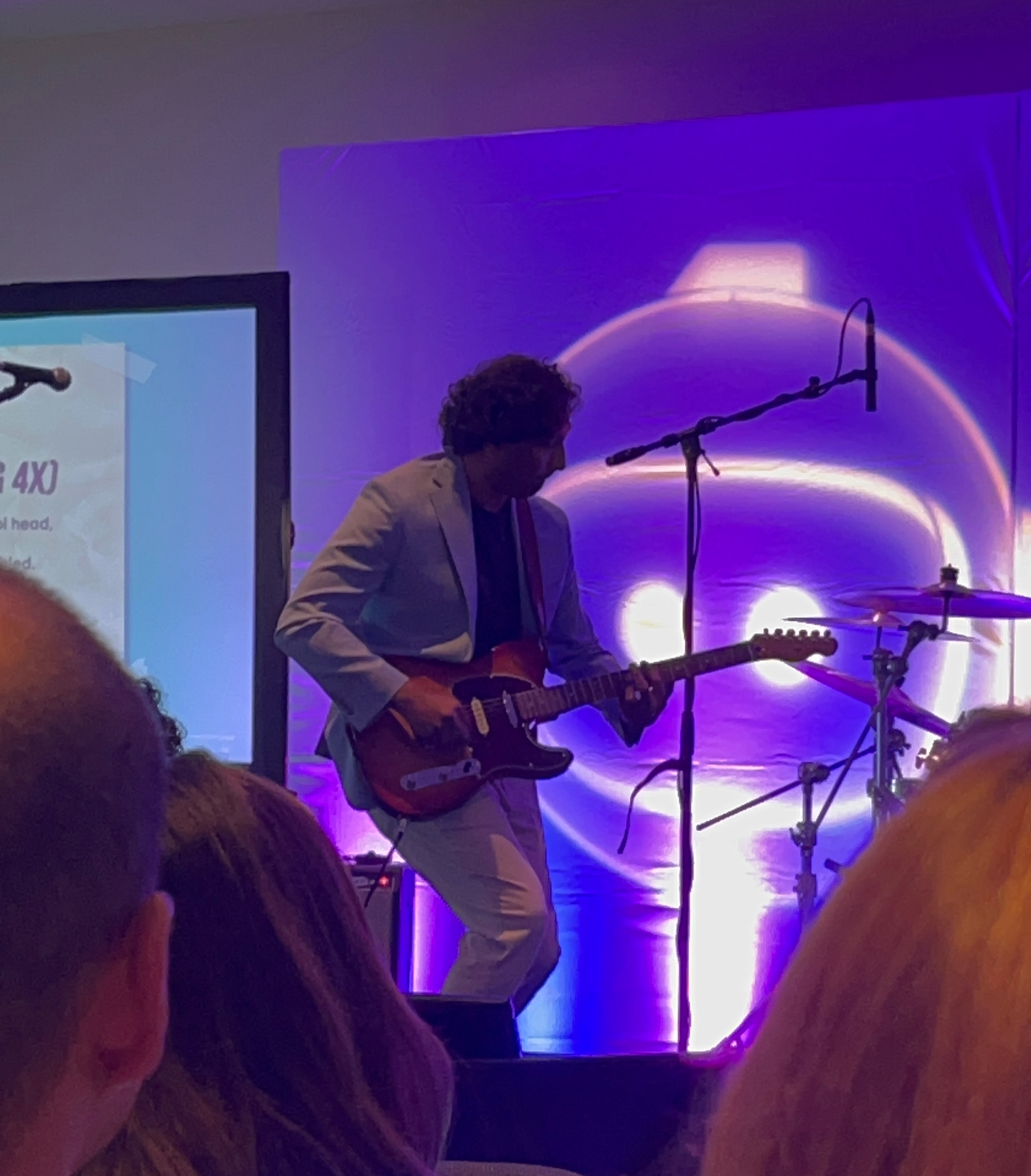
His account of team culture also includes a company-wide testing session, with responsibility for quality extending beyond the people assigned to test software. “Quality is everyone’s responsibility,” he says. The musical gathering and the testing session serve different purposes, but both invite people to contribute beyond the narrow outline of their roles.
He has described meeting every employee when they join and returning for another conversation after 90 days. That is a concrete expression of his interest in keeping communication open. A founder can speak warmly about collaboration; reserving time for the newest person makes the idea easier to judge.
Listening has an editing stage
Customer attention runs through Puttaswamy’s advice. “Listen more, talk less,” he says. He also cautions against assuming customers are right about every requested change. A hundred requests can contain a smaller number of recurring problems. The useful work is to identify those patterns and decide what deserves to be built.
It is a distinction with consequences for product design. A founder who accepts every suggestion can end up with a great many features and a very tiring product. His stated approach is to understand the problem beneath the request. He has criticized the habit of finding a technology first and searching afterward for somewhere to apply it.
His advice about early customers is similarly practical. Looking back on starting Malbek, he recommended finding three early customers from different industries for a product intended to serve businesses across sectors. He had initially kept one in mind. Several perspectives could give the team a better chance of discovering what needed to change.
He gives dissatisfied customers a role in that process as well. When someone considers leaving, his response is to address the immediate complaint and look for the larger pattern behind it. The unpleasant conversation becomes useful if it reveals a problem that will otherwise keep recurring. This requires a founder to leave a little space between hearing criticism and defending the company. His reading has included Frank Slootman’s Amp It Up, which he praised for its account of the realities of being a CEO.
“Listen more, talk less.”
Hemanth Puttaswamy
The promise leaves the filing cabinet
Malbek’s development has brought outside investment and recognition. In September 2021, it announced a $15.3 million Series A led by Noro-Moseley Partners. In November 2025, it was recognized as a Leader in Gartner’s Magic Quadrant for Contract Lifecycle Management. These are company milestones, and they mark the distance traveled from the founders’ original diagnosis.
The product direction keeps returning to accessibility. In March 2025, Malbek launched Conversational Contracts, describing agent and voice prompts for working with agreements. Puttaswamy had already argued for AI as an assistant that helps people handle more work while retaining human judgment. Making the interface easier to use fits that position.
In April 2026 came general availability of BusinessIQ. Malbek describes the product as connecting information across agreements through its LIVEGraph and Context Threading technologies. Its intended audience includes executives trying to understand revenue, exposure and the relationships between documents. A pricing condition can be difficult to interpret if the relevant amendment is sitting somewhere else.
For Puttaswamy, this brings the work back toward the question that troubled him before he founded the company. An organization needs to know what its agreements mean for the business. Storage alone leaves a considerable amount of interpretation to whoever happens to be looking for the answer.
- 2017Malbek is founded
- 2021$15.3M Series A announced
- 2026BusinessIQ and Composable CLM launched
What survives the signature
On October 13, 2026, Malbek introduced Composable CLM at Envision in Austin. The announcement included Malbek Sense for acting on obligations, Drift Detective for reviewing drafts against executed agreements, and an MCP Server intended to let AI assistants work with contract capabilities. Malbek presented these as generally available products.
The organizing idea is to bring contract work into applications people already use, including Word, business messaging tools and customer relationship software. Puttaswamy described sending the contract into the business. For someone concerned with usability, the direction is consistent: reduce the distance between an agreement and the person who needs to act on it.
His career has led him from engineering and product leadership to running a company whose subject can appear dry until a forgotten obligation comes due. He has stayed interested in the people on either side of that obligation, and in the habits that help a team work together. The guitar belongs in that portrait. So does the careful listening. A signature records a promise; the next part depends on whether people can understand it, find it and follow through.
Continue the conversation
Interviews, company writing and a little more context.