BREAKING   Sea Machines' tugboat Nellie Bly ran 1,000+ nautical miles autonomously - commanded from Boston, 3,000 miles away Founded 2015 in Boston by marine engineer Michael G. Johnson Systems deployed across four continents Backers: Toyota, Brunswick, Huntington Ingalls 2024 — unveils SELKIE, its first turnkey autonomous USV 2025 — launches six new autonomy products for defense & commercial fleets
Company Profile · Marine Autonomy

Sea Machines Robotics

Teaching working boats to steer, sense, and think - so crews can command the water from anywhere.

Boston, MA Est. 2015 ~58 people B2B · Hardware + AI Autonomy Without Limits
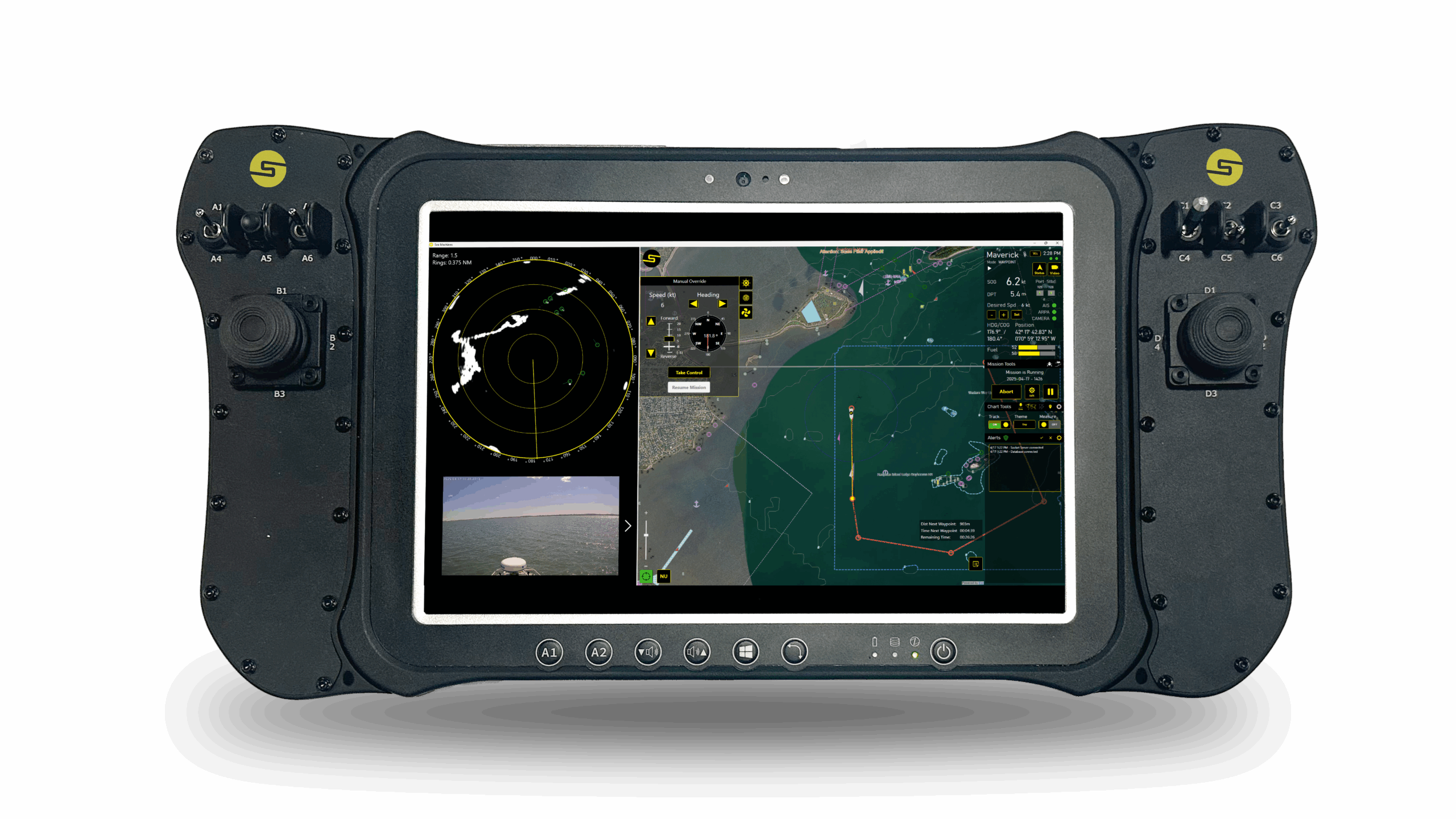
Sea Machines Robotics rugged autonomous command and control console displaying a live vessel navigation interface

THE HELM, REIMAGINED. Sea Machines' command-and-control console - radar, camera feed, and a live vessel track on one screen - is the interface behind the company's autonomous and remote-operated vessels.
Boston, Massachusetts.

1,000+
NM Autonomous Voyage
4
Continents Deployed
2015
Founded in Boston
6
New Products in 2025
The Dispatch

Autonomy finally reaches the water

Autonomous technology has flown aircraft and driven cars for years, backed by billions in investment. The ocean industries - shipping, salvage, survey, spill response - largely kept a person's hands on the helm. Sea Machines Robotics set out to change that. Since 2015, the Boston company has built the control systems, remote-command links, and AI perception that let commercial and defense vessels operate remotely or steer themselves, while a crew supervises from the pier or a shore station.

The idea did not arrive in a lab. Founder Michael G. Johnson, a Texas A&M-trained marine engineer, was working on an Arctic oil-spill response operation when he began asking why so much of a vessel's work still depended on manual control in dangerous, fatiguing conditions. Before founding the company he had been a vice president at Crowley Maritime and the salvage firm TITAN Salvage - a career spent on complex, high-stakes marine projects. Sea Machines became his answer: replace manual helm control with data-driven intelligence and advanced perception.

The company's most public proof point came in 2021. A Damen-built tugboat named Nellie Bly, outfitted with the Sea Machines SM300, autonomously navigated more than 1,000 nautical miles over 13 days - around the Danish islands of Zealand, Funen and Laeso, up to Skagen, then down through the Kiel Canal to Hamburg. Merchant marine officers commanded the vessel remotely from Boston, more than 3,000 miles away. The company called it the Machine Odyssey. It was less a stunt than a demonstration of the model: a real working boat, a real route, a crew that never had to be aboard.
The ocean industries needed a robotics company. Autonomy was already flying planes and driving cars - the water was waiting.

- The founding premise behind Sea Machines Robotics
What it does

A control layer for boats that already float

Sea Machines does not primarily build vessels. It builds the autonomy and perception systems that bolt onto them - new hulls or existing ones. An operator can turn a conventional workboat, tug, survey craft, or unmanned surface vehicle into one that runs waypoint missions, avoids collisions, follows the rules of the road, and can be commanded from shore.

The problems it targets are the ones marine operators live with daily: crew fatigue on long shifts, low-visibility navigation, the risk and cost of putting people in hazardous spots, and the difficulty of getting more done with fewer hands. By keeping a human in command but out of the boat, the company aims to raise safety and productivity at once.

The problems it solves

  • Crew fatigue and human error on long, repetitive runs
  • Navigating low-visibility and hazardous waters
  • Keeping people out of dangerous operations like spill response
  • Doing more with smaller crews and tighter budgets
  • Coordinating and supervising multiple vessels at once
  • Retrofitting autonomy without building a new ship
Products & services

The fleet of systems

From retrofit control kits to a turnkey autonomous vessel, plus the software that ties a fleet together.

Autonomy · 2018

SM300

Industrial-grade autonomous command-and-control system: remote operation, waypoint and mission navigation, collision avoidance, and rules-of-the-road compliance.

Remote helm · 2018

SM200

Wireless remote-helm control from up to ~1 km away, steering propulsion and onboard equipment. Type-approved by ABS, U.S. Coast Guard, and Bureau Veritas.

Perception · 2021

AI-Ris

AI-powered computer-vision sensor that detects, classifies, and tracks objects on the water to boost situational awareness and avoid collisions.

USV · 2024

SELKIE

The company's first turnkey autonomous unmanned surface vehicle - a fully integrated platform rather than a retrofit kit.

Software

SMLINK & Fleetviewer

APIs for streaming vessel data and integrating remote control, plus a dashboard to command and monitor multiple vessels from one screen.

Partnership

JETSense

Intelligent voyage control developed with HamiltonJet for waterjet-propelled vessels.

How it's different

  • Retrofit-first: adds autonomy to vessels that already exist
  • Focus on heavy, working craft - not just small drones
  • Human-in-command model rather than full crew removal
  • Type approvals from ABS, U.S. Coast Guard, Bureau Veritas
  • Cross-industry backers from cars, boats, and defense
  • Field-proven on a 1,000+ NM cross-border voyage
Where it fits

A quiet software layer for a trillion-dollar ocean

Most of the ocean economy still runs on manual control. Sea Machines is among a small group of companies - alongside names like Saildrone, Ocean Infinity, L3Harris, and Orca AI - building the autonomy and perception layer beneath it. Its niche is the commercial and defense workboat: the tug, the survey vessel, the spill-response craft, the low-profile military USV.

That positioning increasingly points at defense. In 2025 the company launched six new products aimed at highly-adaptive marine autonomy, answering demand from defense organizations for commercially-driven, asymmetric fleet capability. It already supplies SM300 autonomy toward the U.S. Marine Corps' Autonomous Low-Profile Vessel program.

Funding

Who's betting on marine autonomy

Tens of millions raised across seed, Series A, and later rounds from an unusual mix of automotive, marine, and defense strategics.

SEED · 2017$1.5M
Launch Capital · Accomplice · LDV Capital · Geekdom Fund · Techstars
SERIES A · 2018$10M
Accomplice · Eniac Ventures · Toyota AI Ventures · Brunswick Corporation
GROWTH · 2020$15M
Accomplice · Huntington Ingalls · Brunswick · TechNexus · Toyota AI Ventures · Dolby Family Ventures
ROUND DISCLOSED · 2024$12M
Round disclosed February 2024 to accelerate deployment
The record

A decade on the water

2015

Sea Machines is founded

Marine engineer Michael G. Johnson starts the company in Boston to bring autonomy to the marine industries.

2017

Seed funding

Raises roughly $1.5M to build its first autonomy systems.

2018

Series A & Maersk trial

Closes a $10M round and trials perception tech aboard an A.P. Moller-Maersk ice-class ship.

2019

First commercial products

Launches its first commercial line for autonomous and remote vessel control.

2020

Approvals & defense wins

SM200 gains ABS and U.S. Coast Guard approvals; secures multi-year U.S. defense agreements.

2021

The Machine Odyssey

Nellie Bly autonomously runs 1,000+ nautical miles, commanded from Boston.

2024

New CEO & SELKIE

David "Chip" Wasson becomes CEO; the company unveils SELKIE and discloses a $12M round.

2025

Product expansion

Launches six new products for adaptive marine autonomy across defense and commercial fleets.

In good company

Partners & customers

Shipping

A.P. Moller-Maersk

2018 trial of computer vision and LiDAR perception aboard an ice-class container ship - among the first on a commercial vessel.

Marine tech

Rolls-Royce

2021 collaboration to develop remote command and autonomous solutions across commercial and yacht markets.

Defense

U.S. Marine Corps / DoD

Multi-year agreements supplying SM300 autonomy, including for the Autonomous Low-Profile Vessel program.

Propulsion

HamiltonJet

Joint development of JETSense Intelligent Voyage Control for waterjet-propelled vessels.

AI data

Scale AI

Used Scale's data-labeling platform to train and refine its marine computer-vision models.

Government

MARAD & U.S. Coast Guard

Regulatory and program partnerships underpinning type approvals and public-sector deployments.

Good to know

Frequently asked

What does Sea Machines Robotics do?
It builds autonomous control, remote-command, and AI perception systems that let commercial and defense vessels operate remotely or autonomously while improving safety and productivity.
Who founded Sea Machines and when?
Marine engineer Michael G. Johnson founded the company in Boston in 2015. He now serves as President and CTO, with David "Chip" Wasson as CEO.
What are its main products?
The SM300 autonomous command-and-control system, the SM200 wireless remote helm, the AI-Ris computer-vision sensor, the SELKIE autonomous USV, and the SMLINK/Fleetviewer software.
Who are its customers?
Commercial marine operators and defense buyers including the U.S. Department of Defense, U.S. Marine Corps, MARAD, and U.S. Coast Guard, with deployments on four continents.
How much funding has it raised?
Tens of millions across seed, Series A, and later rounds from investors such as Toyota AI Ventures, Brunswick Corporation, and Huntington Ingalls Industries, including a $12M round disclosed in early 2024.