At a packaging plant in Lübbecke, Germany, the useful question was surprisingly small: when should a forklift make a noise? A person near a moving truck might be in danger. A person inside a protected walkway might simply be going to lunch. An alarm that treats both encounters alike asks the driver to perform the distinction, again and again, while doing another job.
- Trio Mobil connects AI cameras, proximity tags and industrial controls.
- Its buyers run factories, warehouses and logistics operations.
- The pitch: detect a hazardous encounter, then support an immediate response.
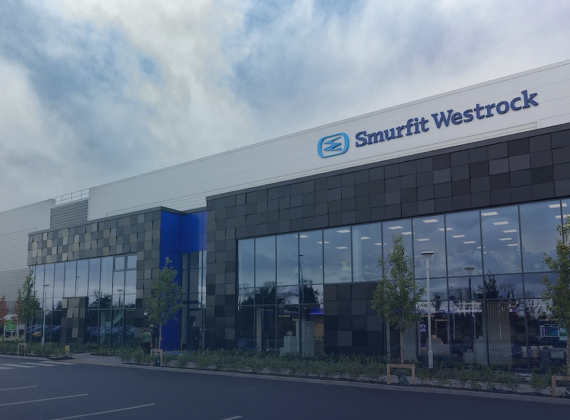
Trio Mobil’s account of its work with Smurfit Westrock turns on that distinction. Cameras watched defined danger zones. Forklift operators received visual and audible warnings when pedestrians entered them. People in safe areas did not trigger those warnings. The clever detail is the silence.
The case describes previous suppliers’ solutions as unsuccessful, then a successful test that led to installation across eight factories. That is the company’s account, rather than a controlled comparison. Still, it offers a practical insight: an industrial safety system has to understand something about the geography of work.
A camera has eyes. A tag has other talents.
Founded in 2011 by Nevzat Ataklı and Celal Barış Özdemir, Trio Mobil began with vehicle tracking and remote diagnostics. Ataklı had worked in Ford’s research and development department as a software engineer. The connection is pleasingly circular: Ford now appears among the industrial customers whose deployments Trio Mobil describes.
The company’s present focus is the shared space between people and machines. Forklifts turn. Workers cross aisles. Pallets interrupt sightlines. Trio Mobil combines computer vision with ultra-wideband, or UWB, proximity sensing, then connects that information to warnings, location-specific rules and, in configured installations, automatic speed reduction.
Each sensing method contributes something different. Cameras can recognize a pedestrian who has never been issued a wearable device. UWB establishes proximity between equipped vehicles and tagged people, including situations where direct visual coverage is obstructed. The combination matters because visitors forget things, shelves exist and warehouses refuse to resemble demonstration rooms.
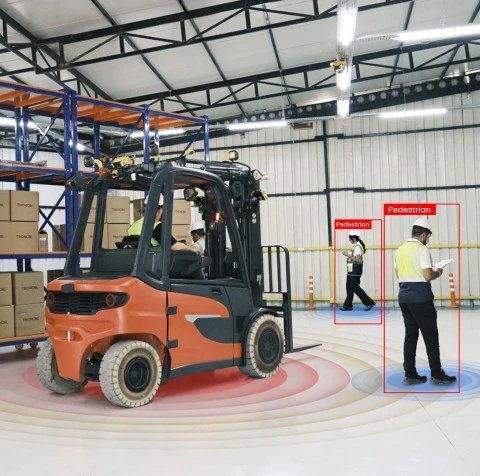
These are also the limits. A camera cannot see through a stack of materials. UWB pedestrian detection requires the person to carry the appropriate tag. A slowdown function needs compatible integration and properly configured rules. Those dependencies belong in the purchasing conversation as much as the dashboard does.
Illustrative sequence. Site configuration determines the response.
The moment after detection
Consider the difference between a camera recording a close call and a system helping a truck slow down before one. Both can produce useful information. Only the second connects recognition to an immediate physical response. That connection is central to Trio Safe and Trio Safe AI, the company’s forklift safety offerings.
Fixed-camera TRUE AI covers designated areas. FleetBridge tracks forklift movement, impacts and performance. Real-time location systems, usually shortened to RTLS, locate vehicles and assets. AI Risk Radar analyzes video for selected hazards, including missing protective equipment and blocked emergency equipment, giving safety teams a way to review recurring exposure.
Together these products place Trio Mobil between industrial hardware, vehicle telematics and workplace safety software. Protex AI offers an alternative centered on camera-based site intelligence. Forklift proximity and fleet-management suppliers such as ELOKON address overlapping needs. A useful comparison starts with the site’s hazards and the action required after detection.
“Our mission is to ensure that every worker returns home safely”Nevzat Ataklı · 2024 financing announcement
What a rollout actually contains
The installations are more revealing than the slogans. Trio Mobil’s Unilever case describes 14 facilities, 777 pedestrian tags and 549 location anchors, alongside equipment on forklifts, reach trucks and pallet trucks. Cold-storage operations also used location visibility and lone-worker safety functions. This is a network fitted around work already happening.
At Mercedes-Benz’s Aksaray factory, the published account describes forklift-door collision protection and vehicle location data connected through an API to production systems. The same infrastructure can therefore answer two questions: is this movement hazardous, and where is this vehicle in the production process?
That overlap helps explain the business. Trio Mobil sells industrial customers a combination of devices, software, deployment and continuing support. Its offices, distributors and after-sales operation support multinational installations. In a 2018 interview, Ataklı described calibration, network maintenance and troubleshooting as part of the operating model. Installing sensors was only the beginning.
Growth financing announced in July 2024, led by NewSpring Growth with 212 and TIBAS Ventures.
The financing was intended to expand international operations and innovation. It was company capital, separate from customer installation budgets. A buyer’s useful unit of analysis is the site: how many vehicles, which crossings, what coverage, which integrations and who will keep the system working?
For the customer, that makes procurement a coordination exercise. The safety team defines the hazard; operations knows the traffic; maintenance understands the truck; IT has to live with the data connection. A proposal that leaves one of those people out may look simpler than the installation will be. The hardware count is the start of a conversation about ownership.
Start with one awkward crossing
There is a method here that another operator can borrow. Choose a crossing with a clear hazard. Observe it across shifts. Test both an untagged visitor and a tagged worker behind an obstruction. Check whether alerts distinguish a protected walkway from an exposed pedestrian. Establish who acts, and what the vehicle actually does.
Ask the pilot to show ordinary work as well as staged danger. A warning can perform perfectly in a demonstration and still become irritating during replenishment or shift change. Record the circumstances of each intervention, invite drivers to challenge the settings and revisit the boundary between safe and hazardous space. The point is to learn which rules survive a working day.
That also suggests a sensible way to think about cost: include installation, training, maintenance and the time needed to refine the rules. Buying a detector creates an ongoing operational responsibility. The person who owns that responsibility should be named before the pilot becomes a fleet-wide purchase.
Then measure the remaining exposure before extending the installation. That recommendation follows from the deployment stories; equipment counts alone cannot establish how much injury risk has fallen. A successful demonstration and a working plant are different tests, especially when traffic, lighting and human routines change.
In July 2026, Frost & Sullivan recognized Trio Mobil for technology innovation in AI-based industrial safety. In September, the company announced analysis covering more than five million industrial interactions and 10,000-plus forklifts. Its argument remained rooted in complementary safeguards. The question for the next factory is wonderfully concrete: what happens at this corner when one sensor cannot see?