The camera was already there. That is the revealing detail in Rainscales’ story. In 2022, a warehouse experience helped inspire Huy Tran and his colleagues to develop eMagicEyes, a computer vision platform for safety and operations. Local reporting describes an incident that prompted a practical question: could a camera help people respond while there was still something useful to do?
CCTV is very good at preserving the past. A manager can rewind, inspect and explain. Rainscales wants to move that attention forward, turning live footage into an event somebody checks and somebody owns. Its wager is that the valuable upgrade happens between seeing a problem and deciding what to do about it.
THE QUICK READ / 30 SECONDS
- Start with the cameras: connect existing footage to site-specific AI detection.
- Keep a person involved: validate events before sending teams into action.
- Test the whole workflow: a useful pilot measures behavior and workload, alongside model performance.
The wider company dates to 2010 and is headquartered in Houston, with operations in Vietnam and Japan. That distinction matters: eMagicEyes is a product developed within a longer-running technology services business. Its current website reports more than 550 employees. The pitch combines software with the people needed to put it to work.
01 A forklift is only half the story
Finding a forklift in a video frame is one task. Understanding whether its movement creates a problem is another. Rainscales’ Intelligent Detection offering targets that second task: relationships between people, vehicles, zones and operating rules. Its examples include unsafe loading, pedestrian near misses and entry into restricted areas.
For a warehouse operator, that could mean identifying risky traffic around a dock. For a production supervisor, it could mean spotting a missing item of protective equipment. The company’s manufacturing offering also addresses congestion and abnormal activity. These are configured applications, shaped around the floor and its procedures, rather than a universal rulebook delivered in a box.
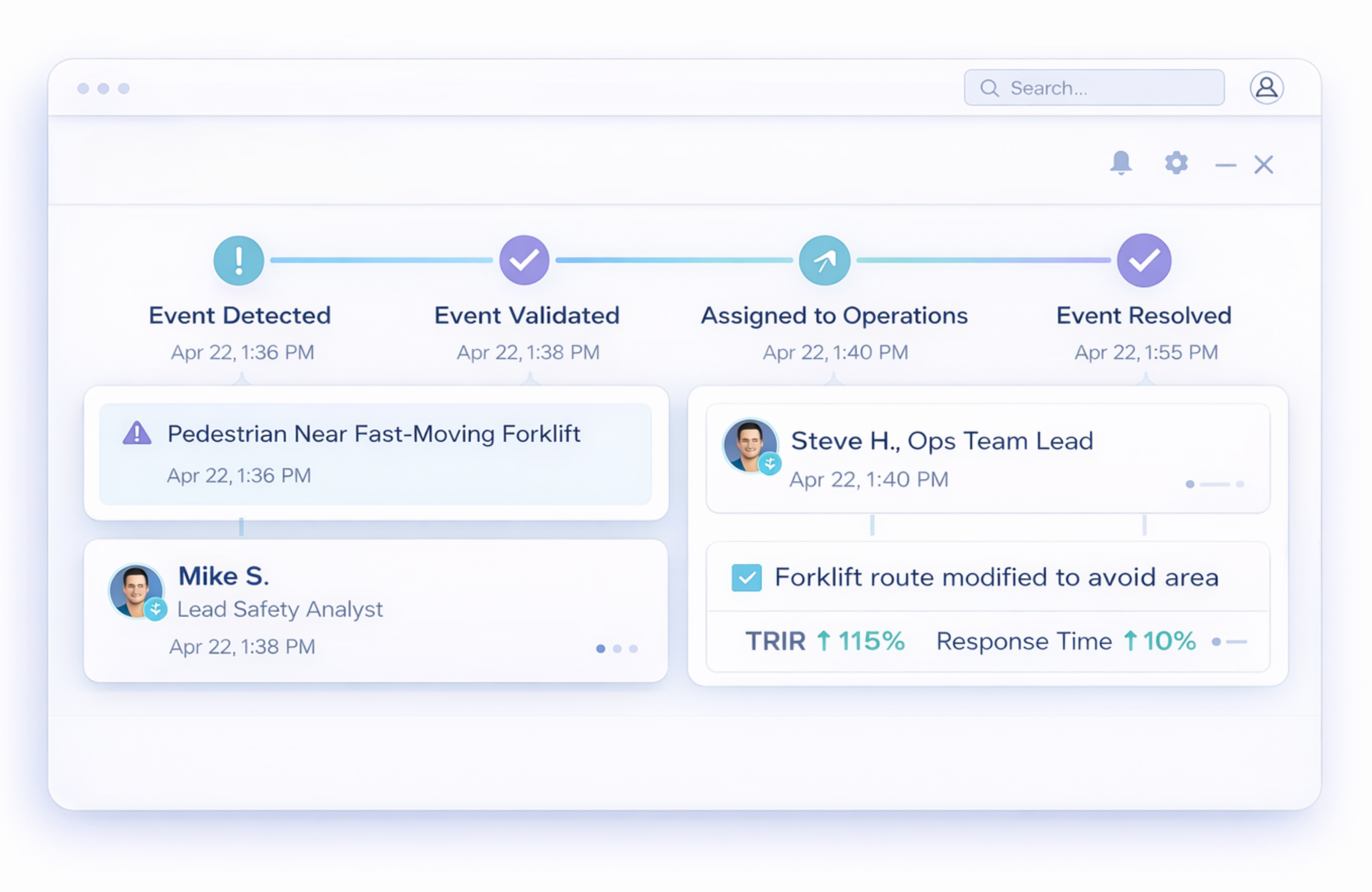
- 01DetectAI flags a configured event.
- 02ValidateA person checks the context.
- 03RouteAn owner receives the event.
- 04ActThe team responds and records.
02 The alert that got everything right
The awkward lesson arrived on the operating floor. In a September 2026 account, Rainscales says it initially assumed sufficiently accurate detection would produce value. Operators challenged that assumption. Some alerts correctly identified routine activity that needed no intervention. Meanwhile, recurring traffic patterns and overlooked near misses were what staff wanted brought to their attention.
That feedback changed the company’s emphasis toward operational relevance. It is an unusually useful admission for an AI vendor: a system can be right about the picture and wrong about what deserves attention. The product has to learn the customer’s meaning of “this matters.”
“No two organizations run the same way.”
Rainscales’ published design principles
The company makes that philosophy explicit in its stated values, including accountability and understanding processes before automating them. It also advertises round-the-clock human-in-the-loop support. In this model, human judgment is part of the service customers are buying.
03 A safety number with a surname
Linfox Vietnam gives the proposition a named customer. Rainscales’ warehouse case-study page reports a 41% reduction in unsafe behavior. Its more detailed commentary describes that as unsafe pedestrian behavior across monitored zones, alongside a 34% reduction in high-risk material-handling-equipment behaviors within the first 90 days.
reduction in unsafe pedestrian behavior across monitored zones
A behavioral measure, not an accident-reduction rate.Those distinctions matter. The figures describe observed behavior, not an assurance about every future accident. They are vendor-reported results. Still, they point toward the right buying conversation: what changed on the floor? A long list of detectable objects is a less persuasive answer than a clearly defined improvement.
04 The bill includes somebody’s time
Rainscales sells managed delivery around its software: coordination with camera vendors, edge hardware integration, tailored AI engineering, quality assurance and ongoing performance monitoring. Its enterprise buyers include safety, operations, risk and compliance leaders. The offering sits between video analytics and operational services, with process automation available alongside detection.
The alternative may be the camera system a customer already uses, manual video review or another computer vision vendor. Rainscales positions its human review, configured rules and managed integration as the reason to choose its service. Its partner program recruits CCTV integrators and EHS platforms, allowing existing suppliers to add detection and recurring services to their own offerings.
Its August 2026 budgeting guide estimates a general single-warehouse AI safety pilot at $8,000-$45,000 over 60-90 days. Treat that as planning guidance, not a Rainscales price list or a bill from a disclosed customer. Infrastructure, integration and scope move the number.
The less obvious expense is review capacity. The guide suggests allowing three to six hours a week from a safety coordinator. Existing cameras can make a project cheaper, but somebody still has to review events, adjust thresholds and follow through. An unanswered alert has remarkably little economic value.
05 A prize, then the next floor
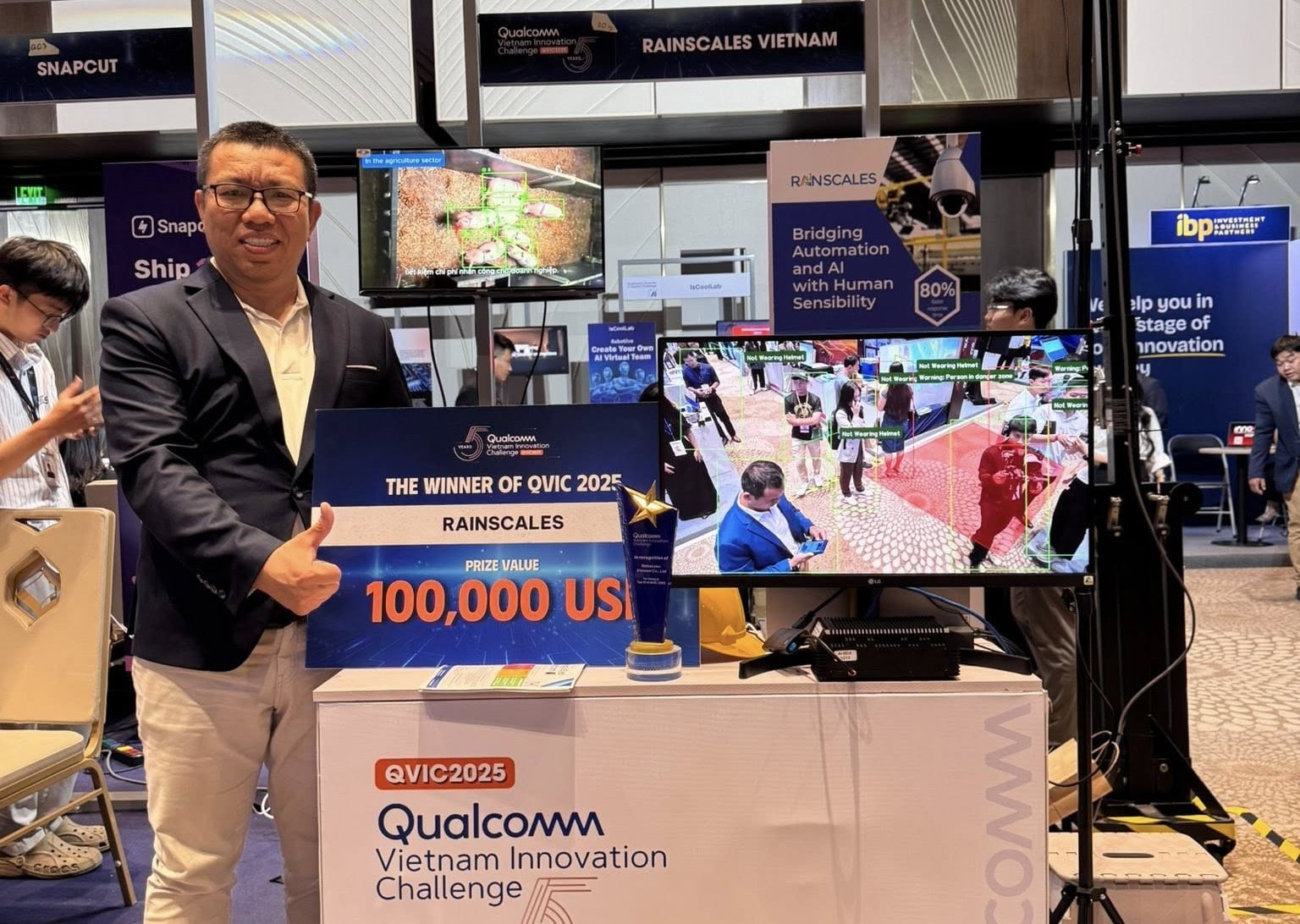
In August 2025, Rainscales Vietnam won the $100,000 first prize at the Qualcomm Vietnam Innovation Challenge with eMagicEyes. The program included technical support, coaching and mentorship. The award gave the product recognition outside a customer demonstration; it did not establish universal deployment performance or constitute an equity funding round.
The Japan subsidiary subsequently announced demonstrations at RISCON Tokyo and CEATEC 2025, presenting configurable rules, audit logs and cloud, on-premises and edge deployment options. For a buyer, those choices raise practical questions about where processing happens and how an event reaches the responsible team.
06 Start with one corner
The approach is most plausible where cameras cover the relevant activity, usable feeds are accessible and staff can review the results. Poor positioning, low resolution or missing coverage weaken the premise of easy reuse. Closed integration interfaces can add expense. An overstretched safety team can become the bottleneck.
The portable lesson is simple enough to borrow: choose a specific risk, establish a baseline, assign a reviewer and decide what success means before connecting more feeds. Rainscales’ pilot process includes measuring precision, recall and operator time saved before expansion. The camera is the starting point. The test is what people do next.