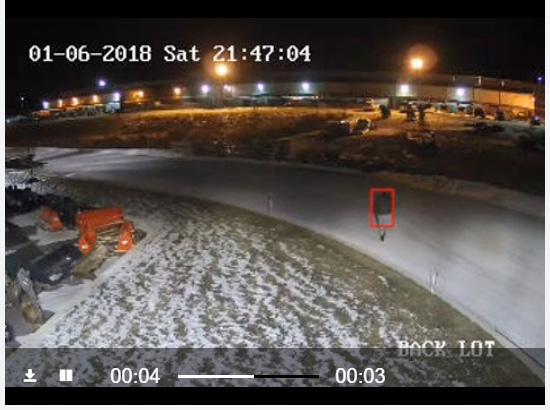
At a tractor dealership in Dallas, an intrusion became a conversation. Video analytics flagged the break-in. Eyeforce, the remote guarding provider, used talk-down, and the intruders ran off before damage occurred. The camera supplied the picture; software selected the moment; an operator supplied the consequence. It is a modest sequence, and a useful place to begin the story of Agent Video Intelligence.
- Agent Vi adds event detection, video search and statistics to surveillance networks.
- Its customers include monitoring providers and enterprise security operators.
- Distributed processing and third-party integrations shape its practical appeal.
- Irisity acquired it in 2021; the technology helped form IRIS+.
A recording is evidence. An alert creates a chance to intervene. Agent Vi, established in 2003, built software around that distinction. Its work belongs to the less theatrical end of artificial intelligence: people crossing boundaries, vehicles stopping where they should not, operators deciding whether to call someone. The product’s value depends on the usefulness of that decision.
The alert that earns its interruption
Eyeforce had tested multiple intrusion-detection systems before deploying innoVi at dozens of remote sites. The provider wanted accurate detection without complicated installation. Each site could have up to fifteen cameras, connected through an innoVi Edge appliance. Detection rules covered perimeter breaches, restricted zones, stopped vehicles and loitering. An alert arrived with a clip, giving the operator something concrete to assess.
“giving our operators better information to decipher”
Daniel Forrest · CEO, Eyeforce
That is an unusually revealing description of AI’s job. The operator still has to decipher. In the documented deployment, the software improves what lands on the desk rather than making the response disappear.
The pressure was in the monitoring workflow. Spyke Security monitored more than 1,500 cameras and wanted to expand without increasing staff or operational costs. The company added innoVi Remote Guarding SaaS in 2017. Rules were scheduled around particular sites and hours: a construction yard after closing presents a different problem from a busy business park during the day.
Three clocks in one camera
Agent Vi’s portfolio addressed three distinct questions. What is happening now? What happened earlier? What keeps happening? Its savVi platform brought together live detections, recorded-video search and business intelligence. innoVi carried that breadth into a deep learning platform, including anomaly detection alongside explicitly configured rules.
Send an alert.
Find the clip.
Read the pattern.
The first question serves a guard. The second serves an investigator. The third can serve an operations manager, interested in pedestrian or vehicle flows. These are different buyers’ needs, even when they share cameras. A system installed for security can therefore become useful to the people responsible for how a site operates.
For an investigator, the interface supports searches using criteria such as vehicle type, colour and timeframe. For an administrator, it provides camera grouping, schedules and event rules. This is enterprise software with the usual enterprise burden: permissions, configuration and a great many devices. A clever detector must coexist with a usable management system.
The small box with a large argument
Agent Vi’s engineering expertise centred on distributed image processing. Its older IPoIP architecture divided analysis between a lightweight component near the camera and a central server. The commercial attraction was straightforward: support existing equipment, limit network traffic and spread the processing load. Compatibility was part of the proposition from an early stage.
A 2018 Intel account shows the architecture evolving. Initially, innoVi Edge handled visual decoding while deep learning inference happened in the cloud. Agent Vi used Intel’s OpenVINO toolkit to move inference onto the edge appliance. That reduced the processing demanded of cloud servers and the bandwidth required between the appliance and the cloud.
Co-founder and CTO Zvika Ashani reported the move from three supported cameras to fourteen with one developer in under three weeks. The copyable lesson is to examine where expensive work happens before buying more capacity. In video, the location of computation becomes part of the product’s economics.
Selling through the people who answer alarms
Agent Vi sold on-premises software and cloud SaaS through resellers and partnerships. Motorola Solutions and Indigo Strategic Partners co-led an investment in 2012 to support product development and North American expansion. In 2016, KuangChi Science committed US$4.3 million, with Motorola also participating, and described plans to support offices in China and Singapore.
Integrations gave that distribution strategy substance. With Milestone XProtect, analytics events could reach operators inside their existing video management environment. Community Active Protection’s documented deployment sent clips to its command centre, where people reviewed them and chose a response. The sale concerned the whole route from camera to action.
Vaidio offers another analytics platform for existing camera networks. Buyers can also consider camera-native analytics. Agent Vi’s appeal lay in distributed processing and integration breadth, but those features still require a fit with the installation. A useful buying exercise is to price software, processing devices, connectivity, integration and support together, then test the events that matter on the actual site.
Configuration deserves the same attention. innoVi’s guide defines rules per camera and field of view, with relevant object types and sensitivity settings. A camera pointed at the wrong area, an irrelevant rule or an alert without a response plan undermines the intended workflow. Begin with one measurable event and a named recipient; expansion can follow evidence.
Why the buyer paid mostly in shares
In September 2021, Irisity agreed to buy Agent Vi for US$67.5 million: US$8 million in cash and US$59.5 million in shares. Completion followed on October 13. Agent Vi’s disclosed 2020 revenue was US$6.1 million. The purchase price measures a corporate transaction, rather than what a customer pays for analytics.
CEO Itsik Kattan said the share component allowed shareholders to participate in future growth. The stated rationale also included complementary technology, customers and geographic coverage. In September 2022, Irisity launched IRIS+, combining its behavioural analytics with Agent Vi’s distributed platform. Agent Vi’s enduring idea was practical: make the next frame useful to the person who can do something about it.
Keep looking
Irisity website ↗ Agent Vi on LinkedIn ↗ Product blog ↗ innoVi guide ↗ Company news ↗ Irisity on YouTube ↗ innoVi presentation ↗