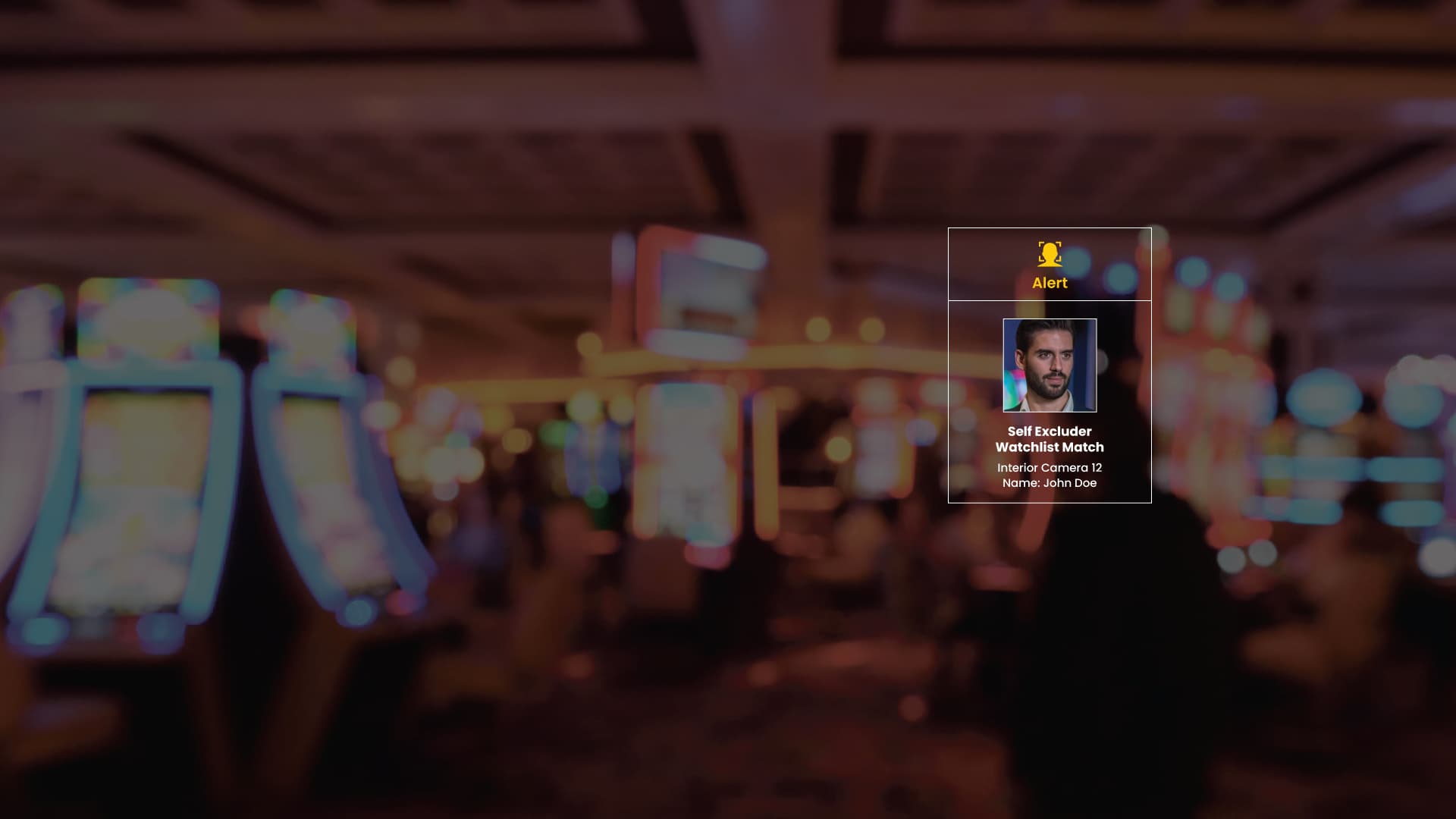
At River Spirit Casino in Tulsa, the problem was memory. About 10,000 guests arrived each day, according to Oosto’s 2022 case study. Some had been barred before. Somewhere among the lights, hats and people looking anywhere except at the cameras, a security team had to notice a familiar face. Cameras could preserve the evening beautifully. Remembering who should not be there was another matter.
- Oosto adds recognition and behavior alerts to existing camera networks.
- Its buyers run casinos, stores, hospitals and other busy physical spaces.
- Metropolis acquired it in 2025; Protect continues to receive product updates.
Oosto’s OnWatch deployment matched faces against a watchlist and notified staff. The customer reported three to five positive detections daily. A modest number, perhaps, until you consider the task: picking a handful of relevant arrivals out of thousands. The lesson travels beyond casinos. A security system earns its place by making a particular decision easier.
01 / A face becomes an instruction
Founded in 2015 as AnyVision by Eylon Etshtein, Neil Robertson and Shlomo Ben-Artzi, the company built face, body and object recognition software. Its commercial proposition was economical in spirit: make cameras already installed do more. A retailer could flag a returning person on its watchlist. A hospital could authorize an employee at a restricted entrance. An investigator could search recorded footage.
These are related jobs with different consequences. OnWatch handles watchlist alerts; OnAccess handles touchless biometric entry and liveness detection. OnPatrol takes watchlist alerting into mobile use. Inquiry, also described as OnSearch, supports retrospective investigation. The buyer purchases help with a workflow, not simply a mathematical resemblance between two faces.
“Casinos are pretty challenging environments, to be honest.”
Sean Crain, Orion Security Solutions
River Spirit deployment, 2022
That explains the role of integrators. Orion Security Solutions had tested Oosto before the River Spirit installation. Intellicene later integrated its recognition technology into Symphia. Existing security infrastructure is a crowded dinner party. A newcomer needs introductions.
02 / The next camera has a bill
Recognition consumes computing resources. Add camera streams and the server, power, cooling and maintenance requirements grow. In 2022, Oosto introduced a near-edge appliance based on NVIDIA’s Jetson Xavier NX. It moved processing nearer the video source, using a small device instead of making every expansion a server-room project.

This is where Oosto sits in the market: between the camera and the security team’s next action. Corsight AI and FaceFirst offer overlapping recognition capabilities; Alcatraz AI competes in biometric access control. Oosto emphasizes recognition in difficult camera conditions, integrations and deployment options. Those are buying criteria to test on site, rather than a reason to declare a universal winner.
The business sells enterprise software and services through demos, proposals and partners, with cloud, on-premises and SDK options. Buyers should budget for compatible processing hardware and integration alongside software. Moving work to the edge changes the cost structure; it does not abolish the bill.
03 / Money could not settle the trust question
AnyVision attracted camera, chip and cloud investors. Its completed Series A totaled $74 million in 2019. In 2020, however, Microsoft chose to divest after an audit into allegations about surveillance in the West Bank.
The distinction matters. The joint statement said the available evidence did not substantiate the alleged mass-surveillance program or a breach of Microsoft’s pledge. Microsoft still concluded that minority ownership gave it insufficient oversight of sensitive technology. An investor relationship had broken down over control. That finding does not establish that the recognition software failed.
In July 2021, AnyVision announced a $235 million round led by SoftBank Vision Fund 2 and Eldridge. That October it became Oosto and announced research with Carnegie Mellon on broader recognition. The company said it had considered more than 300 names. “Oosto” had no English meaning. Naming, at least, offered a problem with a tidy ending.
July 2021
January 2025
Announced financing is not cash received. A sale price is not a funding round. These figures do not establish investor returns.
04 / Beyond the returning face
In 2023, Oosto described a shift toward embedded, multi-class AI and acknowledged workforce changes. Protect arrived in April 2024, combining identity with body and behavior alerts. Its proposition included fighting, falls and crossing into unsafe areas. The company announced commitments covering 3,000 cameras at 200 locations. Commitments, naturally, are a different measure from working installations.
The change widened the question a camera could answer. A watchlist asks whether someone is already known. Behavior analysis asks whether something needs attention now. Neither removes the need for careful rules. A fall alert requires a response plan; an identity match requires review. Buyers can copy the discipline of choosing one event, one responsible team and one measurable outcome before expanding.
This approach needs usable camera views, suitable enrollment images and operators who can act. It loses its point when alerts exceed the team’s capacity or the intended use is prohibited. Oosto’s EU policy excludes specified public-space, real-time biometric identification for law enforcement and other prohibited practices. Privacy settings deserve attention equal to detection settings.
05 / A parking company enters the picture
In January 2025, Metropolis acquired Oosto. Reporting put the consideration at $125 million, largely in shares. Metropolis uses computer vision for checkout-free payments in physical places. The combination suggests a practical affinity: both businesses turn an observed arrival into an operational event. Oosto said its team would join Metropolis while customer support continued.
The May 2026 Protect release offers a revealing coda: scheduled rules, bulk stream controls and live previews while alert clips load. Less glamorous than recognizing a stranger across a room, perhaps. But a rule that runs at the right time and an operator who sees the scene promptly are exactly how an algorithm becomes useful.
Oosto website · Protect + product demo · Watch the Protect demo · YouTube videos · Security leaders in conversation · Company news · Innovation Obsessed · LinkedIn · X · Facebook