A media player and a door reader have an unexpected thing in common: both must make sense of a signal before a person loses patience. In 1995, RealNetworks helped turn data arriving over a slow internet connection into audible speech. Today, its SAFR business turns a camera image into an authentication decision at a doorway. The company has travelled a considerable distance. The waiting human has barely moved.
- Then: RealAudio helped establish consumer internet streaming.
- Now: SAFR sells computer vision and access control; RealPlayer and GameHouse remain consumer businesses.
- The change: TransUnion acquired the mobile division in April 2026.
- The lesson: a technical skill survives only when someone finds another useful job for it.
That makes RealNetworks worth a second look. Many people remember the brand as a piece of software on an old computer. Its current portfolio is stranger and more revealing: facial authentication, personal video libraries and casual games. Think of a familiar restaurant that has quietly started making the locks on the front door.
The voice before the video
Rob Glaser founded the Seattle company in 1994 as Progressive Networks. RealAudio Player arrived in April 1995. The problem was straightforward to describe and difficult to solve: people wanted to hear something over the internet without first waiting for the whole audio file to arrive.
The breakthrough was a change in the experience of waiting. A file could become a performance while it was still travelling. RealPlayer’s later incarnations added video and a growing collection of media functions. This was roughly a decade before YouTube launched. The idea that a browser-connected computer could be an everyday entertainment device still needed some engineering persuasion.
Being early did not settle the question of who would control the market. Microsoft became a formidable rival. In October 2005, the companies announced three agreements valued at $761 million to RealNetworks, resolving antitrust disputes and establishing music and games collaborations. A fight over distribution ended with distribution agreements. The irony came with a very large price tag.
The lasting lesson is less glamorous than a pioneer’s legend. An invention, its distribution and its eventual business model are separate achievements. A company can accomplish the first and spend years negotiating the other two.
The bill for changing direction
RealNetworks’ AI work began well before it left the stock market. In 2018, it publicly introduced SAFR with a free offer for individual K-12 schools in the United States and Canada. An early Seattle school pilot used registered parents’, guardians’ and staff members’ faces for gate access. This was an actual workflow, with a defined population and a physical gate.
But a promising application is a poor substitute for a healthy income statement. In 2021, revenue from continuing operations was $58.2 million, down from $68.1 million in 2020. The net loss attributable to RealNetworks was $21.2 million. SAFR revenue grew 44 percent and KONTXT revenue grew 14 percent that year, while the overall business contracted.
“Our overall financial performance did not meet our expectations.”Rob Glaser, February 2022
In 2022, management introduced a more decentralized structure and new business leadership. SAFR SCAN began shipping in May, giving the computer-vision business a purpose-built access-control device. That December, a Glaser-controlled buyer completed the take-private merger at $0.73 in cash for each eligible common share.
The sequence matters. Private ownership did not conjure the AI strategy into existence. It changed the setting in which an existing strategy would be pursued. Meanwhile, the hardware made the sales proposition more tangible: a customer could buy something with a clear place beside a door.
A face at the front door
SAFR serves organizations that need to manage entry, interpret live video or recognize an enrolled person. SCAN handles facial authentication at the edge, meaning processing happens close to the point of use. Its integrations connect that decision to the access systems customers already operate.
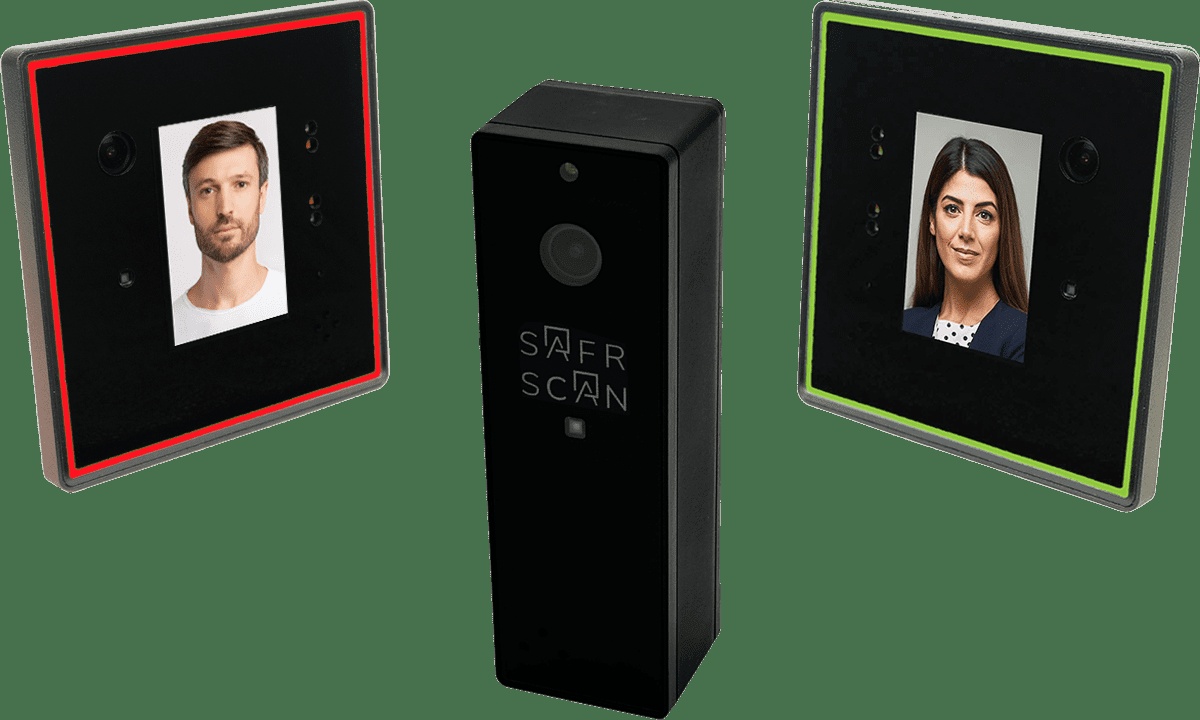
Consider the Genetec integration. Cardholder records, credentials and photographs can be synchronized for use by SAFR readers. The practical value is administrative as well as technical: a security team needs an access decision to reflect the same permissions it maintains elsewhere. A marvellous recognition demo loses its charm if someone must maintain two disagreeing lists of employees.
SAFR Guard, launched in April 2025, gives the technology another specific job. It matches faces on the camera against a retailer’s enrolled security list and sends alerts. The intended buyers are loss-prevention and asset-protection teams. The problem is remembering a repeat offender quickly enough to respond before another incident develops.
- 01Entry image
- 02On-camera match
- 03Mobile alert
- 04Human review
In SAFR’s published Fiesta Foods customer story, staff receive a matched-face snapshot, information about previous incidents and an image showing what the person is wearing that day. That last detail is wonderfully practical. An alert must help someone find a person in a store, not merely admire a model’s powers of recognition.
This is also where precision matters. A face match is not evidence that a new theft has occurred. It compares an image with an existing record. An unfamiliar offender may have no record to match. The value depends on careful enrollment, staff review and a sensible response.
SAFR’s published Guard privacy rules say unmatched biometric data is deleted immediately, enrollments must relate to verified incidents and authorized personnel review alerts. They also require store signage. Those are product policies; the deployment still needs people to carry them out. The camera can send a notification. It cannot supply good judgment.
The mobile business leaves home
The same broad move toward interpreting signals produced KONTXT, the former mobile division’s messaging and voice technology. Its customers were carriers rather than shoppers. Their problem was separating useful communication from spam and fraud without making legitimate contact harder.
A 2022 Vodafone Germany pilot illustrates the work. CallProtect used KONTXT reputation information and an Android SDK to flag potentially fraudulent or unwanted calls. The pilot was designed to assess both performance and user acceptance. Blocking a call is easy to celebrate until the blocked caller is someone the customer wanted to hear from.
In February 2026, Glaser said KONTXT had blocked more than eight billion spam and scam messages over eight years. That is a company-reported measure, not a count of today’s RealNetworks users. TransUnion completed its acquisition of the mobile division on April 1, 2026. The capability continues under a different owner, alongside TransUnion’s communications products.
Three customers, three kinds of cash
The remaining businesses should not be squeezed into a single software-company description. RealPlayer addresses a consumer with a collection of videos: download, play, organize, synchronize and find the clip again. Its free download brings users in; paid upgrades sell additional functions. The alternative may be another player or downloader, or the decision to leave everything inside a streaming service.
GameHouse addresses a different appetite. It publishes and distributes casual games across mobile and PC. Purchases, subscriptions, virtual goods and advertising have all appeared in the company’s games economics. Its place in the portfolio is entertainment, with recurring engagement rather than a door-opening event.
SAFR has the enterprise sale: software, devices, integrations and deployment. Buyers compare it with badges, mobile credentials, other biometric systems and other facial-matching products. The relevant cost includes installation, permissions management and compatibility with existing equipment. A consumer software upgrade tells you very little about that budget.
Borrow the workflow, not the nostalgia
RealNetworks describes its culture as a collection of startup-like businesses under one umbrella. Its history suggests a useful discipline for anyone trying to renew an older company: describe the capability without the famous product’s name. Then find a customer whose problem makes that capability worth buying again.
The next step is less poetic. Put the capability inside a complete workflow. At a door, synchronize credentials. In a store, make the alert useful to staff. In a video library, help someone find the person or scene they remember. Each job has a different buyer and a different test of success.
The old RealAudio proposition was that the internet could speak while the data was arriving. SAFR’s proposition is that a system can interpret an image while the decision still matters. There is a family resemblance there. Reinvention becomes convincing when it reaches a particular person, at a particular moment, and saves them a particular piece of trouble.
Try it, watch it, follow it
Products, demonstrations and the company’s own updates.