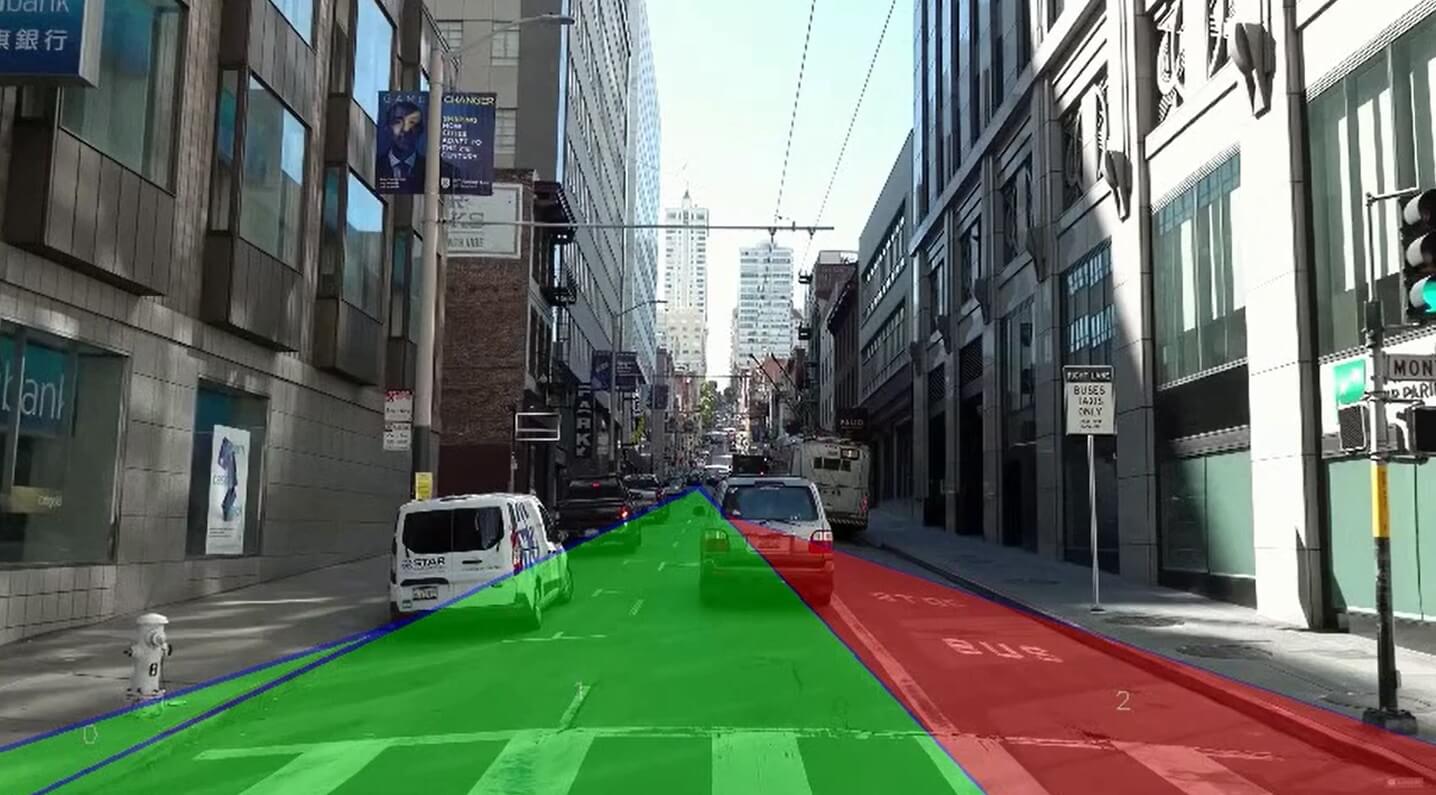
A city bus trundles through its route. To everyone aboard, it is public transport. To NAYAN, it is also a survey vehicle: a moving pair of eyes that can spot a crater in the asphalt, a car squatting in a bus lane and a traffic light ignored by a motorcyclist. The bus does not detour. It simply collects another layer of work while doing the first.
That second job is the essential idea behind NAYAN, a New Delhi computer-vision company founded in 2018. It mounts cameras on vehicles already circulating through a city, analyzes what they see and packages useful moments with a place, a time and visual evidence. Municipal officers can inspect a damaged road. Traffic police can review a violation. Fleet managers can see harsh braking or a driver nodding off. A lens that begins as a safety accessory becomes a field-data network.
01 / The useful trickA moving camera beats a lonely pole
Traditional CCTV is excellent at staring. It watches one intersection, one gate or one corridor with impressive patience. Its weakness is geography. A fixed camera cannot see the pothole three streets away, and blanketing a city with poles, cables and maintenance contracts is expensive. NAYAN’s answer is to borrow motion from sanitation trucks, police cars, taxis, buses and delivery fleets. Routes become coverage.
The company says a mobile system can lift observable city coverage from the sliver reached by fixed CCTV to something much broader. That claim depends on where participating vehicles actually travel, but the economics are intuitive: use a fleet that already exists, add a connected camera and revisit the same roads as part of normal operations. A camera on a bus also changes perspective. It records the road between intersections, where broken surfaces, illegal parking and damaged street furniture tend to live.
The software looks for a broad and slightly surreal roll call: red-light jumping, wrong-way driving, helmetless riding, missing seat belts, illegal parking, bus-lane intrusions, potholes, cracked surfaces, broken bollards, damaged pavers, garbage and waterlogging. Turn the second camera inward and the list changes to sleep, distraction, mobile-phone use and other risky behavior. Add GPS and telemetry, and fleet operators get routes, speeding, sudden acceleration, collisions, live streams and playback.
“Through a single deployment, Nayan is able to serve benefits to multiple government bodies and businesses.”Jayant Ratti, founder and managing director
02 / From app to applianceThe phone on the dashboard grew up
NAYAN did not begin with its current black, dual-facing camera. In 2020, founder Jayant Ratti described a crowdsourcing app that drivers could download and prop on the dashboard. Algorithms analyzed the phone’s video and reported hazards or violations. Contributors were meant to earn money for useful road reports, turning driving time into a form of digital fieldwork. Roughly 1,000 people were testing the product then, with a target of 100,000 users the following year.
The current product tells a more sober hardware story. NAYAN Cam has road-facing and cabin-facing lenses, GPS, live streaming, cloud playback, battery backup, role-based access and on-device event detection. The company says the edge processing can keep useful functions running without constant connectivity. This is not a repudiation of crowdsourcing. It is what happens when a promising phone demo meets fleet procurement, heat, vibration, patchy networks, power interruptions and the need for a repeatable camera angle.
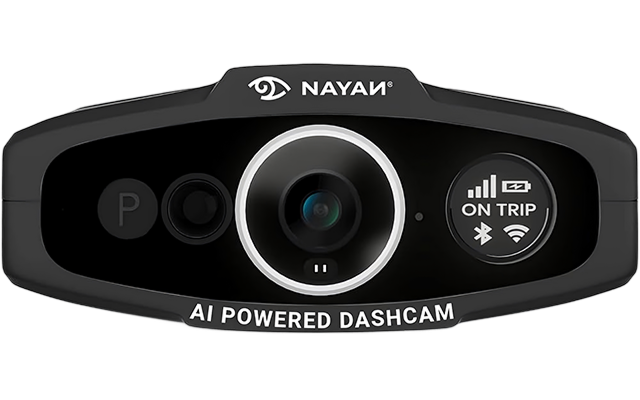
The change also clarifies the buyer. Early NAYAN had a consumer flavor: ordinary drivers would collect footage, earn for reports and receive alerts. Today the clearest pitch is institutional. The website names municipal bodies, smart-city projects, traffic departments, public transport and private fleets. In October 2024, NAYAN said it had enrolled more than 17,000 drivers, signed 35 customers and built a ₹35 crore order book. Its website now says the system has captured more than 1.9 million events across more than 12 countries.
03 / The bill₹899 is the front door, not the whole house
public NAYAN Cam listing
NAYAN is therefore a SaaS and services business wrapped around hardware. It charges for analytics, dashboards and deployments, with cloud delivery for convenience and on-premise options for clients that cannot send sensitive video elsewhere. The camera is the collector. Recurring access to detections, evidence and search is the product that can compound.
That model lets one installation court several budgets. A transport operator wants fewer crashes. A public-works department wants a road-defect list. Police want reviewable violations. An insurer wants a cleaner account of risk. NAYAN’s difference from a fleet telematics vendor is its civic vocabulary; its difference from a road-inspection app is the inward camera and driver coaching; its difference from fixed surveillance is mobility.
04 / The first thing to breakAn alert with nowhere to go
Road AI can fail long before the algorithm does. A dirty lens produces bad evidence. Glare, monsoon rain and chaotic mixed traffic confuse neat categories. A bus route may repeatedly scan one corridor while leaving another invisible. Connectivity drops. Cameras drift out of alignment. A false positive consumes an officer’s time; a false negative quietly disappears. Video of drivers and number plates also brings privacy, retention and access questions that cannot be solved with a cheery dashboard.
But the most important failure is organizational. Detection is not repair. A pothole can be accurately identified, mapped and photographed, then sit untouched because no department owns the handoff. A risky-driver alert matters only if a fleet has coaching and discipline procedures. Evidence of a traffic offense matters only if local rules permit its use and an authorized person reviews it. The last mile is not computer vision. It is a work order.
NAYAN works best where vehicles repeatedly cover the target area, cameras are maintained, legal authority is clear and someone is measured on closing the resulting cases. Without those four conditions, the system can create a handsome map of unattended problems.
This is also what others can copy. Do not begin by buying a new citywide sensor estate. Find an asset already moving through the environment: buses, waste trucks, delivery vans, inspection cars. Give it one additional sensing job. Define a small event vocabulary. Attach proof and location. Most important, design the receiving workflow before filling a screen with dots. The modest question - who clicks next? - is worth more than another accuracy boast.
05 / A business in the handoffWhat NAYAN is really selling
Ratti, an engineer and roboticist who previously built drone and robotics systems in the United States, returned to India and put a reported ₹3.5 crore of initial capital into NAYAN. Abhishek Bose and Anuj Middha were named as co-founders in early coverage. In an interview, Middha said the team numbered about nine when he joined in 2019. His most revealing startup lesson was not technical: do not focus only on building cool things; learn the business side and eventually choose a niche.
NAYAN chose roads as that niche, then kept widening what a road camera could sell. The company raised $2 million in October 2024 in a round led by BEENEXT, with We Founder Circle, Venture Catalysts, LetsVenture and FAAD Capital participating. The money was earmarked for AI and IoT expansion in India and abroad. By then the company had accumulated recognition from RAISE, the National Startup Awards, the GPAI summit and urban-mobility competitions. It now promotes 23 granted patents and dozens of additional technology patents and trademarks.
Awards are pleasant; renewal revenue is sterner. NAYAN sits between several established markets: fleet dashcams from companies such as Netradyne and Motive, road-survey tools such as RoadMetrics, connected community cameras such as Nexar, fixed CCTV and large traffic-system integrators. Its opportunity is the overlap those categories leave behind. Its risk is the same overlap: a municipal buyer may prefer a systems integrator, a fleet may need only telematics, and privacy rules may narrow how collected footage can be reused.
Still, the core observation has legs. Cities are full of machines already tracing their streets. Each journey contains information that somebody currently pays to collect later, badly or by hand. NAYAN wants to turn that exhaust into a searchable civic record. The eye-shaped logo is almost too neat. The harder and more valuable organ is the nervous system behind it - the route from a flash of pixels on a windshield to a person who fixes what the camera saw.