smart-cities
(62)
The Dashcam That Wants to Give a City Eyes
NAYAN’s cameras ride buses, police vehicles and commercial fleets, turning ordinary journeys into a live index of potholes, violations and risky driving. The clever part is not the lens - it is the workflow that turns street footage into evidence someone can act on.

The UK Launchpad learned to open doors at the right time
Sandeep Arora’s early mistake was introducing clients to opportunities before they were ready. His UK Launchpad now pairs corporate access with the preparation that makes a meeting useful.

Tech Istanbul Opens the Door to a City-Sized Customer
Free support is the easy part to explain. Tech Istanbul’s more interesting offer is a chance to test a startup’s product inside the machinery of Istanbul’s municipal services.
Leading Cities wants your next climate idea to survive City Hall
The Boston nonprofit pairs startup training with prepaid city pilots. Its real test comes after the pitch: getting a charger onto a curb, a map into local hands, and a useful experiment into everyday service.

Intersection’s pitch: let the ads pay for the city
The company behind LinkNYC advertising turns sidewalks, stations and bike docks into media. Its history shows both the appeal and the hard limits of getting brands to fund public conveniences.
Boldyn Networks wants to own the places your phone goes silent
Under railway tracks, around racetracks and inside livestock sheds, Boldyn builds networks that other businesses use. Its wager: sharing the infrastructure can make difficult connections worth the expense.

Gorilla Technology’s Next AI Act Comes With a Bigger Bill
Gorilla made its name teaching cameras to spot trouble. Its next act is financing and deploying AI compute across Asia - a bigger business with a much bigger bill.

Anahita Poonegar Makes Trust Legible
A Cornell-trained planner became the translator, marketer, and operator behind Intertrust's shift from digital rights to data governance - while building its India business from the ground up.

Flock Built a $7.5 Billion Crime-Solving Network. Now It Has to Prove the Network Can Police Itself.
Flock made license-plate intelligence cheap to deploy and easy to share. The product worked so well that the governance around it became the company’s most important engineering problem.

INRIX Bet the Road Would Become a Sensor - Now It Sells the Traffic Jam
After 70 investor rejections, INRIX replaced helicopters and roadside loops with a moving network of vehicles. Twenty years later, its harder job is turning a 50-petabyte data lake into answers cities, carmakers and logistics teams will actually pay for.

The Modem That Refuses to Stay Put: Hojun Kim’s Bet on Software-Defined Roads
After years designing chips, Hojun Kim is trying to make road infrastructure age more like software: upgradeable, interoperable and ready for the next radio standard.
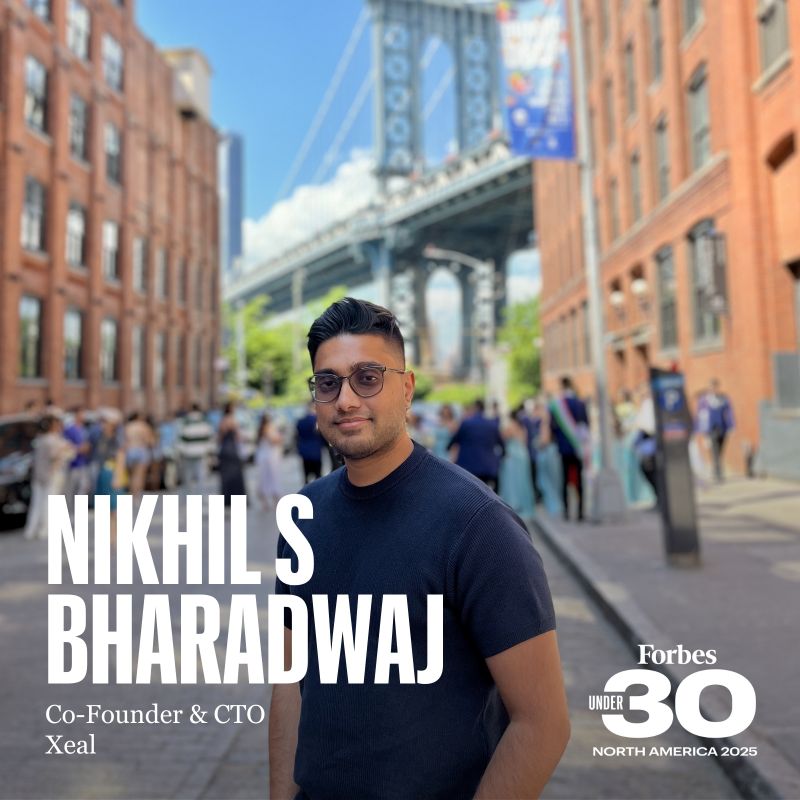
Nikhil Bharadwaj Put the Cloud on Notice
The Xeal co-founder learned EV charging’s least glamorous lesson in concrete garages: if the network disappears, the product cannot. His answer was to move the essential work closer to the plug.

The Garbage Trucks That Went to War With Urban Blight
A University of Alabama economics experiment strapped cameras to trash trucks to map urban decay. Five years and $15 million later, City Detect is doing the work of 40 code officers with one vehicle - and cities are starting to fix blight before it spreads.

Chuan Yu Is Designing the City From the Chassis Up
The architect behind PIX Moving does not begin with the car. He begins with the street, the neighborhood, and a stubborn question: what if useful spaces could come to us?
The Bus Shelter That Became a Global Media Machine
JCDecaux turned a piece of civic furniture into a 60-year business model. Now its hardest trick is making a million physical advertising panels behave like software without making cities feel like websites.
Vontier
The company you have never heard of runs the fuel pumps, tool trucks and traffic lights you pass every day - and it is quietly betting all of them on the messy middle of the energy transition.

Leila Dillon
Leila Dillon has built a career explaining the systems most people notice only when they fail - from sensor-equipped city bins to the energy infrastructure beneath schools, governments and businesses.
Intelmatix
Intelmatix is a deep-tech enterprise AI company founded by MIT-trained technologists that builds EDIX, an Enterprise Decision Intelligence Platform designed to act as a 'digital brain' for organizations. Using context-aware AI agents, knowledge graphs and generative AI, EDIX lets companies sense, learn, decide and act across functions like demand forecasting, inventory, workforce planning and site selection - without needing an in-house data science team. Headquartered in Riyadh with offices in London and Boston, Intelmatix focuses on the MENA region, training on local context data that global platforms overlook. It raised a $20M Series A in 2024 - the region's largest AI Series A of its kind - and in 2025 became the first Saudi and MENA AI company named a World Economic Forum Technology Pioneer.

Quantela Inc.
Quantela is a smart-city technology company that helps cities and communities digitize urban infrastructure through an AI- and IoT-powered data platform. Founded in 2015, it evolved from a dashboard tool into a full urban infrastructure platform spanning smart lighting, traffic, public safety, digital advertising and citizen services. Quantela is known for pioneering an 'outcomes-based' business model, funding projects up front in exchange for a share of the resulting revenue or savings, and operates across the Americas, EMEA, India and Asia-Pacific.
Saferoad Information Technology LTD.
Saferoad Information Technology is a Saudi telematics and IoT company based in Al Khobar that builds both the hardware and the software behind vehicle tracking and fleet management. Founded by Mohannad Alhaj in 2009, it positions itself as the Kingdom's first and only full-stack telematics provider - designing its own GPS trackers, dash cams and sensors while running an AI-driven cloud platform for fleet monitoring, driver-behavior scoring, cold-chain compliance, car sharing and school-bus safety. Its stated mission is to reduce road fatalities and improve driving behavior across Saudi Arabia, serving corporate and government clients including Saudi Aramco, Saudi Post, SAPTCO and the Transport General Authority.

Chirag Jain
Chirag Jain is the co-founder and CEO of Get My Parking, a smart parking technology company he started in 2015 with Rasik Pansare after the two met on the Jagriti Yatra train journey across India. An IIT Madras graduate who spent two years in the automotive industry, Jain set out to digitize the largely unorganized parking sector with affordable, white-labeled, IoT-driven software. Under his leadership Get My Parking has grown to serve tens of millions of parking transactions across more than a dozen countries, raised multiple rounds of venture funding, and pushed into AI-powered products like license plate recognition and the AVA voice support agent. He was named to Business World's Disrupt 40 Under 40 in 2017.

Nexar Inc.
Nexar is a New York-based mobility technology company that turns connected dashcams into a real-time sensing network for the physical world. Founded in 2015 by Eran Shir and Bruno Fernandez-Ruiz, it sells LTE-connected 4K dashcams to consumers while aggregating anonymized road imagery into CityStream, a platform that gives cities, mapmakers, insurers and autonomous-vehicle developers a minute-by-minute, ground-level view of streets. In July 2026 Nexar agreed to merge with Nauto to form an independent infrastructure platform for physical AI, backed by more than 10 billion historic miles of driving data across 50+ countries.

Zencity
Zencity is a govtech company that builds the leading platform for community trust, purpose-built for local government. It combines AI-driven social listening, statistically representative resident surveys, and communication tools to help cities, counties, and public safety agencies understand what residents think and turn that input into decisions, budgets, and policy. Founded in 2016 and headquartered in New York and Tel Aviv, Zencity works with more than 600 government agencies and has raised roughly $93M in venture funding.

Eyal Feder-Levy
Eyal Feder-Levy is the co-founder and CEO of Zencity, a govtech company that uses AI to turn millions of resident interactions into actionable insight for local governments. An urban planner by training who came up through nonprofit community work in South Tel Aviv, he started Zencity in 2015 to give cities a routine 'finger on the pulse' of their communities. Under his leadership the company has raised roughly $93M, works across six countries, and serves hundreds of government agencies reaching hundreds of millions of residents.

Commsignia
Commsignia is a vehicle-to-everything (V2X) technology company that builds the software stacks, on-board units, roadside units and cloud platforms that let cars, road infrastructure and traffic operators talk to one another. Founded in Hungary in 2012 and now headquartered in Santa Clara, California, the company supplies standards-compliant C-V2X and DSRC solutions used by automakers, road operators and departments of transportation across more than 20 countries, with the goal of reducing collisions and smoothing traffic flow under the banner 'Trust for the road ahead.'

Lantronix
Lantronix is an Irvine, California-based global provider of secure IoT and remote environment management solutions that combine intelligent hardware, connectivity, software-as-a-service and engineering services. Founded in 1989 and publicly traded on Nasdaq as LTRX, the company builds device servers, IoT gateways, cellular routers, console servers and PoE switches, paired with cloud management platforms like Percepxion and ConsoleFlow, to help organizations connect, compute, comprehend and control equipment at the edge across automotive, industrial, smart city, defense and enterprise IT markets.

Archetype AI
Archetype AI is a San Mateo-based physical AI company founded by former Google Advanced Technology and Projects (ATAP) leaders. It builds Newton, a multimodal foundation model that fuses real-time data from cameras, radar, microphones, accelerometers and dozens of other sensors with natural language, so machines can perceive, understand and reason about the physical world. On top of Newton, the company ships an Archetype Platform, an Agent Toolkit and prebuilt Physical Agents that turn raw sensor streams into actionable insight for manufacturing, construction, energy, telecom and city infrastructure. It raised a $35M Series A in November 2025, bringing total funding to $48M.

Obvio
Obvio is a San Carlos, California startup building solar-powered, AI-equipped camera pylons that watch intersections for dangerous driving - running stop signs, speeding, illegal turns, crosswalk violations and distracted driving. The cameras process footage on-device, flag only genuine violations for human review, and hand verified cases to local police, who decide whether to issue citations. Obvio installs the hardware for municipalities at no upfront cost and earns revenue from a share of citation fees. Founded by former Motive engineers Ali Rehan and Dhruv Maheshwari, the company raised a $22 million Series A led by Bain Capital Ventures in June 2025 and reports that early Maryland deployments cut stop-sign running by roughly 50-70%.

BlueZoo Inc.
BlueZoo Inc. is a Menlo Park-based analytics company that measures real-world foot traffic by passively counting the Wi-Fi probe requests smartphones broadcast - turning phones into an anonymous proxy for people. Its cloud software and Wi-Fi sensors deliver real-time, auditable, privacy-respecting counts of visitors, unique visitors, and dwell time for out-of-home advertising, retail media, hospitality, and smart-city customers. Protected by seven U.S. patents and GDPR-certified by ePrivacy, BlueZoo is positioning itself as an independent measurement 'currency' for the digital-out-of-home advertising industry.

Tashinga Musiyazviriyo
Tashinga Musiyazviriyo is the Founder and CEO of The Singular, a Johannesburg-based digital transformation company building purpose-driven IoT, AI, and private 5G network solutions across industries including mining, telecommunications, manufacturing, smart cities, and healthcare. With a career forged inside Ericsson's core network engineering teams and a deep grounding in mobile network design and performance, Tashinga brings both technical precision and entrepreneurial drive to the challenge of connecting Africa's industries to the future.