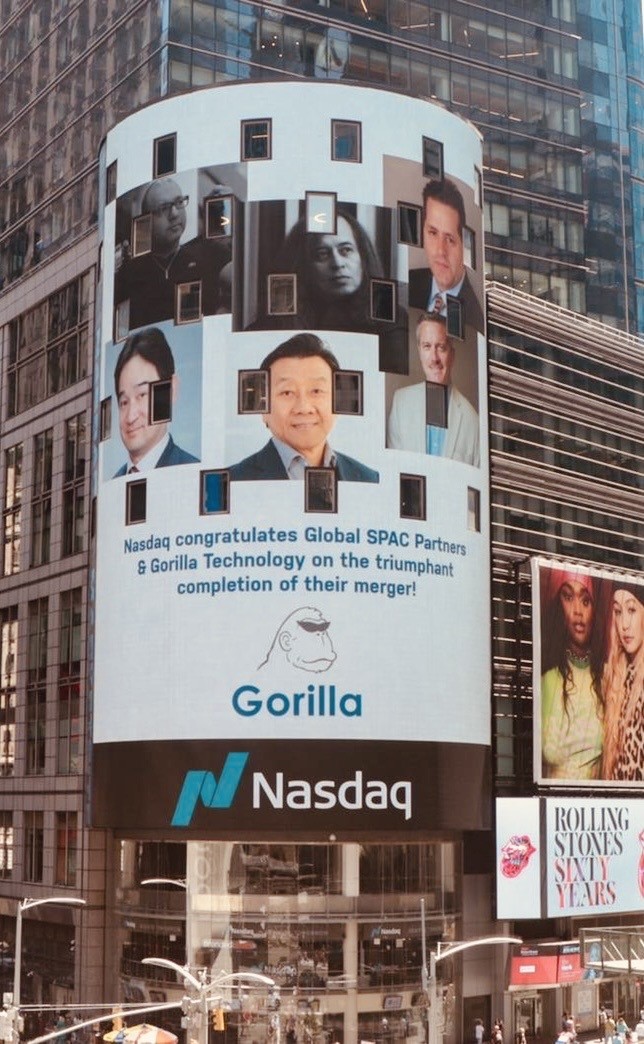
Spincer Koh’s face ended up on a building in Times Square. There it was, among the executives on a Nasdaq display congratulating Gorilla Technology and Global SPAC Partners on their merger. For a founder whose business involved extracting useful information from images, it was a pleasantly extravagant image: a career measured, briefly, in square feet of Manhattan.
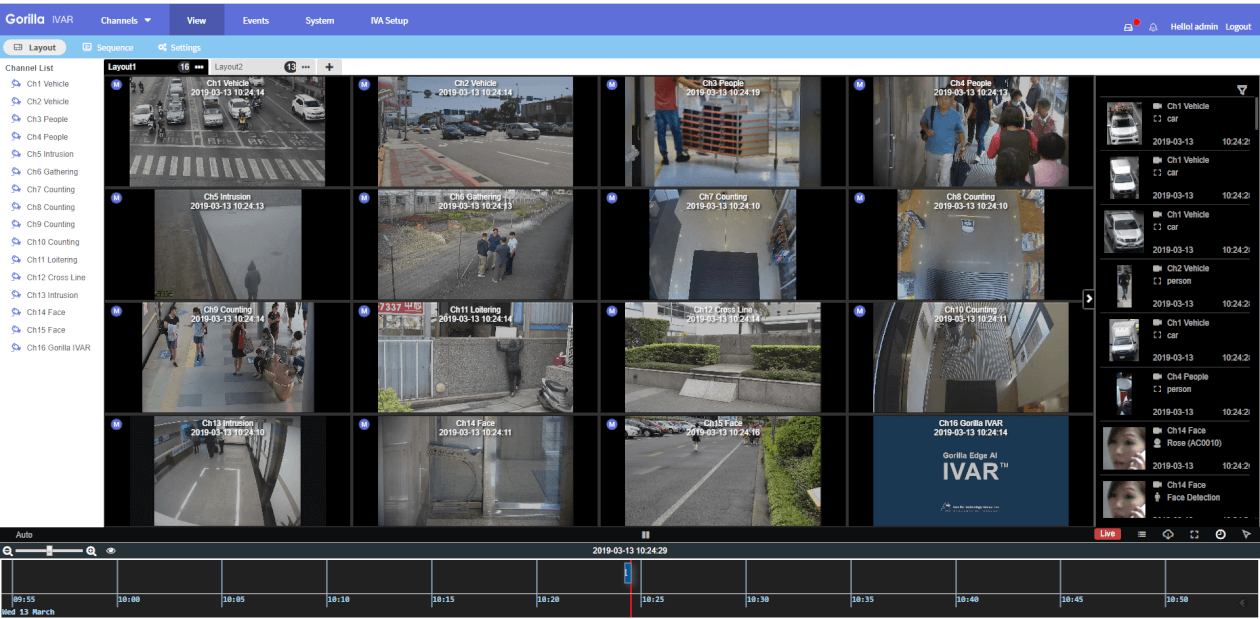
The more revealing picture is smaller. Think of a camera, a processor and a job that needs doing. The processor has limited resources. The software must still respond quickly enough to be useful. Much of Koh’s work at Gorilla concerned that negotiation. Before the stock symbol GRRR, there were years of trying to make video intelligence function inside the limits of an actual machine.
Those two scales belong together. The public company grew out of the patient engineering business. Koh’s story runs through naval service, American graduate schools, digital media archives and partnerships across hardware and software. It also has a definite handover: Gorilla began trading on Nasdaq in July 2022. In September, its founder retired as chief executive.
The first engineering career
His formal name is Sih-Ping Koh. The education behind the doctorate on his business biography crosses three institutions: a Bachelor of Science from Taiwan’s Chung-Cheng Institute of Technology, a master’s in Naval Architecture and Marine Engineering from the University of Michigan, and a Ph.D. from the University of Washington. His LinkedIn profile dates the Washington years to 1986–1989.
Naval architecture is an arresting qualification to find behind a video AI company. It is also a reminder that a founder’s technical history can be longer and less fashionable than the market eventually attached to it. Koh was an engineer before edge AI became the label on his work.
He returned to Taiwan in 1989 and worked on missile manufacturing automation at the Chung-Shan Institute of Science and Technology. His service also involved video command systems and transferring manufacturing technology into civilian industry. He retired from the navy in January 1999, after twenty years, with the rank of colonel. Entrepreneurship followed a substantial first career.
The archive learns to watch
At the turn of the millennium, Koh co-founded Gorilla. Its early territory was digital media management: helping customers organize, retrieve and reuse video. An archive full of footage is only useful if someone can find the piece they need. Before the camera could become an analytical instrument, there was the less glamorous matter of making its output searchable.
In his account of the company’s development, Koh described a progression from media digitization to surveillance analytics, followed by deep learning and systems that divided work between the edge and the cloud. The applications changed as cameras and computing improved. Video remained the raw material.
One retail example made the application tangible: at Planet Sport, part of Indonesia’s MAP group, video-derived shopping information was combined with point-of-sale data to inform changes to counters and brand placement. The result Koh described was a store layout decision, an ordinary action at the end of a technically complicated chain.
The name Gorilla gives all this a welcome interruption. Koh’s LinkedIn introduction calls him “The Silverback of the Gorilla Troop.” Corporate biographies are rarely accused of having too much wildlife. Here, at least, the founder allowed himself a joke. The work underneath it was concerned with making images useful to people who had decisions to make.
The processor gets a vote
By December 2021, as Gorilla announced its proposed public-market transaction, Koh was describing a three-way compromise: accuracy, computing time and resource usage. Improving one number would not, by itself, settle the product question. The application had to operate with the resources available where it was installed.
This is an unshowy way to talk about artificial intelligence. It gives the customer’s hardware a seat at the table. A more accurate result loses some of its appeal if it arrives too late. A fast application has another problem if it requires equipment the installation cannot accommodate. Koh’s emphasis was on the combination.
“We can do a lot more today”
Spincer Koh, discussing Gorilla’s work with Intel
Gorilla’s collaboration with Intel put a number on part of that effort. A 2019 case study reported that OpenVINO optimization allowed low-end edge devices to analyze 1.5 times as many frames per second. The measure concerned a particular workload and configuration. Its appeal was concrete: extract more useful work from the machine.
How much work fits?
Relative frames processed per second in the 2019 Intel case study. Results depend on the tested hardware and workload.
There is an economic story inside that technical one. Software reaches a customer through a collection of physical limits, purchasing decisions and existing equipment. Each of those conditions can veto an elegant idea. Working within them is part of product development, even when the announcement gives the algorithm most of the attention.
A product needs other people
In May 2019, Asteria and Gorilla announced a strategic partnership to combine Asteria’s Gravio edge computing software with Gorilla’s image recognition technology. The plan brought complementary products together for deployment in their respective markets. For Koh, international expansion involved working with another company’s software and commercial relationships.
A relationship like that makes the word “platform” more demanding. The technology has to connect with something beyond its own demonstration. Interfaces, deployment arrangements and support all become part of the promise. A useful product is rarely the work of one organization acting entirely alone, however tidy the company story may look afterward.
The same month, AAEON announced a COMPUTEX Taipei demonstration pairing its AIOT-AIVD gateway with Gorilla’s IVAR analytics. The hardware combined an UP Squared board with Intel’s Movidius Myriad X. The demonstration included recognizing registered staff as they arrived. Koh’s software was being shown through a device another team had built.
Such partnerships help explain the texture of his career. The founder’s job included making a technology legible to hardware makers, software partners and customers with different requirements. A working demonstration is one meeting point. A dependable installation is a longer conversation, with rather more people entitled to ask difficult questions.
Two kinds of security, one conversation
Koh’s public writing extended beyond video. In May 2018, he published a sequence of LinkedIn articles about cybersecurity, the Internet of Things, physical security and security convergence. The subjects overlap for a practical reason: a connected camera occupies a physical place and belongs to a network. Its usefulness and its vulnerabilities travel together.
That connection became part of Gorilla’s product story. The company offered a Security Convergence Platform alongside its video intelligence work, bringing network surveillance and cybersecurity into the discussion. For a business growing around connected devices, the network could hardly remain somebody else’s problem.
Koh also took on the explanatory work himself. Gorilla’s Edge AI Video Series featured him discussing video analytics, vision AI and network security. In 2021, he shared a recorded Intel webinar covering AI appliances and toolkits. The topics were the machinery of deployment: how a customer or partner could put the technology to work.
The teaching format suits the subject. “Edge” can sound like a distant frontier. In this context, it puts processing closer to the place where data is generated. That makes the discussion local in a literal sense: a device, a site, a useful response. The grand vocabulary eventually has to fit inside a practical explanation.
A loud ticker, a quiet handover
Gorilla’s business combination with Global SPAC Partners closed on July 13, 2022. Its ordinary shares began trading the following day under GRRR. The warrants traded as GRRRW. After years spent organizing and analyzing other people’s images, the company acquired a very public image of its own.
The company’s July filing carries Koh’s signature as chief executive. By September 12, Gorilla was announcing Jay Chandan as his successor. The timetable is precise enough to resist the usual blur of a founder biography: the listing and the retirement were separate events, two months apart, after a commitment stretching over two decades.
Announcing his retirement, Koh said, “now is the right time for me to step away and enter retirement.” He credited Chandan’s contribution to the company’s recent milestones. A founder’s departure can invite an elaborate theory. His own announcement presented a simpler decision: a long period of building had reached a point at which he was ready to hand over.
Experience finds another use
Retirement did not end his interest in what other people might build. By January 2025, Koh was discussing the value of passing his experience to Taiwanese startups. The proposed contribution drew on both careers: defense engineering and the technology business. The accumulated experience had another possible use beyond running Gorilla himself.
There is something appealingly practical about that next chapter. A younger founder may need help with precisely the matters a polished success story leaves out: fitting a product to an installation, choosing a partner, carrying an idea through years of changing requirements. Koh’s career contains a long exposure to those questions.
Times Square provides the memorable photograph. The more durable subject is the work behind it: finding useful information, respecting the limits of the machine, assembling the people needed to make a product function. Spincer Koh spent decades on those details. By the time his face reached the billboard, thinking smaller had carried him quite a distance.
Follow the threads
Continue with Koh’s public writing, conversations and company milestones.
- Spincer Koh on LinkedIn ↗
- The 2018 conversation about Gorilla’s evolution ↗
- Inside the IVAR optimization work with Intel ↗
- Watch: Koh’s Edge AI Video Series introduction to vision AI ↗
- Watch on YouTube: Gorilla Smart Patrol Solution ↗
- Koh’s recorded Intel webinar announcement ↗
- The January 2025 career interview (Chinese) ↗
- The July 2022 listing milestone ↗
- The September 2022 handover ↗
- Gorilla Technology’s website ↗