The Story
Buses, Not Billboards
There are roughly 490 million bus trips taken in New York City every year.
On a good day, about 30% of city bus delays are caused by vehicles
illegally parked in bus lanes and bus stops. Marty Beard looked at that
number and didn't write a think piece. He built cameras.
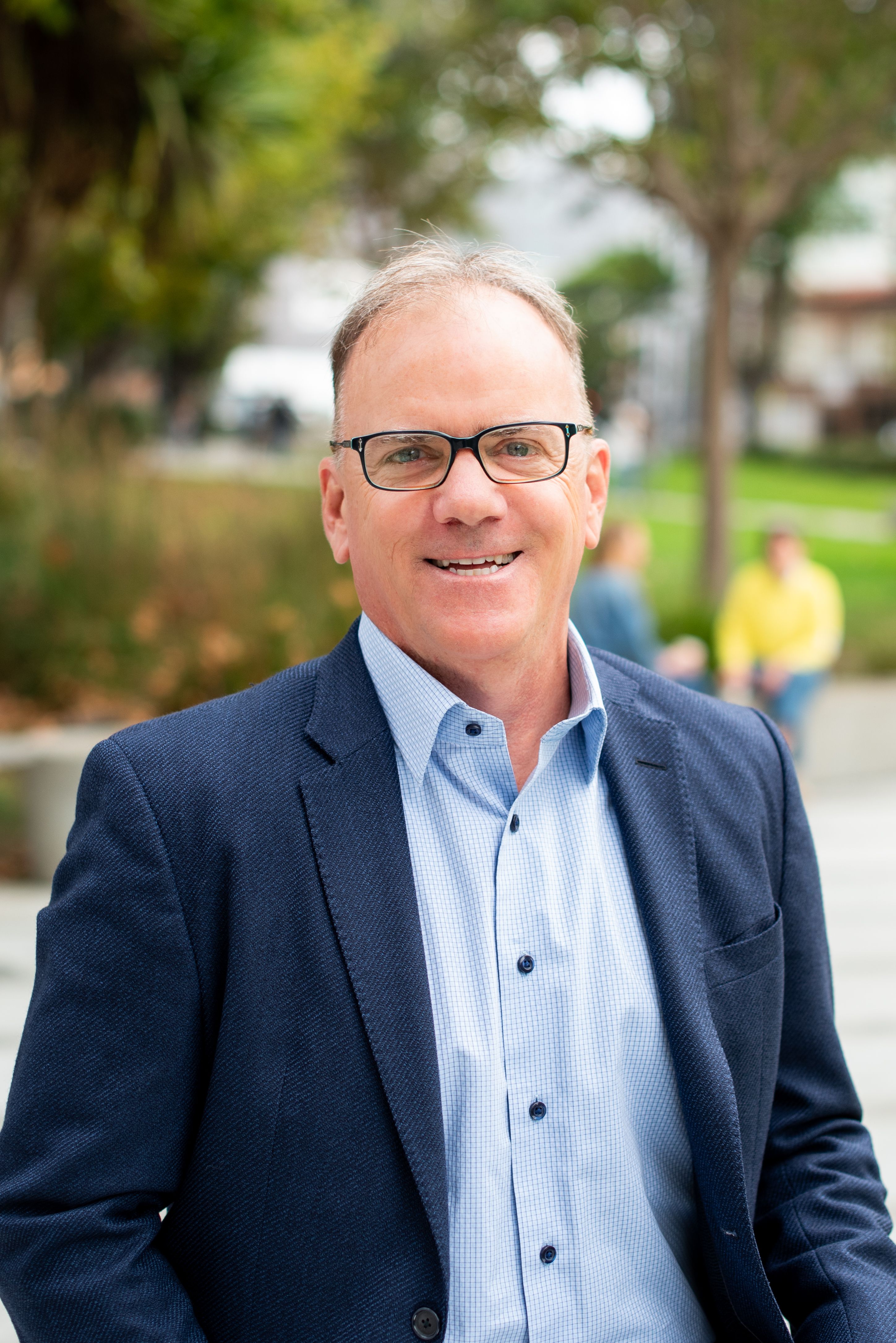
As CEO of Hayden AI since August 2025, Beard leads the largest mobile automated
bus zone and bike lane enforcement company in the United States. The company's
AI-powered cameras mount to buses and parking enforcement vehicles, scanning
the street in real time, tagging violators, and building an evidence chain
without a single police interaction. No faces captured. No data retained.
Just the violation, packaged and airtight.
His mandate is specific enough to be measurable: improve bus speeds, reliability,
and safety. Cities running Hayden AI's platform are seeing bus speed improvements
of 20% or more. That's not a rounding error. For a rider who depends on the M15
to get to work, it's the difference between making a shift and losing a job.
"We're a public transit company. Everything we do is focused 100 percent on improving public transit."
- Marty Beard, CEO, Hayden AI
That framing - public transit company, not enforcement company, not surveillance tech -
is a deliberate choice. Beard has spent enough time at the enterprise intersection
of technology and institutional trust to know that mission framing is everything.
When he talks about Hayden AI, he's talking about equitable mobility: the bus rider
who can't afford Uber, the person in a wheelchair who depends on predictable transit,
the city that needs its streets to work.
He doesn't collect extra credit for caring. He just makes sure the system proves it
in the data: transit agencies own every byte of footage. No human identification.
No long-term storage. The camera sees the car blocking the lane. After that, the
data belongs to the city.
Career Arc
The Pattern: Find the Pivot, Run Toward It
Beard's career doesn't follow a straight line. It follows a pattern: arrive at a
company undergoing a strategic identity crisis, steady the ship, and steer it into
the next chapter. He's done this at BlackBerry. He's done this at LiveOps. And he
spent several years doing it from scratch at alwaysAI.
He started at Oracle as Vice President of Oracle Online, the company's e-commerce
unit, in an era when "buying software online" was still a novel concept. From there,
he moved to Sybase, eventually becoming President of Sybase 365, the mobile messaging
and mobile commerce subsidiary. For six years he ran a unit sitting at the intersection
of telecom and enterprise software before anyone was comfortable calling it both.
Career Timeline - Visual Overview
2000s
Sybase - President, Sybase 365
2018-25
alwaysAI - Co-Founder & CEO
In 2011, he took the CEO role at LiveOps, then a cloud contact center platform
built on an unusual premise: 20,000+ independent contractor agents working from
home before "remote work" was a strategy. The pandemic would validate that model
a decade later. Beard was already running it at scale. Under his leadership,
LiveOps became an early proof-of-concept for distributed cloud labor markets.
Then came BlackBerry. In July 2014, he joined as COO when BlackBerry was still
publicly losing the handset war and quietly pivoting toward enterprise security.
He oversaw marketing, the BlackBerry 10 app ecosystem, and customer care during
the company's most turbulent phase. The turnaround worked, eventually. BlackBerry
became a serious cybersecurity and software company. Beard was part of that transition.
"Rather than speculate about what AI might do years from now, we've built solutions that solve real problems for cities today."
- Marty Beard, CEO, Hayden AI (Santa Monica Next, 2025)
When he left BlackBerry in 2017, he didn't take a board seat or write a book.
He co-founded alwaysAI in 2018 - a company built to put deep learning computer
vision on edge devices. Not in the cloud. On the device. In real time. The year
before edge AI was a mainstream talking point. He was building the thing that
NVIDIA's Jetson platform was about to enable.
At alwaysAI, he worked with construction firms, manufacturers, and industrial
operators who wanted computer vision without sending video footage to a data
center. That experience - edge processing, privacy constraints, real-world
deployments, enterprise sales cycles - maps directly to what Hayden AI does.
The company's enforcement cameras run perception AI on the vehicle itself.
Violations are detected at the edge before anything moves to the cloud.
The Company
Hayden AI: The Infrastructure of Enforcement
Founded in 2019 and headquartered in San Francisco, Hayden AI built the largest
mobile automated transit enforcement platform in the US. The core product: AI cameras
mounted on buses and enforcement vehicles that detect vehicles blocking bus lanes,
bus stops, and bike lanes in real time.
The system works 24 hours a day, across all weather conditions, including at night
(night vision cameras are part of the stack). Each detection generates a violation
record with timestamped footage, GPS coordinates, and AI-verified evidence - a
complete chain for citation issuance. Cities use this data to issue automated
citations, replace manual enforcement patrols, and build a case-by-case evidence
archive that would be impossible to maintain at scale with human officers.
As of early 2026, Hayden AI has crossed 2,100 installations across major US and
European cities. The platform recently expanded to parking enforcement vehicles
for the first time - a meaningful product expansion that signals the company's
ambitions beyond the transit bus. Beard is also watching the emerging use case
around unpermitted construction in transit zones - a source of delays that's
harder to cite but increasingly on cities' radar.
🚌
Transit Focus
Every product decision at Hayden AI maps back to one metric: does this make buses faster, safer, and more reliable?
🔒
Privacy First
No facial recognition. No human identification. Transit agencies own all collected data. The camera sees plates - not faces.
⚡
Edge Processing
AI runs on the vehicle itself. Violations are detected in real time before anything leaves the device - a design choice that enables privacy and speed simultaneously.
🏆
2026 AI Excellence Award
Hayden AI won the 2026 AI Excellence Award. Industry recognition for practical, deployed AI that measures its own impact in miles per hour.
Education
History, Rhetoric, and Running AI Companies
Beard's academic path is not what you'd predict. His undergraduate degree from UC
Berkeley is a double major in History and Rhetoric - two disciplines that, at their
core, are about understanding how power moves and how language shapes decisions.
Neither is a technical degree. Both are, arguably, perfect training for an enterprise
CEO who has to explain AI enforcement cameras to city governments.
University of California, Berkeley
BA - History & Rhetoric
Georgetown University
MBA - Business Administration
Up Close
What Actually Makes Him Interesting
Beard lives in San Diego. The company is in San Francisco. That's not unusual in
California tech, but it matters as a signal: he's not a founder who tied his identity
to the zip code. He runs the company; the company doesn't run his life.
He talks about Hayden AI's work in terms of equity more than efficiency. Bus riders
are, statistically, lower-income than car commuters. When a car blocks a bus stop,
it's not an inconvenience - it's a cumulative structural problem experienced primarily
by people who don't have alternatives. Beard frames enforcement technology as a tool
for redistributing road access, not just generating citations.
At BlackBerry's CES 2015 event, he was the public face of a company many in the
media had already written off. He made the case for enterprise software with the calm
of someone who knew where the company was actually going, even when the stock market
didn't. That poise under narrative pressure is a recurring pattern.
He chose to co-found alwaysAI rather than take a comfortable executive role somewhere
after BlackBerry. That's the detail that distinguishes an operator from a builder.
He didn't just run the company. He started one from zero.
Career Timeline
The Sequence
1990s
VP, Oracle Online
Led Oracle's e-commerce division when buying enterprise software online was still an experiment.
Early 2000s
President, Sybase 365
Ran the mobile messaging and mobile commerce subsidiary of Sybase for six years. Built one of the early mobile enterprise platforms before "mobile-first" was a slogan.
2011
CEO & Chairman, LiveOps
Took the top job at LiveOps, scaling a distributed cloud contact center with 20,000+ independent contractors - a remote-work model nearly a decade before it became standard.
2014
COO, BlackBerry
Joined BlackBerry at its most existential moment. Oversaw marketing, apps, and customer care as the company pivoted from consumer hardware to enterprise security.
2018
Co-Founder & CEO, alwaysAI
Built a computer vision platform for edge devices from scratch. Pioneered deep learning inference on embedded hardware before "edge AI" became a category.
August 2025
CEO & Board Member, Hayden AI
Appointed to lead the largest mobile automated transit enforcement platform in the US. Immediately began scaling deployments and expanding use cases beyond bus lanes.