A revealing thing about Eric Danziger's robotics career is that he stopped just short of building a robot. Invisible AI, the company he co-founded in 2018, makes a device that watches the physical world in three dimensions, reasons about what it sees and keeps the record close at hand. It has the eyes and part of the mind. It does not have the arm. For a founder formed by Army deployments, a demanding return to school and a front-row seat to the self-driving boom, restraint is less a lack of ambition than a design principle.
Danziger runs Invisible AI from South San Francisco, where the company builds computer-vision systems for manual assembly. The phrase sounds tidy. A working assembly line is not. People step in and out of stations. Vehicles keep moving. Parts arrive late. A process that looked stable at 9 a.m. acquires a limp by lunch. Managers have traditionally sampled this world with stopwatches, clipboards and periodic observation. The method captures a few cycles and asks them to stand in for thousands.
Invisible AI's proposition is to give the factory a continuous, searchable memory. Its edge devices combine a high-resolution 3D camera, computation and local storage. They can break a cycle into work, walking, waiting and picking; compare shifts; flag ergonomic concerns; and preserve visual evidence for a later investigation. The data stays on premises. In a place where the footage may show people, products and proprietary processes, architecture becomes a social fact.
First came purpose. Then came perception.
Danziger graduated from the University of Virginia with a degree in systems engineering and enlisted in the Army in 2007. At infantry basic training, his drill sergeants pulled him aside and showed him the pay difference between enlisted and officer tracks. They tried to persuade him to switch. He did not. His explanation, years later, was lightly comic: the officer route sounded too much like a real job, full of desks and PowerPoint. There would be time for that later.
He stayed for more than seven years and became a Special Operations team leader. When he visited friends living the usual post-college lives in San Francisco and New York, the contrast was sharp. His own work could mean spending 12 hours outside. More important, it offered a collective purpose. That attraction to tangible, consequential work did not disappear when he left the service. He now connects it to manufacturing, where a shift ends with something made rather than merely discussed.
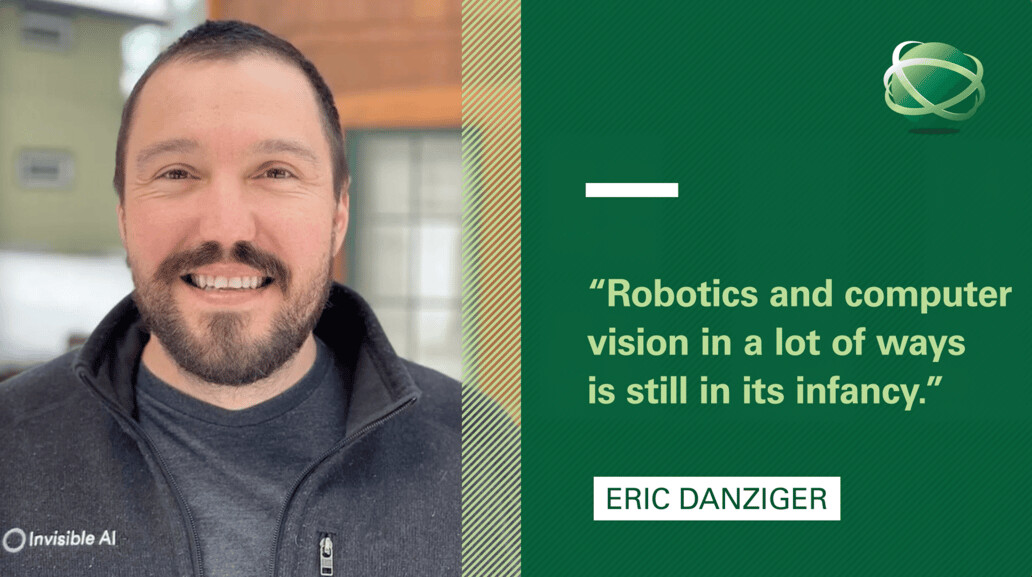
“To be honest, I wanted to work in space robotics.”Eric Danziger
The first version of the next chapter was more cinematic. Danziger wanted to work in space robotics and emailed an asteroid-mining company. Nobody replied. He has joked that Top Gun helped inspire the military and Armageddon supplied the asteroid idea. Underneath the joke was a practical search: where could someone learn robotics well enough to enter the field?
He found Carnegie Mellon while deployed in Afghanistan and applied during his third deployment. He had not previously heard of the university. Within months of returning, he was in Pittsburgh studying at its Robotics Institute, surrounded by classmates arriving directly from undergraduate programs. Nearly a decade had passed since his own time in school. The first semester was brutal. He later described getting through much of it by force of will, a phrase that makes graduate school sound like both engineering and fieldcraft.
A route into physical AI
While in Pittsburgh, Danziger visited factories to understand where computer vision might matter. The answer was not obvious enough to become his immediate job. He moved to Silicon Valley, worked at startups including Cogniac and then joined Luminar, the lidar company racing to make autonomous vehicles possible. He rose from senior engineer to director of engineering, leading a group of more than 30 people through difficult technical problems in the field.
02 / One step behind motionThe self-driving lesson was written in the fine print.
Self-driving was a remarkable education in the difference between a demonstration and a deployment. A vehicle can perform beautifully inside a carefully mapped boundary while the larger promise remains years away. Danziger now sees a similar pattern in humanoid robotics. Locomotion can look uncannily complete. A polished video invites the viewer to imagine competence that the system has not yet earned.
The Army had supplied an earlier version of the same lesson. Impressive technology could fail when it was needed, leaving people with a fallback more dangerous than the plan they would have made without it. High stakes create conservative adopters for good reason. Reliability is not a final coat of paint. It determines whether the thing deserves to enter the room.
Invisible AI therefore sits one step behind actuation. Its devices observe, map and interpret; they do not move machinery. Danziger describes them as the head and visual system of a robot without the body. If perception can become fast, local and dependable, the result can serve human engineers now and perhaps a robotic planner later. The company gets a present-tense business while building familiarity with the environment future systems will need to understand.
How the factory keeps its memory
That sequence also answers an awkward question about factory cameras: who benefits from being watched? Invisible AI has said its product does not use facial recognition, offers face blurring and keeps customer data behind the customer's firewall. Those choices narrow some risks, but technology alone cannot settle the relationship between observation and surveillance. Adoption still depends on governance, transparency and whether the people on the line experience the system as a tool for improvement or a scorekeeper aimed at them.
Useful factory AI has to survive changing processes, tight bandwidth, security rules and the ordinary suspicion reserved for any device pointed at a workplace.
Danziger's public language returns often to workers as participants in improvement. The company's applications center on safety, quality, cycle analysis and root-cause evidence, not facial identity. At an Automate 2025 panel with leaders from Nissan and Toyota, his emphasis was that technology spreads when the workforce sees its value. Organic adoption is less dramatic than a launch video. It is also a better sign that a product has found its place.
A pilot is a compliment. A plant is a cross-examination.
In a 2025 presentation on scaling computer vision at the edge, Danziger reduced the journey from laboratory to plant floor to a series of rude awakenings. A pilot with four workstations and eight devices wanted 40 megabits per second where only 10 were available. Covering the plant meant multiplying the device count hundreds of times. Then the process changed, a jig moved and carefully trained labels became wrong. The hardware kept working. The model became the bottleneck.
The response was architectural. Put the camera, depth sensing, GPU, storage and networking in one rugged unit. Keep inference and retention on the device. Design around physical space rather than a single task, so a changed process can be handled in software without moving cameras. Make units identical enough to swap and update. Shift toward prompt-based computer vision that can be reconfigured faster than a fresh labeling campaign.
The memorable number from that presentation was 400 devices installed in less than a month. The more revealing principle came at the end: design for more than 1,000 nodes, then work backward. Many startup products begin with a controlled demo and discover scale as a series of exceptions. Danziger's approach treats the large deployment as the original object. The pilot is only a small slice of it.
The factory does not grade on elegance. It grades on whether Monday still works after Friday changed the process.The physical-world test
This is where his operator side overtakes the roboticist. Once technology works, milestones change. Customers care about jobs per hour, accuracy, time to value and whether a rollout can continue without an engineer beside every device. A manufacturing technology company can grow impressively in its own market and still look slow beside software spreading through browsers. Physical AI must obey the speed of hardware, facilities, safety review and human trust.
04 / The long gameThe ambition is larger because the promise is smaller.
Invisible AI announced a $15 million Series A in 2022, bringing its stated total funding to $21 million. That year it also announced an expanded Toyota Motor North America partnership, including an initial 500-device deployment at Toyota Indiana. Danziger joined the A3 Vision & Imaging Technology Strategy Board. These are signals of access to real factories, where claims meet fluorescent lighting, union conversations, old networks and processes that refuse to pose for the camera.
In 2025, the company announced an agreement to acquire nFlux, a NASA-born developer of AI guidance for manual assembly, subject to approvals. The logic extends the original idea: observation becomes useful when it helps someone decide what to do next. In 2026, Danziger continued making the case in industry conversations, including a long discussion about the reality gap in robotics and a RealSense podcast on transforming factory floors with vision AI.
His long-term view reaches beyond dashboards. Dense devices distributed across assembly areas can create a three-dimensional understanding of a factory: who is working where, what stage a process has reached, what happened just before an anomaly and what may happen next. A future robot needs exactly that context. Someone else may build the motors, batteries and hands. Danziger wants Invisible AI to understand the room.
Watch the conversationEric Danziger on the reality gap in robotics and AIThere is a trace of the asteroid-mining ambition in that goal, only redirected toward a world measured in takt times and workstations. The romance is hidden inside practicality. Factories are large coordinated systems. They contain motion, judgment, improvisation and consequence. Teaching a machine to understand one is not a lesser problem than teaching it to move. It may be the prerequisite.
Danziger's career looks, from a distance, like a sequence of unrelated worlds: systems engineering, infantry, special operations, robotics school, startups, autonomous vehicles and assembly lines. Up close, each chapter asks the same question. Can advanced technology behave reliably where the physical world refuses to be neat?
His answer is still being installed, one edge device at a time. It begins with a modest instruction to the machine: look carefully. Remember what happened. Help the people here see it too. The robot can wait.