Bill Jiao has the sort of origin story that makes a networking event feel badly designed. In the summer after his first year of college, he was in a small gym in Beijing, wearing his first perm, when a stranger complimented his hair. The stranger was Guanming Wang. Conversation exposed an improbable amount of overlap: both were international students, both were deep into machine-vision research, and both had wanted to build companies since high school. They even noticed matching moles on their arms, a detail too peculiar for a corporate biography and therefore perfect for a friendship.
The two started building together. Then they returned to schools separated by roughly 3,300 miles and five time zones. The partnership survived through calls that ran for hours, bouncing among product features, customer acquisition and ordinary student life. Three years after the dumbbell-rack introduction, they reunited in person in San Francisco as the co-founders of General Instinct, part of Y Combinator's Spring 2026 batch.
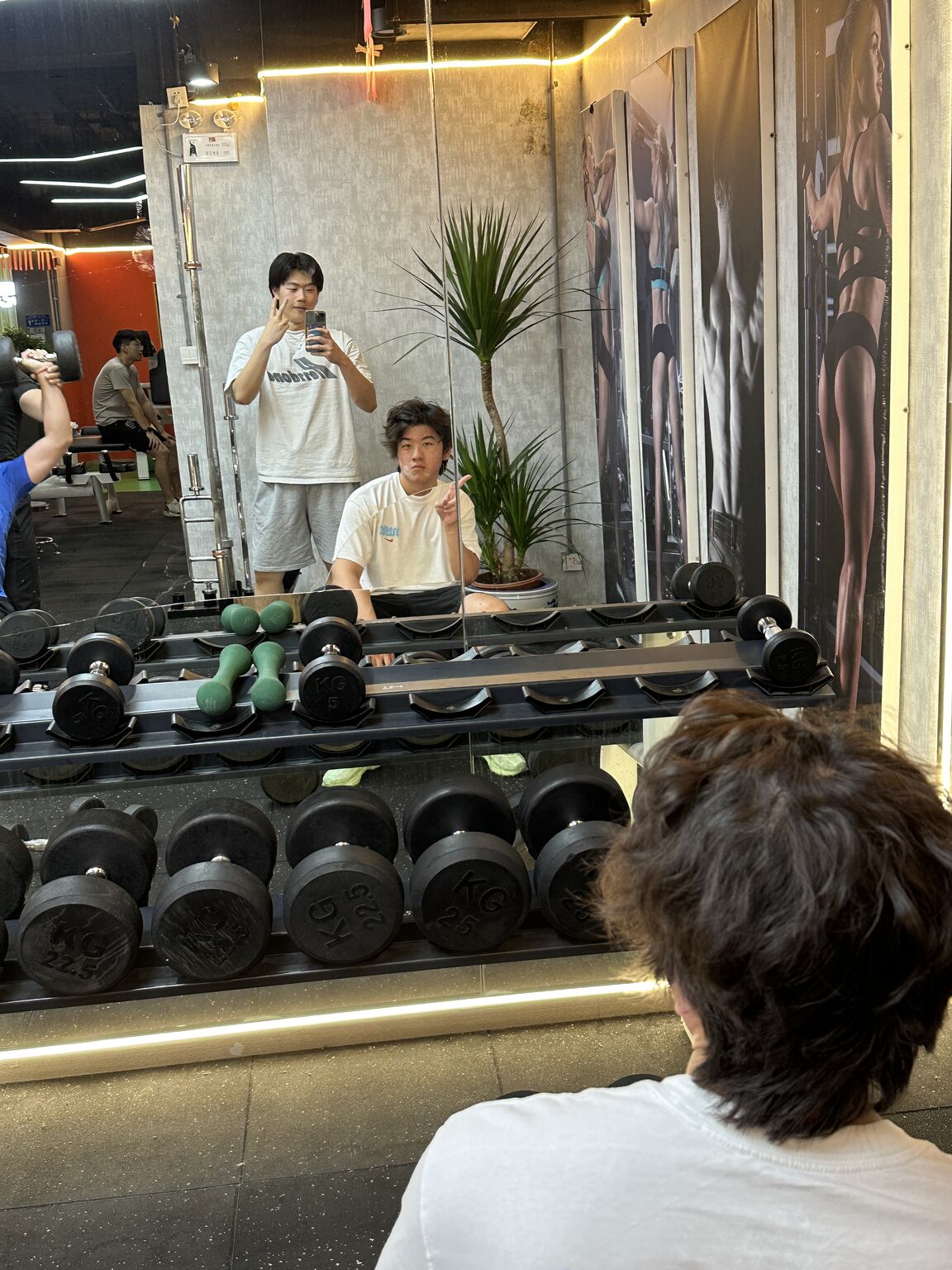
Jiao's retelling does not sand down the silliness. He writes about the perm, the moles and the conversations with the loose candor of someone texting a group chat. He also lands on a serious point: hardship becomes more bearable when the person beside you understands why the work matters. Long before the pair had a company, they had already tested the part of a startup most difficult to benchmark - whether two people will keep calling when distance makes stopping easy.
A career built around hostile environments
The tidy version of Jiao's career says that he moved from biology to machine learning to robotics. The more revealing version is that he kept choosing systems under pressure. As a high-school junior, he secured two patents concerning tardigrade proteins. Tardigrades are famous because survival is their great party trick. By 2021, he was part of the iGEM ambassador cohort for Asia and Oceania, participating in the international synthetic-biology community before his professional attention swung toward computation.
At Boston University, where his public profile records mathematics and computer-science studies from 2022 to 2026, he joined the research culture early. His undergraduate work applied machine learning to neural spectral signals. In a separate burst of student building, he and three teammates created prof.io during HackHarvard 2022, a mobile application designed to match undergraduates with research opportunities. The team assembled a machine-learning model and a full-stack prototype in 24 hours. It was small, quick and practical - a preview of his fondness for taking an abstract capability and forcing it into a useful shape.
Industry added harder edges. Jiao worked at Siemens, where he contributed to the company's first multimodal foundation model, and held machine-learning and software roles at industrial-sensor company SICK. The distinction matters. A factory camera and a clever notebook demo inhabit different moral universes. One can be restarted after lunch. The other is expected to keep watching.
By the time Jiao and Wang formed General Instinct, the question in front of them was less romantic than the phrase “physical AI” can sound. Frontier models might perform beautifully in a lab and then arrive at a robot with too much appetite: too much memory, too much power, too much waiting for the cloud. A drone cannot pause midair while an API considers its options. A machine operating beyond reliable connectivity cannot make the internet a limb.
The model, the machine, the clock
General Instinct describes itself as inference infrastructure for physical AI. Its first product, Instinct Edge, begins with three inputs: a model, a target device and a latency budget. The promised output is an offline runtime tailored to hardware such as NVIDIA Jetson modules, mobile neural processors, ARM CPUs, Apple's Neural Engine and Qualcomm Snapdragon chips.
Underneath that plain contract sits compression work, device-specific CUDA, Metal and ARM NEON kernels, and a pipeline connecting changing data to serving. The important business choice is to treat deployment as a product rather than the weary final chore of a model team. In the cloud, one can often purchase another increment of compute. On a robot, the hardware has already arrived. Physics has closed the procurement window.
A published production example gives the argument numbers. General Instinct ran a multimodal classifier on a Jetson Orin NX with a 111-millisecond cold start. Every decision landed within a 150-millisecond budget. The system made no cloud calls. Those are not scoreboard decorations. They describe a machine that can act on time, in place, without asking a distant server for permission.
Jiao makes the same case with less ceremony on social media. In June, he wrote that robotics models could run on devices small enough for a pocket and priced around $200. The provocation is useful because it moves the robotics conversation away from what a laboratory can afford and toward what a product can carry. Intelligence that demands a shrine of GPUs remains impressive. Intelligence that fits inside the object changes what the object can be.
Missing the party on purpose
One of Jiao's most telling company announcements began with an absence. General Instinct, he wrote, had not attended a winter demo-day event. The team had spent the day trying to squeeze a 15-billion-parameter vision-language model into an iPhone 13. It is hard to invent a cleaner image of early-stage priorities: the room full of people on one side, the stubborn old phone on the other.
The post is funny because everyone understands the trade. Startup life supplies an endless buffet of rooms in which one might be seen building. Jiao chose the room where the build was actually failing. There is no evidence that one intense day settles the problem forever; model deployment is a moving target. But the decision reveals what the company wants to be good at. Its craft lives in the indignities between “the model works” and “the model works here.”
The pair's public interests are already pushing beyond perception toward world-action models, systems concerned not merely with understanding a scene but with choosing what happens next. In August 2026, Jiao shared their appearance at a Y Combinator paper-club session on real-time world-action models. A July talk announcement framed the question more playfully: “Is Latent All You Need for World Action Models?” The title borrows the cadence of machine-learning literature while pointing back to the same engineering anxiety. A capable model is not yet a usable actor. The inference has to arrive before the world changes.
At a robotics session that month, the founders closed on a wonderfully excessive image: a useful robot should not require two data-center-grade GB200 systems for each body. It is easy to laugh at the mismatch, but it locates the quiet infrastructure problem beneath the robotics spectacle. Every fleet multiplies the cost, heat, power and latency of its intelligence. Compression is not housekeeping when copied across thousands of machines. It becomes economics.
The useful instinct
General Instinct is young. Its YC directory lists two people, one product direction and the blunt status “Active.” There is virtue in keeping the scale visible. The published work supports a precise story: Jiao and Wang are building tools to deploy large models on constrained hardware, and they have demonstrated concrete latency results. Everything beyond that belongs to the future, which is famously poor at honoring press releases.
Still, Jiao's path offers something worth stealing now. He has repeatedly entered a field through its constraints. In biology, survival under hostile conditions. In student research, signals that refuse to explain themselves cleanly. In industrial vision, models meeting machines. At General Instinct, frontier capability squeezed through the narrow doorway of the edge.
The same pattern appears in the founding relationship. A friendship had to fit around five time zones before a company could fit around it. The calls kept happening. The projects kept shipping. When the pair finally arrived in the same city, their collaboration was no longer hypothetical. It had been quantized for distance.
Perhaps that is the useful instinct in the company name: begin with what refuses to move. The device has this much memory. The decision must arrive in 150 milliseconds. The network may vanish. The co-founder is 3,300 miles away. Grand systems become real through small, unamusing limits. Bill Jiao seems happiest precisely there, where the glamorous idea meets the obstinate machine and somebody has to make the two get along.