The valuable moment in autonomous driving is not always the smooth merge or the flawless left turn. Sometimes it is the instant a safety driver grabs the wheel. Five seconds of confusion - a pedestrian half-hidden in shadow, a peculiar cone, glare across a camera - can teach more than a thousand quiet highway miles. The trouble is that a failure on an actual road is stubborn. It happens once, amid weather and traffic that refuse to report for a second take.
- Parallel Domain rebuilds real roads and flight paths from customers’ sensor logs.
- PD Sim reruns them with deterministic camera, lidar and radar output.
- The company abandoned six years of procedural world-building to make PD Replica its core.
- Its best idea is practical: turn every field failure into a permanent regression test.
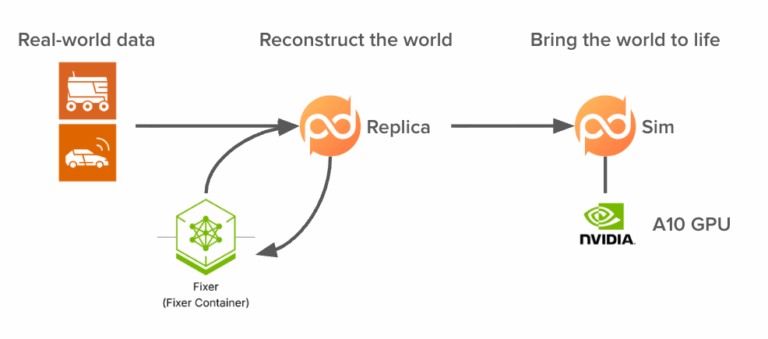
Parallel Domain exists to make that failure repeatable. Give its software a drive log or flight log - camera data, GPS and, when available, lidar - and PD Replica reconstructs the route as a dynamic simulation. Then PD Sim can move the pedestrian, dim the light, swap the lens, add rain or change the timing by half a second. Run it once, or ten thousand times. The machine gets to make its dangerous mistake in a place where danger has no pulse.
The Pixar apprentice who built roads for robots
Kevin McNamara arrived at autonomy by an unusual road. As a Harvard student, he interned at Pixar on Brave, learning how procedural systems could grow a complicated forest without asking an animator to place every leaf. He took the craft to Microsoft Game Studios, then joined Apple’s autonomous-systems work in 2015. There, the same question became urgent rather than cinematic: how do you build enough worlds to train and test a machine that must move through this one?
McNamara left Apple in July 2017 and started Parallel Domain. The early product was easy to picture as a colossal video game for cars. A customer could ask for blocks, bike lanes, mountains, pedestrians and particular road shapes; software assembled the scenery. NIO became the first publicly named customer. Investors supplied roughly $2.65 million in seed capital, followed by an $11 million Series A in 2020 and a $30 million Series B in 2022.
By the Series B, the business had evidence of its own: Parallel Domain reported 2.5 times year-over-year revenue growth, customers in the double digits, several seven-figure annual subscriptions and machine-learning development cycles accelerated by more than 180 times. Google, Continental, Woven Planet and Toyota Research Institute were among the names it disclosed. The cost to buyers was enterprise-scale; the pitch was that collecting, labeling and waiting for the equivalent real-world data cost more.
Then the first product failed - in the useful way
Procedural worlds gave engineers control. They also carried the family resemblance of every imitation: they were invented. A street could look persuasive to a person and still produce sensor data that nudged a perception model differently from the street outside. The gap between simulation and reality is not a cosmetic flaw when the software under examination decides whether a smudge is a shadow or a child.
A little over a year before March 2026, the company made what it called a bet-the-company decision. It stopped making procedural environment creation the center of the product and shifted to scalable reconstruction. Instead of asking artists and rules to approximate reality, PD Replica would let customer data describe it. The change was technical, but the reason was commercial: reconstruction proved more scalable and more useful for testing and validation.
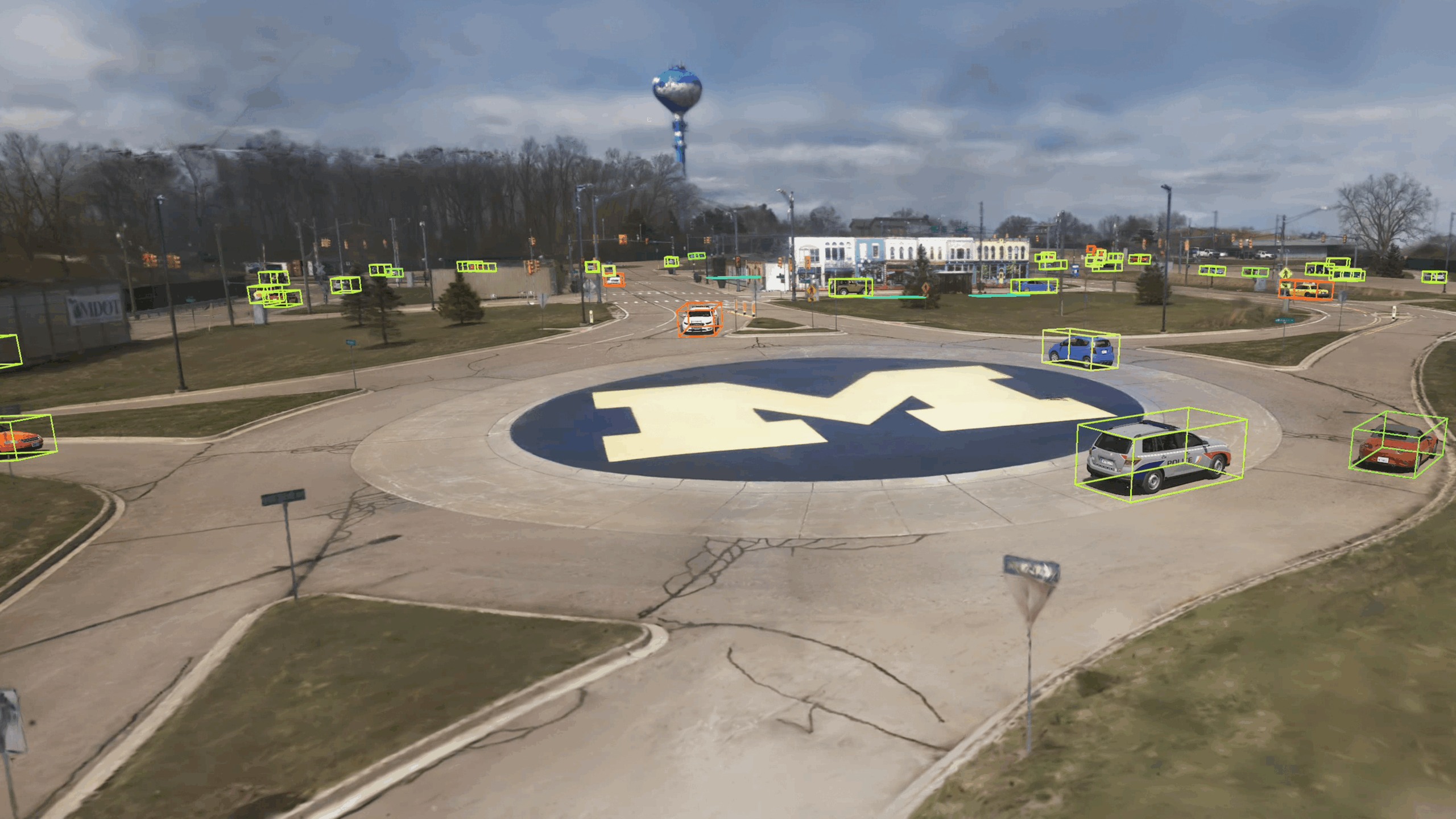
The new unit of value was no longer the imaginary mile. It was the captured mile made editable. PD Replica ingests the untidy material fleets already own: drifting GPS, sparse lidar, camera timing offsets and changing sensor rigs. It produces geometry, dynamic actors, matched lighting, a collision mesh, segmentation and an HD map. Replicas can stretch for as much as three contiguous kilometers - enough for a lane change or terminal approach, not merely a handsome intersection.
A laboratory built from the worst five seconds
The company calls its working loop the Failure Flywheel. The phrase is grand; the mechanism is agreeably plain. A real vehicle discovers a failure. The scene becomes a replica. Engineers vary the circumstance to learn what actually confused the model. After the fix, the original event and its cousins join the regression suite. Tomorrow’s software must pass yesterday’s embarrassment before it ships.
This is the part another team can copy even without buying the platform: preserve the field failure, reconstruct the relevant conditions, vary one cause at a time, and never let the repaired case disappear. Treat production mistakes as permanent test assets. The method is less glamorous than announcing a new model. It is also how mature engineering disciplines stop rediscovering old defects.
Parallel Domain says ten seconds of driving can be expanded into 1,000 hours of virtual testing. That claim depends on variation: changing clothing, pose, traffic, timing, weather, lens distortion, lidar scan patterns or radar response while keeping the underlying scene grounded. PD Sim produces camera, lidar and radar together, so a sensor-fusion stack receives synchronized evidence rather than three unrelated stage sets.
Not the whole simulator - the difficult middle
The market around autonomous-system simulation is crowded with different answers to different questions. CARLA offers an open-source environment. NVIDIA supplies simulation, infrastructure and world models. Applied Intuition sells a broad vehicle-software toolchain. Foretellix specializes in scenario generation and measurable safety coverage - and now partners with Parallel Domain. Internal simulator teams remain the most stubborn competitor of all.
Parallel Domain’s distinction is the middle ground between a recording and an invention. A recording is real but cannot react when the planner chooses a new path. A procedural world reacts, but its pixels and physics may not match the customer’s operating territory. A replica begins with an actual place, then permits controlled interference. Each delivery includes a sim-to-real report measuring geometry, appearance and annotations. “Looks real” becomes a number someone can challenge.
The partnerships reveal the boundaries. Foretellix contributes scenario logic and coverage metrics; Parallel Domain supplies reconstructed worlds and sensor output. NVIDIA contributes GPUs, physics libraries and NuRec Fixer, which repairs under-observed regions and novel camera angles. At the University of Michigan, Mcity supplied drive logs from its physical test facility; Parallel Domain returned a virtual track that researchers can use remotely and compare against the real one.
Where it earns its keep
Safety-critical perception, expensive field collection, rare edge cases, repeated model releases, multi-sensor rigs and teams that need auditable results.
Where the spell weakens
Poor source captures, behavior questions that do not depend on sensor realism, prototypes without a regression discipline, or teams unable to validate simulation against field data.
The grown-up phase
In March 2026, Parallel Domain appointed Zack Novak chief executive. Novak had scaled industrial AI and enterprise-software sales at Uptake and Quantix. McNamara moved to Chief Product Officer, closer to engineering and customers. It was a sensible division after an odd journey: the founder who learned to generate worlds now oversees the product that replaced generation with reconstruction; the new CEO is charged with turning that reversal into an operating business.
The customer aperture is wider than it was in 2018. Cars remain central, but the same problem visits autonomous trucks, delivery drones, eVTOL aircraft, farm machines and warehouse robots. Every one must perceive a disorderly physical world. Every one encounters events that are dangerous, rare or ruinously expensive to arrange on demand.
There is a Wildean joke hidden in all this: the company became more original when it stopped inventing. Its strongest asset is not a perfect copy of the world. Perfect copies are impossible and, worse, uneditable. The useful replica is faithful where the sensor cares, pliable where the engineer needs control, and honest enough to report the distance between the two.
That is why the bad mile matters. It is not merely the event a safety team wishes had never happened. Properly captured, reconstructed and varied, it becomes the one mile the software may drive forever - until it can no longer get it wrong.