Before Aswin Andrison built software that watches hands assemble products, he used his own hands to haul rice. STOQO, the restaurant-supply startup he co-founded in Jakarta, began with two customers and an operating system of traditional markets, rice sacks, and Uber cars. Andrison bought the supplies and delivered them himself. It was hardly the frictionless choreography promised by a pitch deck. It was more useful: an intimate lesson in how small businesses actually procure what they need.
Restaurant buying is full of invisible labor. Owners wake early, visit several suppliers, compare prices of perishable goods, arrange transport, and hope every ingredient arrives before the first order. A missed chili delivery can become a lunch-service crisis. STOQO tried to gather those loose ends into a reliable system, combining a marketplace with delivery, supplier curation, and financing terms.
That first rice run also established the pattern of Andrison's founder career. He tends to begin where polished enterprise software loses interest: the loading bay, the neighborhood kitchen, the WhatsApp group, the workstation. These are places where work is physical, fragmented, and difficult to reduce to a row in a spreadsheet. They are also places where a better process can immediately change someone's day.
An engineer learns the room
Andrison came to startups by a route that mixed machines, code, and boardrooms. He studied computer science and chemical engineering at UNSW, then business at London Business School and MIT. His early work included control and automation engineering at Honeywell, strategy and innovation consulting at IBM, and consulting at McKinsey. In other words, he learned to see both the mechanism and the meeting about the mechanism.
Former IBM colleagues remembered his energy, international awareness, and willingness to confront old organizational problems. Those are flattering recommendations, but the more revealing evidence is what came next. At STOQO, the consultant became the delivery runner. The engineer became the employer. The business-school graduate learned the daily arithmetic of eggs, meat, packaging, spoilage, and a restaurant owner's working capital.
By 2018, STOQO employed 80 people before counting its field sales team and served thousands of restaurants around Greater Jakarta. Andrison joined Alibaba and UNCTAD's eFounders Fellowship, spending two weeks in China studying the country's digital transformation. Y Combinator's later account says STOQO ultimately served 40,000 restaurants, built a workforce of 1,500, and raised $13 million.
Scale did not grant immunity from reality. In 2020, the pandemic emptied dining rooms and slashed demand. STOQO closed. Public startup mythology prefers failure as a tidy prelude to triumph, edited into a sentence and placed safely before the next funding round. Andrison spoke about it more plainly in a podcast episode whose title translates to what he learned from shutting down his startup during the pandemic. The subject was the struggle itself: why STOQO closed, how a founder experiences that decision, and why anyone would dare to begin again.
The company after the company
Something survived STOQO that no balance sheet could capture. Former employees kept a WhatsApp group alive and used it to help one another find jobs. Andrison later explained that this mutual aid helped inspire Lumina, a worker community and employment platform. The failed company's alumni had improvised a small piece of infrastructure. He paid attention.
Lumina launched in 2021 for the enormous population of Indonesian workers largely ignored by white-collar recruiting products. It combined job discovery with community and, in Andrison's description, the ambition to offer career resources and development. In early 2022, Lumina announced backing from Y Combinator and Alpha JWC Ventures. At the time, the company said it had helped more than 100,000 job seekers and filled more than 20,000 openings in two months.
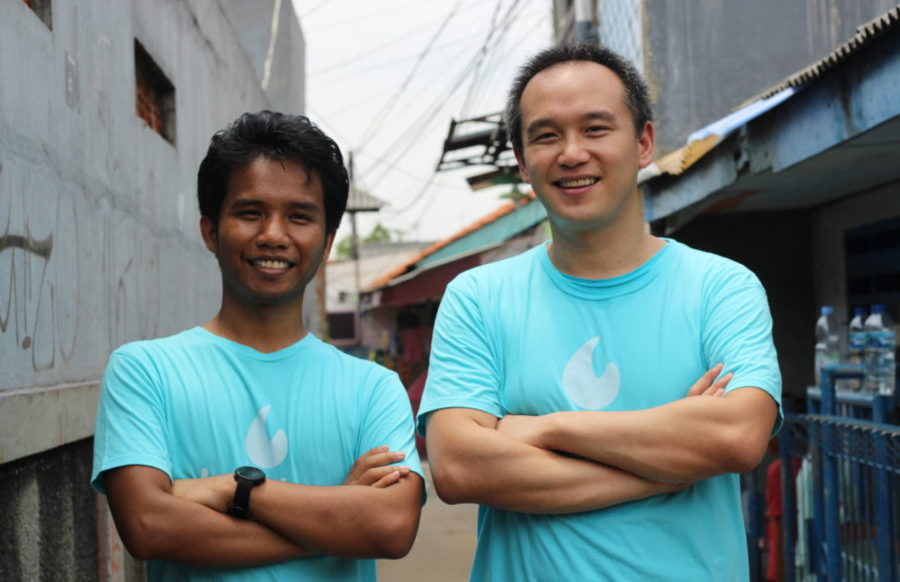
The idea was personal as well as commercial. Andrison and later co-founder Aurora M. had known each other for six years and often discussed whether Indonesian workers could match the productivity of peers in rapidly industrializing countries. His experience at STOQO changed his answer. Given the right conditions, he wrote, Indonesian workers could be exceptionally productive. Their dinners and hangouts became a founding conversation.
Physical goods
Worker community
Industrial operations
Manual assembly
Y Combinator now describes Lumina's reach as 1.5 million workers and 30,000 companies. Yet the venture's next form moved away from recruiting. Under the LumiBot name, Andrison and his team first offered broad AI and human-powered workflow automation, including data operations and complex business processes. His public posts from 2024 put industrial back offices, procurement, and automation at the center.
The camera moves to the workstation
LumiBot has since narrowed its lens, quite literally. Its current product is a video-AI copilot for real-time hand-tracking in manual manufacturing. A customer walks the team through work instructions, cameras are set up, and video of an operator's hand movements is used to build a workflow-specific copilot. After launch, the model is fine-tuned toward the target accuracy.
The problem is easy to picture. Complex assemblies may contain many small steps, each dependent on the last. Traditional quality control often discovers an error after a unit has traveled farther down the line, when correction is slower and more expensive. LumiBot's proposition is to observe the sequence while the operator performs it and flag trouble close to the moment it begins.
This is a sharper product than generic automation, and it fits Andrison's history. Restaurant procurement taught him that operational mistakes have physical consequences. Lumina taught him that tools must accommodate the people doing the work. Honeywell supplied an early vocabulary of controls and automation. IBM and McKinsey supplied the language of processes and change. LumiBot compresses those lessons into a camera pointed at a workbench.
He makes a similar argument about sales. On a trip to Dallas, Andrison wrote that relationships grow through time spent in discussion and shoulder-to-shoulder problem-solving. It is a modestly unfashionable view in a business culture that treats every flight as an inefficiency. For industrial technology, physical presence is often part of product discovery. A factory has sounds, tempos, awkward camera angles, safety routines, and informal workarounds that vanish when converted into meeting notes.
His own public style is direct, occasionally goofy, and allergic to founder sanctimony. Commenting on the chores that come with building a company, he wrote, “Embrace the sh1twork.” He posts with robots and forklifts rendered in emoji, calls for coffee when visiting customers, and describes himself as a robotics enthusiast. The humor performs a useful task: it keeps difficult operational work from becoming a solemn abstraction.
A thesis hiding in plain sight
Seen as a list, Andrison's companies resemble a string of pivots: food distribution, employment, business-process automation, manufacturing vision. Seen from the ground, the continuity is stronger. Each company starts with people performing essential work through a tangle of manual steps. Each asks whether technology can make that work more reliable without pretending the physical world is a clean database.
There is also a widening map. STOQO was rooted in Greater Jakarta. Lumina addressed Indonesia and Southeast Asia. LumiBot now speaks to manufacturers from a base associated with Novi, Michigan, while Andrison's customer and industry posts run through Dallas, Chicago, and Tokyo. In late 2025 he attended SEMICON Japan, praised the companies and technology he encountered, and promised friends he would return. The geography follows the machinery.
Andrison also serves in Monk's Hill Ventures' scout community, which gives founders and operators discretion to find and back early Southeast Asian companies. It is a natural side role for someone whose career has repeatedly crossed the boundary between advising and doing. His listed mentorship interests include fundraising, managing blue-collar workforces, and the pitfalls of fast-growing startups. Experience has supplied material for all three.
The useful idea in his story is not that every failure contains a hidden unicorn, or that every manual process needs a camera. It is smaller and more durable. Stay close enough to ordinary work that you notice what people improvise. A rice sack can reveal a broken supply chain. A WhatsApp group can reveal a labor network. A pair of hands can reveal where quality control arrives too late.
Software has spent decades making desk work legible. Andrison keeps walking toward the work still happening beyond the desk. The scenery changes. The question does not: where does the day snag, and what would help it move again?