The problem arrives after the impressive part. An AI agent has understood an instruction. It knows what ought to happen next. Then it encounters the application where the work actually lives: a login, a menu, a form, another screen. Intelligence has reached the front desk. Someone still has to let it into the building.
Rithvik Vanga co-founded Zatanna around this sort of obstruction. The company makes APIs for software that lacks them, reconstructing the requests underneath a workflow so an agent can call them directly. Its founding team described encountering the difficulty while building vertical AI. Keeping integrations working was absorbing effort they wanted to spend on their product.
That is a less glamorous starting point than a grand prediction about the future. It is also easier to picture. A capable program waits outside an ordinary piece of business software. The founders decide to work on the doorway.
Before the login screen, a robot
Vanga’s technical life includes a long volunteer chapter. From June 2017 to May 2022, he mentored students through FIRST Global, the international robotics competition. His mentoring record names teams from Solomon Islands, Micronesia, Russia, Somalia, and Burundi. It also describes helping kickstart a national FIRST Tech Challenge program in Burundi.
The geographical range is striking. These were teams in different countries, working within a common competition. Robotics brings an unusually concrete standard to technical work: the machine has to do something. A plan on paper can be elegant; a robot has the discourteous habit of testing it.
Mentoring adds another practical requirement. Knowledge has to travel from one person to another before the team can use it. The volunteer entry places Vanga in that setting for five years, well before Zatanna’s launch. His profile also lists Eagle Scout recognition.
These details give the career a different opening from the usual university-to-startup sequence. There were other teams, other systems, and a period of sustained participation before the company appeared. They belong in the story on their own terms, without turning a teenage volunteer role into a prophecy about a later business.
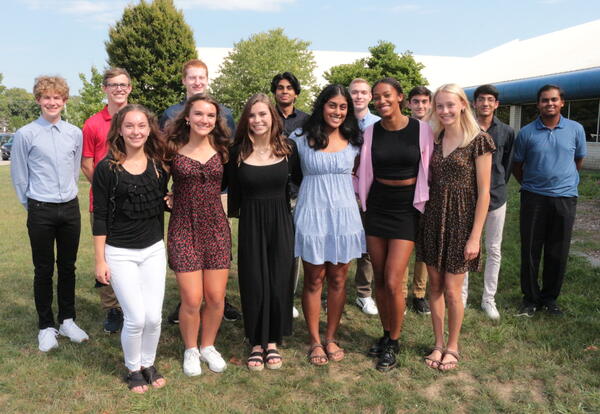
In October 2021, Pleasant Valley Community High School named him among its semifinalists for the 2022 National Merit Scholarship Program. The announcement connected him with Bettendorf, Iowa. It is an early, dated marker in a career that would soon move into university product work.
Six people, one research kit
At the University of Michigan, Vanga helped found CORE, a customizable research kit intended to be deployed without coding. The six-person team won the university’s 2022 Innovation Jam. The finale took place on November 14 in Robertson Auditorium at the Ross School of Business.
CORE brought together Akbar Arsiwala, Alyssa Ciapala, Ethan Marshall, Karthik Ramani, Vanga, and Riya Dev. The group included MBA and computer science students. Its presentation assigned roles around academic strengths and involved the members in an interactive pitch and demonstration.
There is a small but useful distinction here. A working prototype has to persuade a machine. A pitch has to persuade a room. CORE’s team was doing both, combining product work with the explanation of why anyone would want it.
The project’s promise was practical: make a research kit customizable and easier to deploy. Set that beside Zatanna and a recurring topic appears. Different users, different products, but in each case a technical system becomes more accessible. That connection is a reading of the projects, rather than a declaration of Vanga’s private motives.
The application behind the application
Vanga is a Michigan computer science graduate. His prior experience includes Coinbase, Hamming AI, and John Deere. Those names place crypto infrastructure, AI tooling, and agricultural equipment in the same career history. The employers are varied; the public record does not require an invented revelation connecting every job.
Zatanna’s launch introduced Vanga alongside Alex Blackwell and Tarun Vedula. Blackwell brought experience from Pikkit, where he had worked on anti-bot problems. The company, founded in 2025, joined Y Combinator’s Winter 2026 batch.
The founders’ account of the original obstacle is unusually specific. As models became easier to work with, the software around them remained troublesome. Their agents still needed access to existing operational systems. Integration maintenance was taking time away from the agent itself.
That shifts the question from what a model can understand to what a product can accomplish. A business task may end in an existing portal, not in a chat window. The place where the instruction is interpreted and the place where the result is recorded can be two different systems.
A shorter route to the same work
Zatanna describes a three-step approach. First, observe a person carrying out a workflow. Next, reconstruct the sequence of network requests that makes it happen. Finally, host that workflow as an API endpoint, something another program can call with structured inputs.
The distinction is easier to see in an ordinary form. A person sees fields and buttons. Behind the screen, the application sends requests and receives responses. Browser automation follows the visible interface. Zatanna works with the communications behind it.
- 01 / ObserveA person performs the task.
- 02 / ReconstructModel the underlying requests.
- 03 / CallAn agent uses the API.
An explanatory diagram, not a performance comparison.
In its technical explanation, the company points to a familiar maintenance problem: automation tied to page structure can fail when that structure changes. A renamed element, a revised layout, or a timing difference can interfere with a script that previously worked.
Moving beneath the interface changes the dependencies. It also leaves plenty to manage. Authentication, cookies, request order, and error handling still matter. The proposed convenience is that the customer calls an endpoint while Zatanna maintains the machinery required to make that call useful.
The second attempt matters, too
Consider an illustrative order-entry task. A program submits an order and loses the connection before receiving confirmation. Should it try again? A second attempt may be sensible, but two orders would be a rather expensive way to demonstrate persistence.
This is why idempotency appears in Zatanna’s technical material. The term describes an operation designed so that repeating it does not create an additional unintended effect. For workflow automation, the practical concern is preventing retries from producing duplicate records.
Error recovery is another part of the company’s stated reliability work. Its explanations cover retrying failed operations, classifying failures, and using fallback strategies. The point is to decide what to do when the first attempt does not finish cleanly.
These are quieter subjects than an agent’s ability to reason. They are also where an integration earns its keep. A demonstration can end after the successful example. A business process must account for the unsuccessful one, the interrupted one, and the one someone needs to inspect afterward.
For a co-founder building in this category, the product extends beyond the apparent simplicity of the API. The endpoint is the part a customer sees. The handling of awkward cases is part of what that customer is buying.
The work has ordinary nouns
Zatanna’s May 2026 material on Famous Software discusses order entry, inventory adjustments, lot tracking, and reporting exports in produce operations. It offers a concrete example of the workflows the company wants to expose through APIs. These are the everyday nouns hiding inside an abstract phrase such as “agent infrastructure.”
The examples also explain why existing applications matter. A workflow belongs to an operation with its own records and routines. An integration has to reach the place where those records live. Replacing a screen is a different undertaking from connecting to the task behind it.
Zatanna’s proposal is to create that connection around the workflow a customer actually needs. Its material allows for using an official API where it already works and another route where coverage is missing. The ambition is expressed through tasks that can be completed, rather than a requirement that every business replace its software first.
Four words after the launch
When Vanga shared the launch announcement, his own contribution was brief: “Zatanna on top!” It is an exuberant sentence beside a company concerned with sessions, requests, and integration maintenance. Even the people working underneath the interface are entitled to celebrate above it.
“Zatanna on top!”
Rithvik Vanga, on sharing the company’s launch
The fuller story takes more space. Robotics mentoring across five named countries. A school recognition in Iowa. A collaborative research-kit project in Michigan. Engineering experience across several employers. Then a founding team that encountered an access problem and made it the subject of a company.
There is no need to make every chapter march toward the same predetermined ending. The projects are interesting because they are particular. Together, they show Vanga working with teams on systems other people need to use.
At Zatanna, the immediate test is straightforward to state: can the agent complete the workflow? Behind that question sits the work of making the software connection hold. The screen gets the button. The requests get the job.