Six years is a fairly thorough co-founder interview. Mitch Radhuber and Shipra Jha spent roughly that long on the same team at Goldman Sachs, sitting next to each other, building systems together and discovering how the other worked. By the time they founded Corelayer, they had already conducted the part of due diligence that seldom fits in a pitch deck: seeing a prospective partner deal with an ordinary working day.
Their eventual company would investigate production software failures with AI. Their working relationship had developed through a slower process. There were conversations about language models, separate side projects and a small proof of concept built for a hackathon. Radhuber remembers discussing the problem for at least a year before the first line of Corelayer code. An idea can arrive quickly. Arranging your life around it takes longer.
Today, Radhuber is Corelayer’s co-founder and CEO in San Francisco. Jha is its co-founder and CTO. The company entered Y Combinator’s Winter 2026 batch with a problem they knew at close range: engineers spending evenings and weekends debugging financial data systems. A startup can begin with a revelation. This one had the advantage of repeated inconvenience.
The colleague in the next chair
Radhuber had another commitment when the Corelayer idea began taking shape. He was working on a different startup with a different co-founder. He kept telling Jha he wanted to work with her, while also telling himself he needed to concentrate on the venture already underway. This was less a question of finding a partner than of being available to join one.
When the other project stopped being viable for that partnership, he called Jha. The invitation had been waiting. What followed drew on a relationship that extended beyond shared tasks: they had traveled and spent time together socially. Yet Radhuber describes its foundation as professional. Each knew the other’s engineering abilities, habits and approach to work. They also differed in ways he felt complemented each other.
There is a useful distinction here between liking someone’s company and knowing what building a company with them might entail. Years of collaboration gave Radhuber and Jha evidence for both. The familiar desk arrangement survived the change in employers. After discussing their partnership publicly, he wrote that he was lucky to keep sitting beside Jha, talking about things they could build with language models.
“I really wanna work on this with you.”
Mitch Radhuber, recalling his conversations with Shipra Jha
Before the bank, galaxies and robots
Radhuber grew up in Westchester County, New York, and attended Ossining High School. His early interests reached beyond software. In 2014, he won first place in physics and astronomy at the Westchester Science and Engineering Fair. His research concerned a modification to the Tully-Fisher relation, a topic in the study of galaxies. His founder biography also records astrophysics research at Princeton.
That same year, the Ossining robotics team named Mitchell Radhuber as its first FIRST Robotics Dean’s List finalist. The team’s account places the recognition in its 2014 season, when it reached the semifinals at the New York City regional competition. Astronomy and robotics make a pleasing pair: one asks questions across enormous distances, while the other requires something to work in front of you.
He went on to study computer engineering at the University of Michigan. His early professional experience included Cisco and a multidisciplinary design program associated with L3Harris, followed by Goldman Sachs. The later startup founder’s résumé contains both research and practical engineering. It would be too neat to claim that a school science project foretold Corelayer. What it does establish is a technical life that began well before the present enthusiasm for AI agents.
Astronomy fair winner and robotics Dean’s List finalist in Ossining.
Appears as Fince’s co-founder and CTO on The Get Ready Money Podcast.
Corelayer is founded with Shipra Jha.
Corelayer joins Y Combinator’s Winter 2026 batch.
A resignation with little room for negotiation
Before Corelayer, Radhuber was co-founder and CTO of Fince, a venture concerned with personalized financial guidance. In October 2024, he appeared on The Get Ready Money Podcast with fellow co-founder Jay Turner. Their conversation covered personal goals, the wider picture around money and the need to put advice circulating on social media into perspective.
Fince belongs in the story because Corelayer followed an earlier attempt at entrepreneurship. Radhuber had already practiced translating an individual problem into software. The markets were different, but the act of trying to build something outside an established employer was familiar.
Leaving Goldman was a decision he framed in personal terms. When he told a mentor, he explained that he intended to start a company and take no salary. He had thought about it for a long time. A better package at the bank would not settle the question he was asking himself.
“I have to do this or I will absolutely regret it in the future.”
Mitch Radhuber, on leaving Goldman Sachs
He recalls colleagues being largely supportive. His explanation made the usual retention discussion awkward: the destination was an uncertain venture, and the proposed salary was zero. It is difficult to negotiate against a number someone has chosen for reasons other than money.
The error that does not announce itself
At Goldman, Radhuber and Jha built data infrastructure for systems processing hundreds of billions of rows a day, according to their account of Corelayer’s beginnings. They also spent late nights and weekends investigating problems. The scale matters, but so does the kind of failure: a data service can finish its work and still produce an incorrect result.
A failed job offers an obvious starting point. Missing rows, duplicated records or wrong values can demand a different investigation. Corelayer’s founding proposition is that an agent needs to examine the underlying data alongside logs, metrics and infrastructure. For Radhuber, the problem extends to the time engineers lose doing the investigation themselves.
His October 2025 essay on observability puts the human observer under scrutiny. Existing tools collect information for an engineer to interpret. His preferred workflow has an agent investigate and present its findings, with the raw evidence available for people to verify. The dashboard remains useful; the ambition is to reduce the amount of a person’s day spent piecing its contents together.
Giving experience somewhere to live
In November 2025, Radhuber described Corelayer’s memory system through the situation of an engineer new to an on-call rotation. A newcomer can investigate from first principles. A colleague who has seen the system fail before can start with an informed suspicion. The difference is experience that can be recalled and tested.
Corelayer’s design records what went wrong, why it happened, how it was fixed and what engineers thought of the investigation. A later incident can retrieve similar cases and use them to form a hypothesis. That hypothesis still needs examination. Memory is useful when it helps an investigation begin; a remembered answer can also be wrong for the present circumstances.
His January 2026 account adds a revealing constraint: the system should help even when it gets only partway to the answer. Engineers should be able to follow its steps and continue the work. Changes to code or system state require approval in the workflow he describes. For a founder trying to automate support, he spends considerable attention on the person who must judge the automation.
By April, his writing had widened to the scattered knowledge surrounding production systems. Code, deployment settings, incident histories and business context live in different places. As agents produce more software, he argues, making that information accessible becomes more pressing. This is his thesis about where engineering is heading, and the work he has chosen to pursue.
The table gets smaller
The company’s public life also includes dinners. In May 2026, Radhuber hosted fintech engineers, leaders and founders in San Francisco. He credited the small group and shared interests with making people more willing to open up. It is a modest observation about a business gathering, and a useful glimpse of how he likes to bring people together.
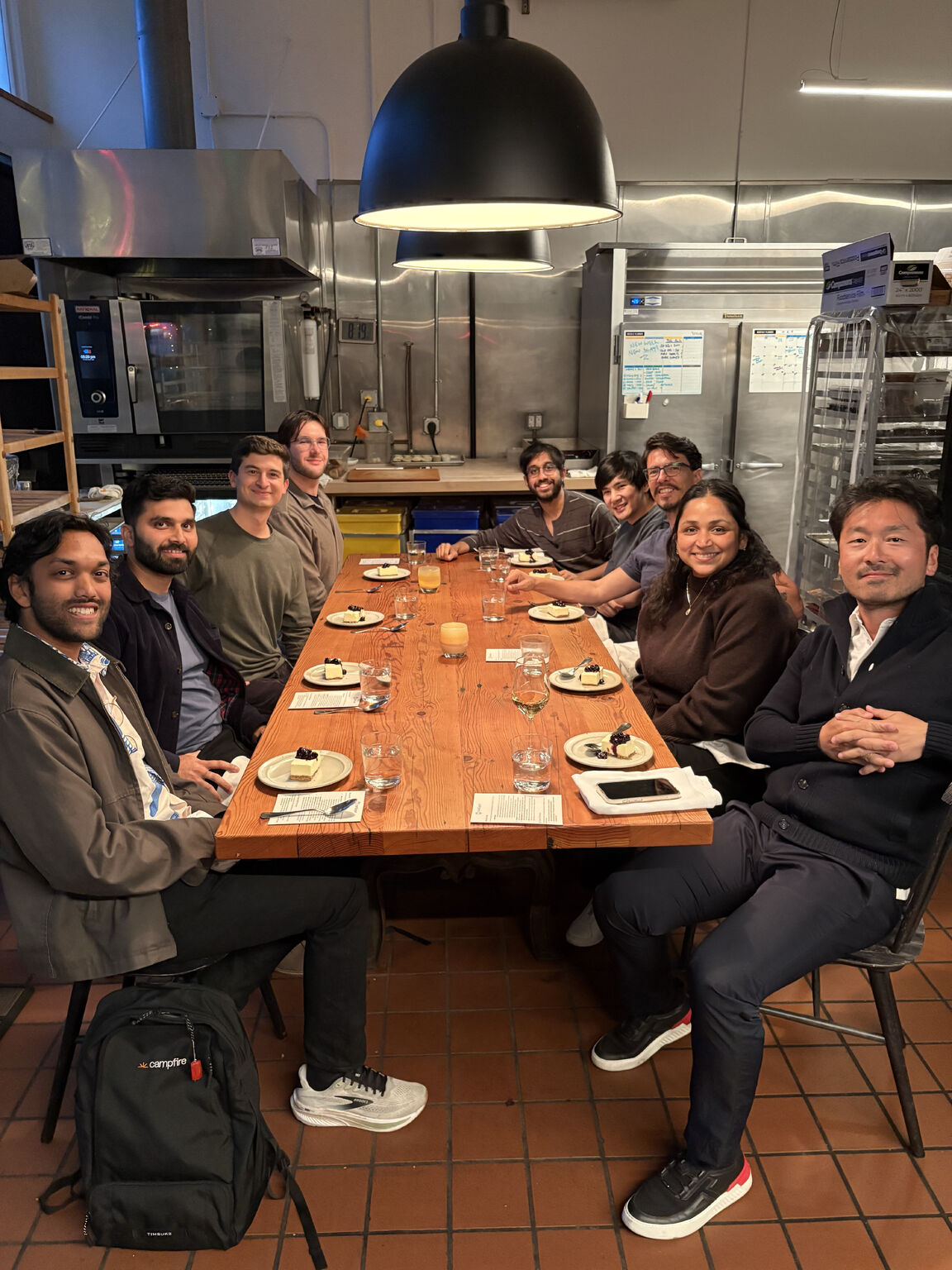
During Y Combinator, dinners and group office hours helped him connect with fellow founders. In his first-month recap, he thanked Diana Hu and Vivian Midha Shen for helping the team focus. He also described a fivefold increase in revenue and weekly public feature launches. Those were his reports of early progress, rather than a forecast of what the company would become.
That recap contained a less polished detail: a note he had written in the week Corelayer was rejected from the Fall 2025 batch. He included it among photographs documenting the later experience. Someone had advised him to record more of the journey. He was trying to oblige through writing and pictures.
There is continuity between the adjacent chairs at Goldman and the smaller dinner table in San Francisco. Radhuber gives time to relationships in which people can speak plainly about work. Corelayer’s technical ambition concerns accumulated experience too: helping software remember enough to make the next investigation less laborious. The company grew from two engineers who already knew one another’s working habits. Its next task is to make more of that hard-earned understanding available when a system goes wrong.