The number is wrong. The dashboard is green. A management meeting starts in an hour, and somewhere inside a chain of feeds, jobs, databases and business rules, reality has quietly parted company with the software meant to describe it. Mitch Radhuber has spent enough time in this scene to narrate it by the minute: find the logs, find the code, trace the API, query the dataset, discover the failed upstream job, rerun it, then chase everything downstream. The first emergency is fixed just as the next user asks why another dashboard has gone stale.
This was not an edge case in Radhuber's early career. At Goldman Sachs, he and Shipra Jha built data infrastructure for systems processing hundreds of billions of rows a day. They sat beside each other for six years. Their work lived in the least photogenic part of software, where reliability is assumed until it disappears and where a plausible wrong answer can be more dangerous than an obvious crash.
That experience now sits inside Corelayer, the San Francisco company Radhuber leads as co-founder and CEO, with Jha as co-founder and CTO. The three-person company joined Y Combinator's Winter 2026 batch with an AI production engineer designed for complex, regulated environments. It monitors infrastructure and underlying data, groups related issues, investigates likely causes and suggests fixes. The larger ambition is to recover the hours that engineers surrender to maintenance, support and the digital equivalent of checking every cupboard for a missing key.
A telescope pointed at the plumbing
Long before he worried about production data, Radhuber studied a different kind of signal. In high school in Westchester County, New York, his astronomy project proposed a modification to the Tully-Fisher relation, a technique used in extragalactic studies. The project won first place in the astronomy and physics category at the 2014 Westchester Science and Engineering Fair. That same year, he was a FIRST Robotics Dean's List Finalist with Ossining's O-Bots.
He went on to the University of Michigan, earning a computer engineering degree in 2018, and did astrophysics research at Princeton. The subjects changed when he entered finance, but the disposition did not. Astronomy asks you to infer distant mechanisms from imperfect observations. Production engineering asks much the same, except the distant galaxy is an undocumented service and somebody in accounting would like an answer before lunch.
Whether the object is a galaxy or a data pipeline, Radhuber's work keeps returning to the same task: distinguish the useful signal from the convincing noise.
At Goldman, the institutional phrase for support and maintenance was “Run the Bank,” or RTB. Radhuber says large engineering teams commonly budget 20 to 40 percent of their capacity for it. Production takes precedence. Planned work waits. Morale absorbs the difference. His public question is deliberately numerical: what if that tax fell to 10 percent, or 1 percent?
The Run-the-Bank capacity question
The failure that leaves no fingerprints
Corelayer is built around a distinction ordinary monitoring often misses. Infrastructure can be healthy while data is wrong. A daily profit-and-loss calculation might depend on positions, trades, prices, foreign-exchange rates and reference data. If one upstream feed changes format, the job may complete without an exception. Joins still join. Aggregations still aggregate. Only the answer is fiction. By the time a user notices, the cause may sit several systems away.
Radhuber describes this problem without pretending that a language model alone solves it. The agent needs tools specialized for the task, an explicit business objective, constrained access, human review, transparency and an audit trail. In a regulated company, an adventurous agent with broad permissions is less colleague than liability. The product therefore offers controlled deployment options and is designed to show the steps behind an investigation.
From incident to institutional memory
Memory is the more interesting part. Radhuber's complaint about a stateless support agent is concise: “Every week is their first week on call.” Corelayer's Agent Memory captures feedback when engineers close an issue, normalizes the symptoms and pattern, stores a representation of the incident, and retrieves similar cases when something new occurs. A memory-refining agent can add, update or remove what the system retains. The goal is not omniscience. It is the modest, powerful instinct of a senior engineer asking, “Have I seen something like this before?”
“Every week is their first week on call.”Mitch Radhuber, on agents without memory
This is where Corelayer's pitch becomes an argument about organizations. The context required to solve a production issue rarely lives in one database. It includes business semantics, design decisions, team preferences, old failure patterns and the little exceptions people carry in their heads. Radhuber's team is building infrastructure to capture and organize that scattered knowledge so agents can use it. The software product is partly an interpreter for institutional memory, an archive of how a company actually behaves rather than how its diagrams claim it behaves.
Six years, one adjacent chair
Co-founder stories are often polished into a lightning strike. This one took time. Radhuber and Jha worked next to each other at Goldman, tinkered on AI side projects separately, talked about language models at work and made a proof of concept together at a hackathon. A year passed before the first line of Corelayer code. Each kept telling the other that they wanted to build together. When another startup effort ended, the timing finally aligned.
Radhuber had already tried the founder role. In 2024 he appeared on The Get Ready Money Podcast as co-founder and CTO of Fince, a personal-finance company. He spoke there about goals, the limits of social-media advice and the need to see money in the context of a life. Corelayer is a different market, but it carries a related preference for context over generic answers.
Leaving Goldman was personal. In an interview, Radhuber recalled telling a mentor that he was not moving to another bank or bargaining for a better package. He was leaving to start something, take no salary and accept the outcome. “I have to do this or I will absolutely regret it in the future,” he said. Most colleagues understood. A conventional counteroffer had no purchase on a decision framed that way.
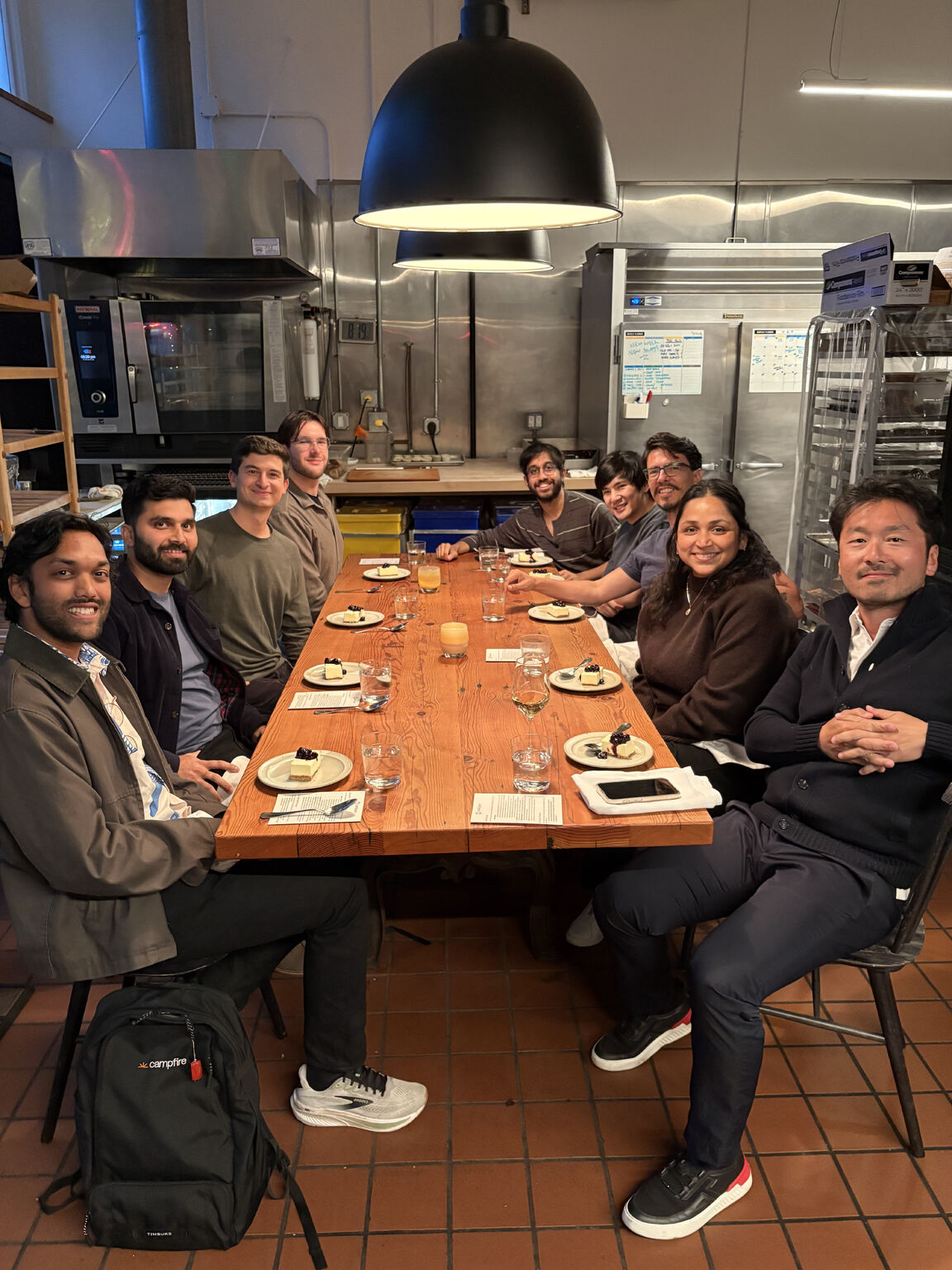
The young company's rituals are deliberately human. During Y Combinator, the team began Sunday family dinners, rotating the cook and occasionally missing a week, then returning to the table. In May 2026, Radhuber hosted a small dinner for fintech engineers, leaders and founders in San Francisco. He liked the candor that appears when a group is small enough to stop performing. For a company devoted to capturing tacit knowledge, dinner is an apt piece of infrastructure.
Commencement
At Y Combinator Demo Day in March 2026, Radhuber met early supporters in person and watched thousands of investors arrive. People called the day a graduation. He preferred “commencement.” The correction is small and revealing. A batch ends; a company begins the longer work of earning permission to operate near critical systems.
Permission is the hard currency in this market. A production agent may need to inspect logs, query sensitive data and recommend a change, yet each additional capability creates another reason for a careful buyer to hesitate. Radhuber's answer is to treat constraints as product requirements: granular access, visible reasoning steps, citations inside the investigation and an auditable record of what the agent did. Corelayer also supports private deployment choices for teams unwilling to send production data beyond their own environment. The technical challenge and the sales challenge meet at the same point. The agent has to be useful enough to invite in and legible enough to remove again.
By June, Corelayer had added a founding engineer and was showing a new layer for organizing production context. The team remained three people. The company was still narrow enough for Radhuber to write product explanations himself and still close enough to the original pain that his examples came with timestamps, user interruptions and the memory of abandoned project work.
There is also a quiet shift in his own job. The engineer who once traced failures now spends more time selling, recruiting and translating a deeply technical problem for executives. He joked publicly that he had already surpassed his entire previous year's GitHub contribution count while serving as the company's sales and go-to-market person. At three employees, job titles are less a boundary than a list of unfinished errands. A founder may explain agent architecture in the morning, host a customer dinner at night and still notice the slow query before anyone else.
His social biography offers the neatest version of the aspiration: “trying to arrange bits in ways others find useful.” It is charming because it shrinks a grand technical project to craft. The bits happen to include alerts, rows, embeddings, access policies and the accumulated judgment of engineers. Useful is the important word. In production, cleverness is cheap compared with the ability to find the bad number, explain how it happened and avoid waking the same person next Friday.
Radhuber's wager is ultimately about attention. Companies hire experienced engineers for judgment, then spend much of that judgment on repetitive archaeology. Corelayer wants software to carry more of the map: what failed, what mattered, who corrected it and what the team learned. The pager may still ring. If Radhuber is right, the system answering it will arrive with a memory, a theory and enough humility to show its work.