Autostep is trying to build the receipts for every hour a company works.
Companies can tell you what they spend on AI. Almost none can tell you the return. A three-person startup out of San Francisco thinks the answer is to watch the work itself - and put a price on it.
There is a quiet joke inside a lot of companies right now. Everyone has bought AI. Nobody can say what it did. The invoices are real - the seats, the tokens, the annual contracts - but when a board asks the obvious follow-up question, the room goes silent. Autostep, a young San Francisco company, is built around that silence.
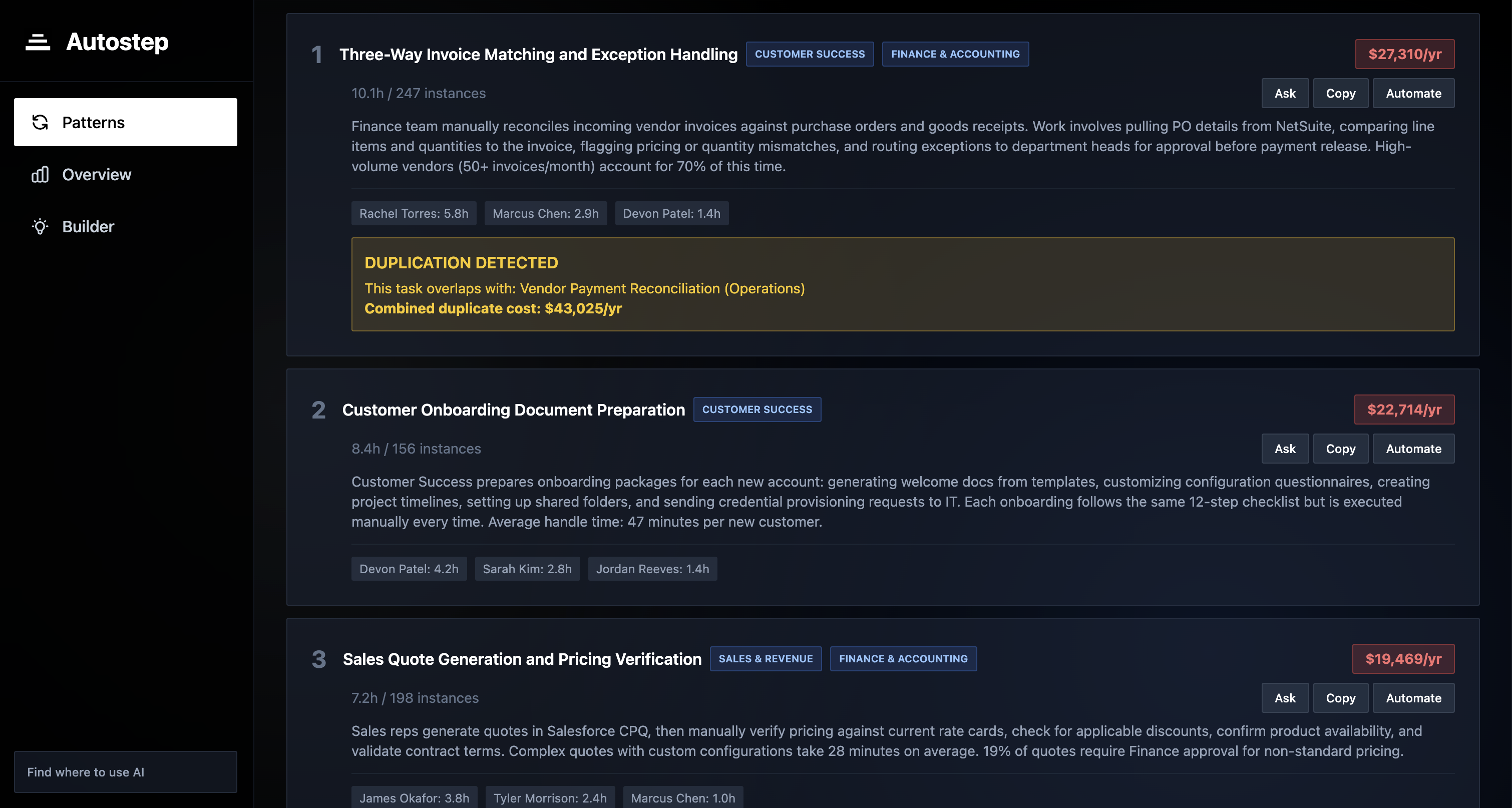
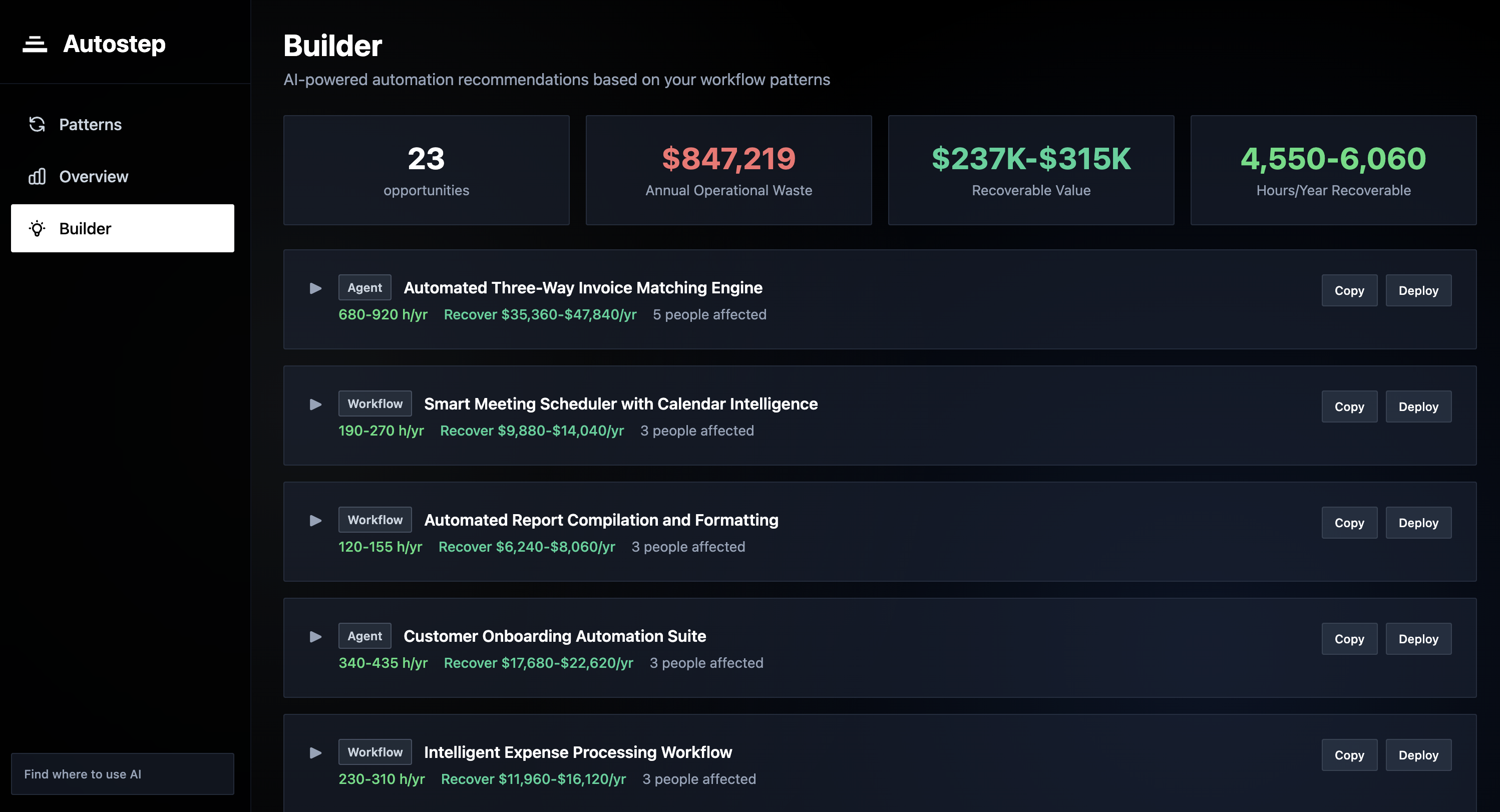
The product is a desktop app. You install it across an organization, and instead of asking people to fill out timesheets or hook up a dozen integrations, it watches how the work actually happens. It notices the tasks that repeat. The waiting. The re-typing. The little administrative loops that never show up on a calendar but quietly eat a payroll. Then it does the thing most tools skip: it ranks all of that by cost and impact, in real dollars, so a leader can see what is worth fixing before spending a cent trying to fix it.
Founder Aidan Pratt describes the company in one accounting phrase - "the P&L for knowledge work." It is a deliberately unglamorous line for a market drowning in glamour. And it points at what Autostep believes is the real problem with the AI moment.
The bottleneck isn't tooling anymore, it's discovery. Without visibility into what people actually do all day, automation efforts are shots in the dark. Aidan Pratt, Founder & CEO
01The problem it is chasing
Think about how most automation gets sold. A vendor arrives with a solution - an agent, a bot, a workflow builder - and asks you to go find a problem that fits it. That works if you already know where your time goes. Most companies do not. The expensive work in a modern business is knowledge work, and knowledge work is famously hard to see. It lives in tabs and documents and Slack threads and the heads of the people doing it.
Autostep's bet is that the hard part of AI is no longer building the agent. Anyone can spin one up in an afternoon. The hard part is knowing which task deserves one. Point a capable agent at the wrong process and all you have done is automate waste, faster. So Autostep starts a step earlier, at discovery, and treats it as the main event rather than a box to check.
Automation vendors start with the solution and hope you know the problem. We start with the problem. Aidan Pratt
That framing has an appealing side effect: it makes Autostep useful whether or not you end up automating anything. Sometimes the answer is a new agent. Sometimes it is changing a process, standardizing a workflow, or simply using a piece of software the company already pays for and forgot about. The recommendation follows the evidence.
02How it actually works
The mechanics are refreshingly blunt. No integration project, no six-week rollout. The app installs at the desktop and begins building what the company calls a "living map" of operations - one that gets sharper each week rather than going stale the moment the consultant leaves.
Under the hood, the company groups its work into three ideas. There is Operational Intelligence - the discovery layer that ranks repetitive work by financial impact and difficulty. There is Auto-Agentic - the part that turns observed patterns into ready-made agents, prompts and templates. And there is Compounding Context - the queryable record of how the company runs, improving week over week. The first tells you what hurts, the second offers a fix, the third makes sure you do not forget what you learned.
03The number that gets attention
Autostep says even the smallest team it has worked with - ten people - uncovered more than $100,000 in operational waste. That figure is doing a lot of work in the pitch, and it lands because it is counterintuitive. You expect waste to scale with headcount. The claim here is that it hides best in small, busy teams that assume they already know where their hours go.
The pitch works because it reframes a cost center as a discovery. The waste was already being paid for. Autostep just makes it visible - and, in theory, recoverable.
04Where it sits in a crowded market
There is a decades-old category called process mining, dominated by companies like Celonis, that did roughly this for structured enterprise systems - think supply chains and ERP logs. It grew up on the factory floor. What it never fully cracked was knowledge work, the messy human stuff at the desk. On the other side sit the RPA suites and the newer wave of agent builders, all eager to sell you the fix.
Autostep is trying to slot in between: upstream of the agent builders, but pointed at the unstructured work that process mining largely ignored. It is less "we automate for you" and more "we are the assay office" - the place that tells you which vein is worth mining before you buy the equipment.
05The people and the backing
Aidan Pratt studied machine learning and computer science at Georgia Tech and has spent time around early-stage building and investing, including stints connected to Kleiner Perkins and 8VC. He signs his name, endearingly, with an avocado emoji. The team is small - two to three people - which is roughly the size of the companies its $100K claim is meant to speak to.
The company raised a $0.5M pre-seed round in June 2026 and is part of Y Combinator's Spring 2026 batch, backed by Neo. It is hiring its first go-to-market person in San Francisco, and lists SOC 2 Type 2 as in progress - the kind of housekeeping detail that signals it expects to sell to companies that ask hard questions about a desktop app watching their work.
Even the smallest team we've worked with uncovered $100K+ in operational waste with 10 people. Autostep
06The longer bet
Ask where this goes and the ambition gets bigger than cost-cutting. Autostep wants to be the "system of record for work" - the place a company goes to understand its own capacity, to measure whether AI is actually earning its keep, and eventually to reward the processes that run well. It is a claim to a layer that does not really exist yet: a P&L not for money moving through the business, but for effort moving through it.
Whether Autostep gets there depends on the hard, unglamorous work of measuring something companies have never measured well. But the timing is hard to argue with. The AI spending has already happened. The question of what it bought is only getting louder. Autostep is one of the few startups building to answer it directly, with a number instead of a shrug.