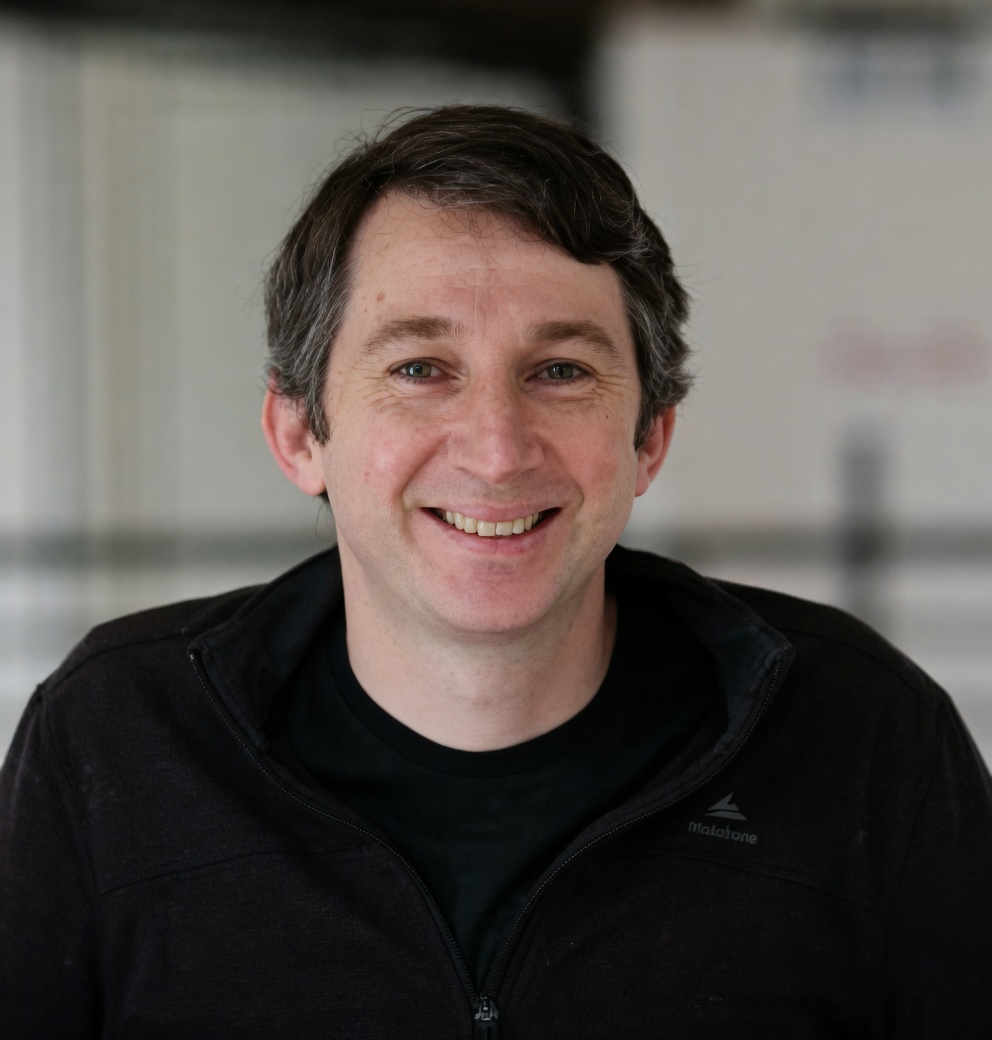
There is a specific kind of defect in a battery cell - a pinhole, microns wide, invisible to the naked eye, invisible even to a trained inspector on a long shift - that can turn a $50,000 electric vehicle into a liability. Christopher Van Dyke has spent the better part of a decade thinking about that pinhole. And the one on the circuit board. And the one on the pharmaceutical blister pack. And the one in the semiconductor wafer that doesn't show up until a customer's product fails in the field.
Van Dyke arrived at the problem the long way around: through Tesla. Eight years, four pivotal roles, one company that treated manufacturing like a sport. He started by launching the Supercharger network from scratch - no infrastructure, no playbook, just a target and a deadline. He built it to 100 stations before most people had heard the word "supercharger." That network is now 25,000+ stations strong, and the connector he designed became the North American Charging Standard. Every EV charger going into the ground across the continent traces its geometry to work Van Dyke did at a desk in Palo Alto.
After that came the Gigafactory. Reno, Nevada. A building the size of several city blocks being filled with equipment that had to work the first time. Van Dyke ran infrastructure and equipment design. Then came Model 3 - the car Tesla needed to prove mass-market EVs were possible. He led the 80-person battery design team from initial concept through high-volume production. Eighty engineers, one launch, no margin for error.
"AI isn't a tool problem. It's an operationalization problem."
Chris Van Dyke, Co-Founder & CEO, Overview AI
What he took from Tesla wasn't just manufacturing depth - it was a particular standard. "You were shooting for better," he says of the culture there. Not perfect, not good enough. Better. That word recurs in how Overview AI is built, what it sells, and who it hires.
He co-founded Overview in 2018 alongside Austin Appel and Russell Nibbelink. The premise was simple to state and hard to build: factories lose an estimated $300 billion annually to defects that slip past human inspectors. Inspectors are expensive, inconsistent, fatigued, and stuck reading specs with their eyes while the line moves. Machine vision existed, but classical machine vision required months to deploy, armies of specialists, and broke the moment a product variant changed.
Overview's bet was different. Edge computing - specifically NVIDIA's Jetson GPUs running directly inside their smart cameras - means the AI never has to leave the factory floor. No cloud dependency, no latency, no data leaving the building. Their cameras can detect a micron-level defect in under a second. More unusually, they can be trained in under an hour by a line engineer - not an AI researcher, not a data scientist, just someone who knows what a good part looks like.
Y Combinator saw it clearly enough to accept Overview into its Winter 2019 batch. Blumberg Capital led the $10 million Series A in February 2022, alongside GV (Google Ventures), Momenta, and Bain Capital - a mix that signals both enterprise credibility and manufacturing domain depth.
The customer list follows the logic of where visual inspection matters most: Toyota, Honda, Amphenol, Tyson Foods. Automotive, semiconductor, pharmaceutical, food manufacturing. Industries where one bad unit in ten thousand can shut down a line, trigger a recall, or end up in a patient's hand. Overview's cameras now sit on production lines across 15+ countries, and the company crossed 1,000 cameras deployed in 2025. Customers typically see ROI within three to six months.
"Companies scaling from 10 to 100 to 1,000 cameras aren't smarter - they're disciplined."
Chris Van Dyke
Van Dyke is direct about what makes industrial AI fail. "The main thread in my career has been problem solving," he says - but he's quick to distinguish problem solving from hype chasing. When everyone else in the AI industry was talking about model accuracy, he was thinking about deployment workflows, defect selection criteria, defined ownership, and parallel pilots. The insight is counterintuitive and correct: AI in manufacturing doesn't fail because the algorithm isn't good enough. It fails because no one at the factory knows who owns the model when it goes wrong at 2am.
There is also a transparency conviction that runs through Overview in an industry that usually hides behind "contact us for pricing." Overview puts prices on their website. In a market where custom quotes are the norm and sales cycles stretch for months, this is a small act of respect toward the customer. Van Dyke talks about it the way he talks about everything else at Overview: as the obvious right answer that nobody else had bothered to do.
He believes factories are heading toward full autonomy - or very close to it. Computer vision, robotics, 3D printing. He's not vague about the timeline, which is smart: the specific gap between where factories are today and where they're going is exactly where Overview lives. Not a sci-fi promise. A deployment decision that a plant manager can make this quarter.
At 71 employees and growing, Overview AI is still small enough that Van Dyke is deeply embedded in product decisions, customer conversations, and technical direction. The four-co-founder structure - unusual and deliberate - was built to enable fast pivots. Early days demanded it. The course corrections they made in 2019 and 2020 were sharp, and having multiple founders with different lenses meant no single blind spot could sink the company.
What Van Dyke brings that many AI company founders don't: a body of physical, consequential work. He has stood in factories. He has watched what happens when a Gigafactory equipment decision goes wrong at scale. He understands why a line manager doesn't trust a new system until it has proven itself through three shift changes and a weekend. The credibility that Overview carries with Toyota isn't because of a clever pitch deck. It's because the person making the pitch has managed battery production for the Model 3.
There is a particular clarity to building a company around a problem you watched cost people money for a decade. Van Dyke isn't solving a problem he read about in a research paper. He built the production lines. He watched the inspectors. He knows exactly where the pinhole is.